#86 Valenki | Russian Felt Boots for Winter
Yuri Miyajima Russian Forest

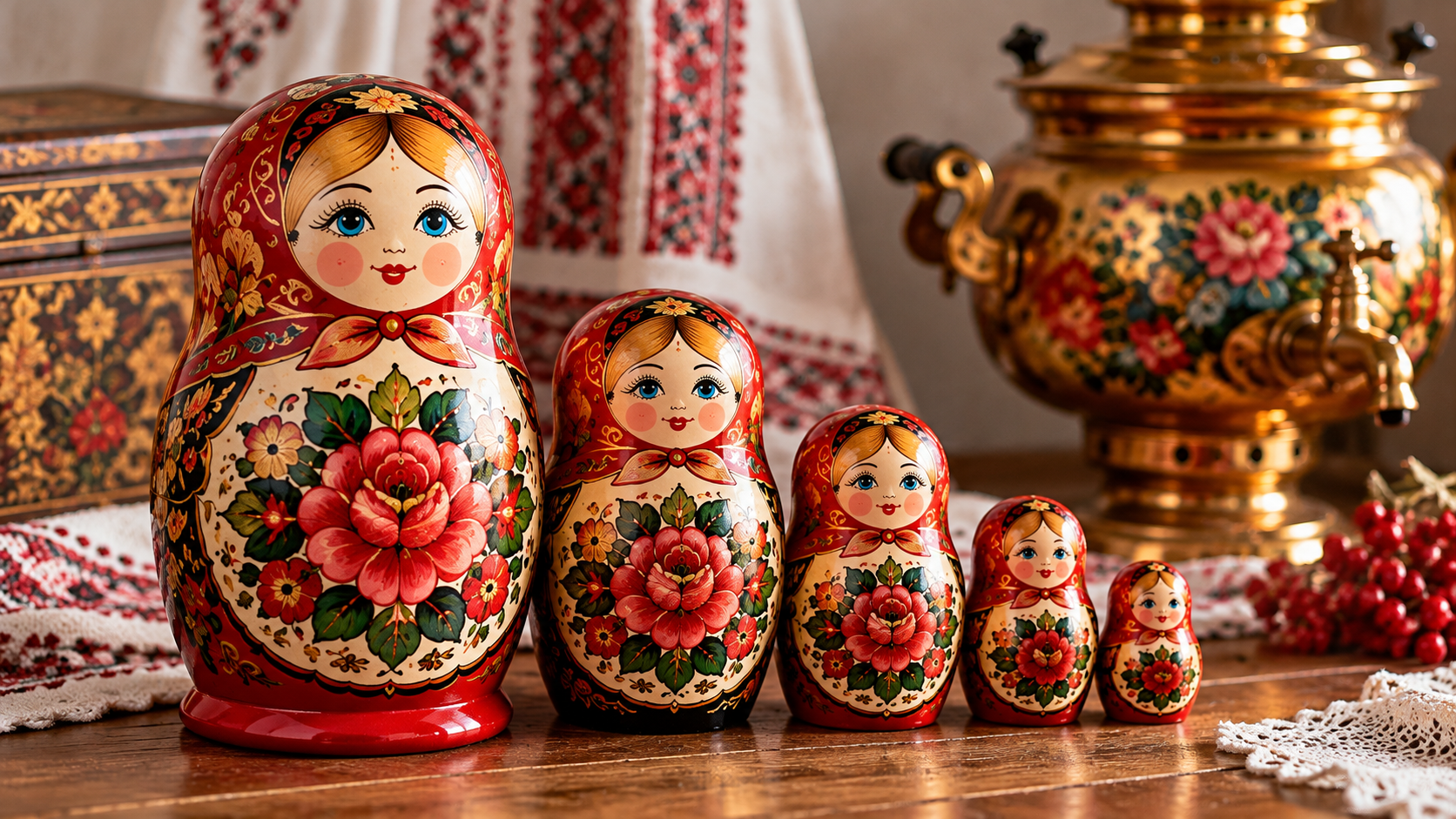
One of Russia’s most internationally recognized traditional handicrafts is the matryoshka doll (матрёшка).
Matryoshka dolls are wooden nesting dolls consisting of a series of progressively smaller dolls placed inside one another. The most traditional designs depict women wearing brightly colored Russian folk costumes, and these dolls are widely appreciated as souvenirs symbolizing Russia.
Matryoshka dolls first appeared in the late nineteenth century. One theory suggests that Japanese handicrafts influenced their origins, and their development was closely connected to artistic movements within Russia and cultural exchanges with other countries.
In this article, I will explain the basic characteristics of matryoshka dolls, the origins of their name, and the history of their creation.
Matryoshka dolls (матрёшка) are wooden nesting dolls that originated in Russia in the late nineteenth century.
Their most distinctive feature is that each larger doll contains a smaller doll inside it.
A typical matryoshka doll can be separated into upper and lower halves. When the outer doll is opened, a smaller doll is revealed inside. Opening that doll reveals another, even smaller doll, and this process can be repeated until all the dolls have been removed.
The number of dolls varies depending on the product. Sets containing three, five, seven, or ten dolls are common, while larger and more elaborate sets may contain several dozen dolls.
Matryoshka dolls have a rounded appearance, with a gently widening silhouette extending from the head toward the body.
Traditional designs frequently depict women wearing Russian folk costumes, including headscarves and garments known as sarafans.
The clothing is often decorated with floral and botanical patterns and painted in vivid colors such as red, yellow, blue, and green.
Some sets feature dolls with slightly different facial expressions and clothing patterns. Displaying all the dolls together allows their individual details to be appreciated as part of a single artistic work.
Today, matryoshka dolls are also produced with designs depicting animals, fairy-tale characters, historical figures, and many other subjects.
The name matryoshka is generally believed to derive from the Russian female given name Matryona (Матрёна).
Matryona was once a widely used female name, particularly in rural areas of Russia.
The name ultimately derives from the Latin word matrona, meaning a married woman or a socially respected woman. The word matrona is also etymologically related to the Latin word mater, meaning “mother.”
Because of these linguistic origins, the name Matryona has also come to evoke associations with motherhood and family life.
In Russian, affectionate or diminutive forms of personal names can be created by adding suffixes.
Examples of familiar forms of Russian names include:
| Full Name | Familiar Form |
|---|---|
| Мари́я (Maria) | Ма́ша (Masha) |
| Алекса́ндр (Alexander) | Са́ша (Sasha) |
| Ната́лья (Natalya) | Ната́ша (Natasha) |
| Матрёна (Matryona) | Матрёшка (Matryoshka) |
The name matryoshka is also connected to this process of forming affectionate or diminutive names.
Russian frequently uses suffixes to create words expressing familiarity, affection, or smallness, and матрёшка developed through this type of word formation.
Furthermore, because the name Matryona evokes associations with mothers and family life, matryoshka dolls have also come to be interpreted as symbols of motherhood and family.
Indeed, early matryoshka dolls depicted a woman wearing traditional Russian clothing together with children.
The structure of progressively smaller dolls enclosed within larger ones also evokes the image of a mother embracing her children or the continuity of a family across generations.
Thus, the name matryoshka combines the familiarity associated with a traditional Russian female name with cultural imagery related to motherhood and family.

Matryoshka dolls originated in the Russian Empire in the late nineteenth century.
During this period, Western European art and culture were widely embraced in Russia. At the same time, movements seeking to rediscover and reevaluate Russia’s own traditional culture and folk art were gaining momentum.
Traditional handicrafts from rural communities, including wooden objects, pottery, folk costumes, and decorative items, attracted increasing attention. Artists and craftspeople began incorporating these traditional elements into new artistic creations.
One of the central figures associated with these cultural developments was Savva Mamontov (Са́вва Ма́монтов), a businessman and patron of the arts.
Mamontov invited painters, sculptors, architects, and other artists to his estate at Abramtsevo (Абра́мцево), near Moscow, where he supported artistic activities inspired by traditional Russian culture.
The community of artists that developed there became known as the Abramtsevo artists’ colony. Its members produced paintings, furniture, pottery, and other works inspired by Russian folk tales and traditional decorative motifs.
In the late nineteenth century, there was also growing interest in giving children’s toys artistic value. This encouraged the production of wooden toys reflecting Russian folk culture.
Matryoshka dolls are believed to have emerged against this background of artistic experimentation and developments in toy production.
The earliest matryoshka dolls are generally believed to have been produced in the 1890s at a Moscow toy workshop called Children’s Education (Де́тское воспита́ние).
The workshop was operated by the family of Anatoly Mamontov (Анато́лий Ма́монтов), the brother of Savva Mamontov.
Two individuals are particularly associated with the creation of the first matryoshka dolls.
Through these developments, a new type of doll emerged that combined Russian folk-inspired designs with traditional woodworking techniques.
Although matryoshka dolls were initially created as children’s toys, their distinctive structure and appealing appearance attracted attention. Over time, they developed into one of Russia’s most representative traditional handicrafts.
One of the most frequently discussed aspects of the origins of matryoshka dolls is their possible connection to Japanese nesting dolls.
During the second half of the nineteenth century, interest in Japanese art and handicrafts increased throughout Europe. Japanese cultural influences spread through an artistic movement known as Japonisme.
Japanese handicrafts were also introduced to Russia, where artists and craftspeople became interested in their distinctive forms and techniques.
One theory concerning the creation of matryoshka dolls suggests that wooden nesting dolls brought from Japan provided inspiration for their development.
A particularly well-known explanation connects their origins to a doll representing Fukurokuju, one of Japan’s Seven Lucky Gods.
Fukurokuju is traditionally associated with happiness, wealth, and longevity. He is commonly depicted as an elderly man with an elongated forehead and a long white beard.
According to a widely known theory, a Japanese nesting doll depicting Fukurokuju was brought to Russia and subsequently served as a model for the development of a new type of doll at a Moscow toy workshop.
Another theory suggests a connection between matryoshka dolls and the woodworking techniques and nesting crafts that developed in the Hakone region of Japan.
Hakone has been known for its woodworking traditions since the Edo period, and local craftspeople produced various wooden toys and decorative objects.
These Japanese woodworking traditions may have provided Russian craftspeople with inspiration for developing a new type of nesting doll.
However, historical accounts differ regarding exactly which Japanese doll may have served as the model for the first matryoshka and how such an object might have reached Russia.
Although the theory of Japanese influence is widely known, the precise circumstances surrounding the creation of the earliest matryoshka dolls remain a subject of historical research.
In any case, matryoshka dolls developed in late nineteenth-century Russia as handicrafts that combined a nesting structure with distinctly Russian representations of people and traditional clothing.
One of the events that helped introduce matryoshka dolls to a wider audience was the Exposition Universelle held in Paris in 1900.
The Paris Exposition was a major international exhibition showcasing the technologies, arts, and cultures of countries around the world. Matryoshka dolls were presented there as examples of Russian handicrafts.
This exposure helped attract international attention and contributed to their growing recognition as representative Russian craft objects.
Within Russia, the spread of matryoshka production was closely connected to the woodworking and toy-making traditions already established in various regions.
Sergiev Posad (Се́ргиев Поса́д), near Moscow, was particularly well known as a center of wooden toy production.
The region had a concentration of woodworkers and toy merchants, providing a favorable environment for expanding the production of matryoshka dolls.
As their popularity increased, Sergiev Posad became one of the principal centers of matryoshka production.
During the twentieth century, matryoshka production spread to other regions of Russia, where distinctive designs and painting techniques developed.
Some of the best-known centers of matryoshka production include:
These regional differences gave rise to a variety of matryoshka styles and further enhanced their appeal as traditional handicrafts.
During the Soviet period, organized production expanded through craft cooperatives, factories, and other manufacturing organizations, increasing the number of matryoshka dolls produced.
As a result, matryoshka dolls became widely distributed throughout the country and increasingly popular as souvenirs and export products.
In this way, international exhibitions helped introduce matryoshka dolls to audiences outside Russia, while the development of regional woodworking traditions and craft industries contributed to their widespread popularity both domestically and internationally.
Matryoshka dolls are wooden nesting dolls that originated in Russia in the late nineteenth century.
Their distinctive structure and colorful designs have made them one of Russia’s most internationally recognized traditional handicrafts.
The following points are particularly important for understanding their history:
Matryoshka dolls emerged from a combination of Russian woodworking techniques, folk art, and cultural imagery associated with family life.
Exploring their history provides insight into artistic movements in late nineteenth-century Russia, possible connections with Japanese handicrafts, and the process through which traditional Russian culture became known around the world.