#70 Kokoshnik | Traditional Russian Women’s Headdress
Yuri Miyajima Russian Forest

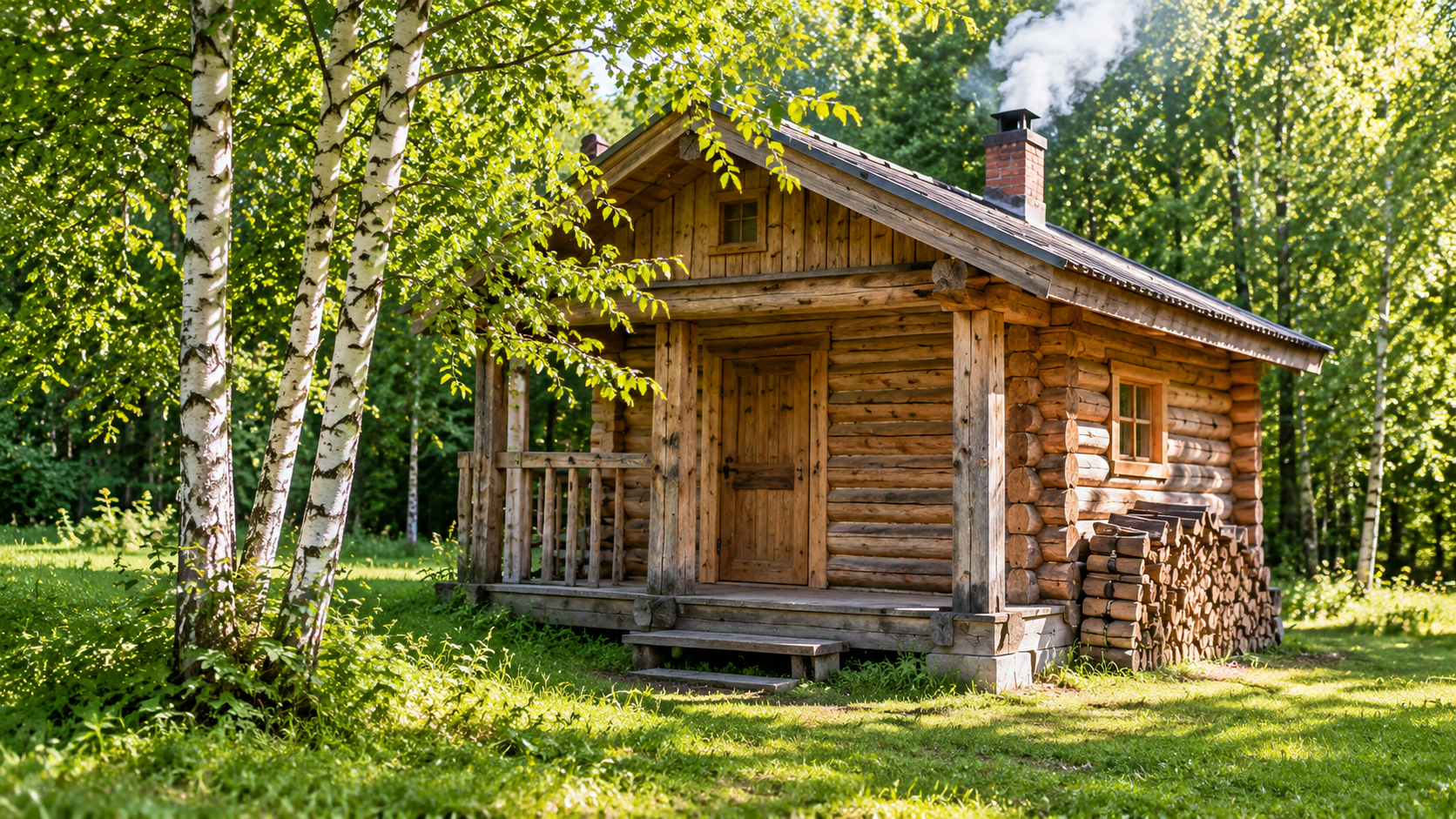
Russia has a traditional type of steam bath known as the banya (ба́ня).
For centuries, banyas have been used in Russia as places to maintain personal hygiene. They have also been valued as spaces where family members and friends can socialize, relax, and rest.
Banyas have distinctive features and customs, including the practice of pouring water over heated stones to produce steam and using bundles of birch or other leafy branches, known as veniks, to gently strike the body or direct warm air toward it.
Another traditional practice involves cooling the body with cold water after a steam bath or, during winter, cooling off in the snow.
These bathing customs have developed in close connection with Russia’s history, climate, and everyday life.
In this article, I will explain the history of the banya, its traditional structure and bathing methods, the use of veniks, and bathing customs in modern Russia.
The banya is a traditional type of steam bath that has been an important part of Russian life for centuries.
In Russian, the word ба́ня (banya) refers to a steam bath facility or the bathing activity that takes place there.
One of the main characteristics of a banya is the practice of pouring water over heated stones to produce steam, allowing bathers to warm their bodies in a hot, humid environment.
Like Finnish saunas, banyas use heated stones and water to generate steam. In traditional Russian banyas, bathing methods that use steam to increase humidity while warming the body are common.
Another distinctive custom involves using veniks, bundles of birch or other leafy branches, to gently strike the body or direct warm air toward it.
The following Russian words and expressions are associated with banyas:
In Russia, banyas have traditionally served not only as places for washing but also as spaces for relaxation and social interaction.
Public banyas can be found in urban areas, while in rural and suburban areas, some households have a separate bathhouse on their property.
In rural communities in particular, banyas were an essential part of everyday life, and families traditionally gathered to bathe before weekends or holidays.
Thus, the banya developed as a facility for maintaining personal hygiene while also becoming a place where people could relax and enjoy social interaction.
The history of the banya is long, with its origins extending back to the lives of the East Slavs before the medieval period.
Since ancient times, East Slavic communities have practiced bathing methods that involved using fire-heated stones and water to produce steam.
References to banyas can also be found in the Primary Chronicle, compiled in the early 12th century.
The chronicle contains a traditional account describing how the people of Novgorod heated wooden bathhouses, struck their bodies with bundles of branches and leaves, and then poured cold water over themselves.
Such accounts suggest that bathing customs still associated with modern banyas were already known during the medieval period.
Banyas of that time were generally small wooden buildings equipped with a stove or furnace that heated stones. Water was poured over the stones to generate steam.
People used these bathhouses to wash their bodies and perspire, helping them maintain personal hygiene.
Banyas were also associated with important life events, including marriage and childbirth.
In some regions, people traditionally visited a banya before a wedding, using the bathhouse as a place for ritual purification during significant life transitions.
Furthermore, banyas were associated with the treatment of illnesses and the maintenance of health, as warming the body was believed to have beneficial effects.
As Russian cities developed, public banyas became increasingly widespread.
During the 18th and 19th centuries, public bathhouses of various sizes began operating in cities such as Moscow and Saint Petersburg.
For people whose homes lacked adequate bathing facilities, public banyas were essential for maintaining personal hygiene.
By the late 19th century, public bathhouses with luxurious interiors and extensive facilities had also appeared, including the Sandunovsky Baths in Moscow.
Following the Russian Revolution of 1917, banyas continued to play an important role in everyday life.
During the Soviet period, improving public hygiene became a priority, and public bathhouses helped support sanitary conditions for urban residents.
Regular visits to public banyas were particularly common among people living in homes without private bathrooms or showers.
At the same time, banyas remained popular as places where friends and acquaintances could socialize and spend time relaxing together.
Today, although private bathrooms and showers have become widespread, the banya continues to be preserved as an important part of traditional Russian bathing culture.
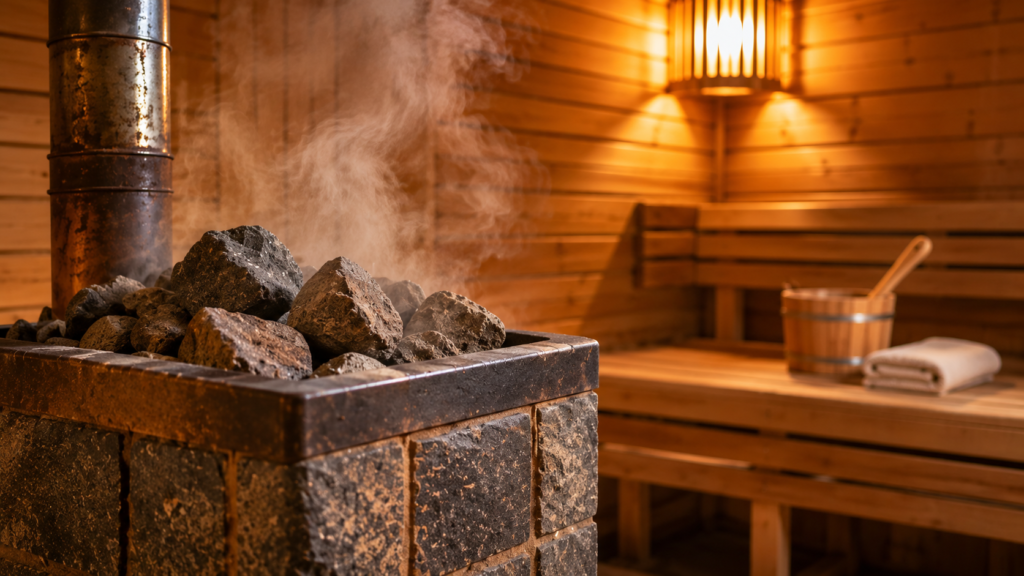
Traditional banyas are often constructed from wood and contain a steam room, washing area, and relaxation space.
Logs and timber are used in the construction of the building, while wood is also commonly used for the walls, ceilings, and floors of the steam room.
Because wood conducts heat relatively poorly and is suitable for high-temperature environments, it has long been widely used in traditional banya construction.
The central part of a banya is the steam room, known in Russian as пари́лка.
In this room, stones are heated by a stove, and water is poured over them to produce steam.
When water comes into contact with the heated stones, it evaporates rapidly, increasing the humidity and perceived temperature of the room.
The steam produced in this process is called пар in Russian.
By adjusting the amount of water poured over the stones, bathers can control the amount of steam and the perceived temperature inside the room.
Steam rooms are also equipped with wooden benches or platforms where bathers can sit or lie down while warming their bodies.
Because temperatures tend to be higher closer to the ceiling, the perceived heat varies depending on where a person sits.
Generally, the upper benches are hotter, while the lower benches offer relatively milder temperatures.
In this way, the banya uses heated stones and water to generate steam, allowing bathers to enjoy the experience while adjusting the temperature and humidity of the room.
Traditional Russian banyas can be broadly divided into two types according to the structure of their stoves and the methods used to release smoke.
These are known as black banyas and white banyas, and they differ in their construction and heating methods.
A black banya is called ба́ня по-чёрному in Russian.
In a black banya, firewood is burned in a stove without a chimney, allowing smoke to circulate through the interior and heat the building and stones.
Before bathing, the fire is extinguished, and the smoke is released from the building.
The name “black banya” comes from the soot that accumulates on the walls and ceiling as a result of the smoke.
Black banyas have been used in rural Russia since ancient times and are still preserved today as a traditional form of steam bathing.
A white banya is called ба́ня по-бе́лому in Russian.
In a white banya, stones are heated by a stove equipped with a chimney, and water is poured over the stones to generate steam.
Because smoke produced by the burning fuel is directed outside through the chimney, the structure helps prevent smoke from spreading throughout the steam room.
Today, white banyas are the more common type.
In addition to traditional wood-burning stoves, some modern banyas use electric heaters.
Many banyas also have separate washing and relaxation areas, allowing bathers to alternate between steam bathing and resting.
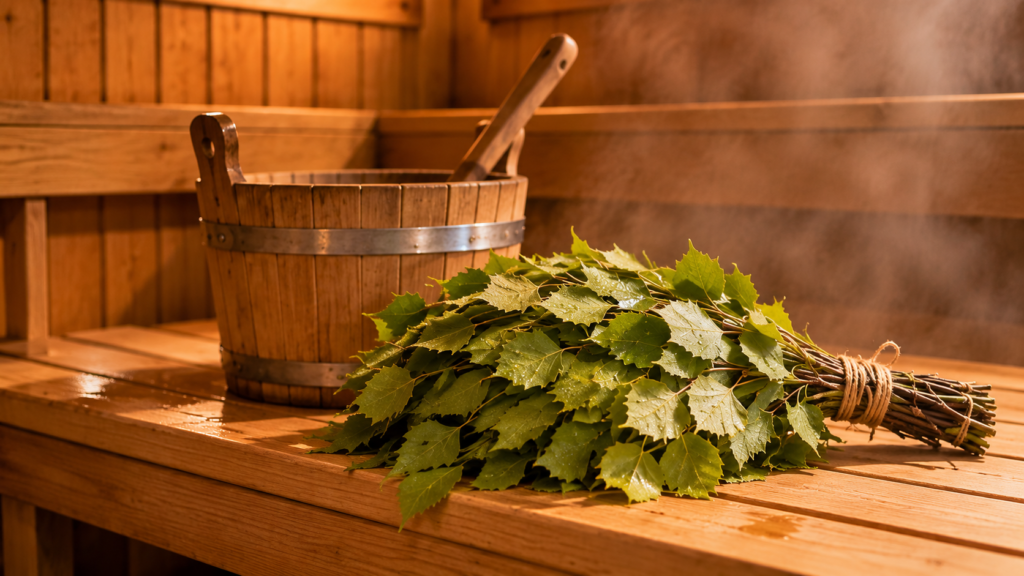
One of the most recognizable items associated with the banya is the venik (ве́ник).
A venik is a bundle of leafy branches, typically made from birch or oak, that is used while warming the body in the steam room.
In addition to the commonly used birch and oak veniks, other plants, including eucalyptus and linden, may also be used.
Veniks are used to gently strike the body with leafy branches or direct warm air toward the skin.
When using a dried venik, it is first soaked in water or warm water to soften the branches and leaves.
Once the body has warmed up in the steam room, the venik is used to gently strike areas such as the back, arms, and legs.
A venik may also be moved near the body to direct warm air from the steam room toward the skin.
These techniques help distribute warm air over the body while providing a sensation similar to a gentle massage.
In banyas, family members and friends may also take turns using veniks to gently strike one another’s backs and other parts of the body.
Thus, the venik is both a traditional bathing tool and an important symbol of Russian bathing culture.
The banya is a traditional type of steam bath that has been an important part of Russian life for centuries.
With a history extending back to before the medieval period, banyas developed as facilities for maintaining personal hygiene. They have also been closely associated with family gatherings, social interaction, and traditional customs.
The most important points are as follows:
Although private bathrooms and showers are now widespread, banyas remain an important part of traditional Russian bathing culture.