#65 Matryoshka Dolls | The Origins and History of Russian Nesting Dolls
Yuri Miyajima Russian Forest
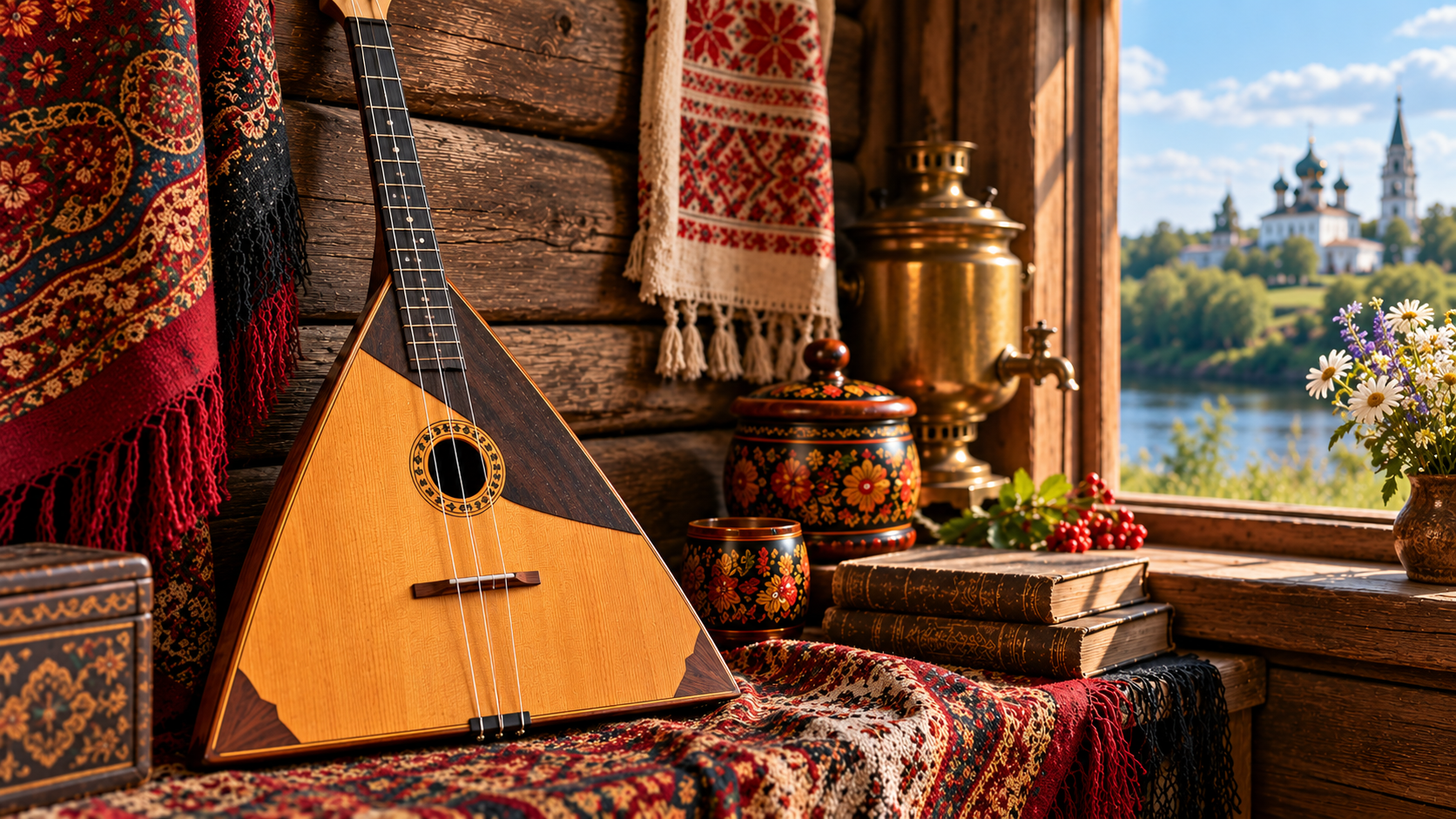
The balalaika (балала́йка) is one of the most representative string instruments in Russian folk music. It is characterized by its distinctive triangular shape and bright, lively sound.
The instrument has long been popular among people in rural communities, where it was traditionally used to accompany songs and dances. In the late nineteenth century, improvements to its design led to its wider use, and today it is performed both as a solo instrument and as part of Russian folk instrument orchestras.
In this article, I will provide a detailed explanation of the balalaika, including its basic characteristics, historical background, playing techniques, different types, and connections to Russian culture.
The balalaika (балала́йка) is a traditional plucked string instrument that developed in Russia.
A plucked string instrument produces sound when its strings are plucked with the fingers or a playing implement. Guitars and mandolins also belong to this category.
The most distinctive feature of the balalaika is its unusual shape, consisting of a triangular body and a long neck.
A typical modern balalaika has three strings and is played by plucking or rapidly strumming them with the fingers.
Its sound is bright and lively, with a crisp, distinctive resonance. Depending on the playing technique, however, it can also produce soft and delicate tones, making it suitable for a wide range of music, from folk song accompaniment to solo compositions.
Balalaikas are produced in several sizes and pitch ranges. Some are primarily used to play melodies, while others provide accompaniment or bass parts.
In Russian, the following words and expressions are associated with the balalaika:
For example, Он игра́ет на балала́йке. means “He is playing the balalaika.”
In Russian, playing a musical instrument is generally expressed using the construction “игра́ть на + prepositional case.” Therefore, балала́йка changes to its prepositional form, балала́йке.
The history of the balalaika can be traced back to seventeenth-century Russia.
One of the earliest known references to the instrument appears in a document dating from 1688. The document mentions the balalaika by name, confirming that the instrument was already in use in Russia during the second half of the seventeenth century.
However, the precise time and place of its origin remain uncertain.
Several theories have been proposed concerning its origins, including possible connections to string instruments used in Russia since earlier times and influences from instruments found in neighboring regions.
One instrument particularly closely associated with the balalaika is the domra (до́мра).
The domra is a string instrument with a rounded body and, like the balalaika, is used in Russian folk music.
Although the two instruments differ in shape, both are traditional Russian plucked string instruments, and their historical relationship has also been the subject of research.
During the eighteenth and nineteenth centuries, the balalaika became widely popular, particularly in rural Russia.
At that time, peasants sometimes made their own instruments using locally available wood. As a result, the shape, size, and number of strings varied from region to region. Some early balalaikas also used pieces of gut or cord tied around the neck to mark the positions of notes, rather than the metal frets commonly found on modern instruments.
In rural communities, the balalaika was primarily used to accompany songs and dances. It was also played at festivals, celebrations, and other gatherings.
Its ability to produce lively rhythms made it particularly well suited to rural entertainment and traditional folk music.
An important figure in the history of the balalaika is the Russian musician Vasily Andreyev (Васи́лий Васи́льевич Андре́ев, 1861–1918).
In the late nineteenth century, Andreyev worked to improve and popularize the balalaika, helping transform Russian folk instruments into instruments suitable for concert performances.
Before his efforts, the balalaika was widely enjoyed as a folk instrument in rural communities. However, its construction and tuning varied between regions, and playing techniques had not been standardized.
Andreyev collaborated with instrument makers to improve the balalaika so that it could be used in formal concert performances.
One particularly important development involved improvements to the frets, which made it possible to play notes more accurately.
Frets are components attached to the neck of a string instrument to mark the positions where the strings are pressed to produce different pitches.
In 1887, the instrument maker Franz Paserbsky (Франц Па́сербский) collaborated with Andreyev to produce a balalaika equipped with metal frets that allowed chromatic playing.
This made it easier to perform more complex melodies and chords, significantly expanding the expressive possibilities of the instrument.
Andreyev also began developing ensembles that combined balalaikas of different sizes.
In 1888, he organized a concert in Saint Petersburg featuring eight performers from the Circle of Balalaika Enthusiasts (Кружо́к люби́телей игры́ на балала́йках).
The ensemble was well received and subsequently began performing not only throughout Russia but also abroad. Through these activities, the balalaika became internationally recognized as a traditional Russian musical instrument.
Andreyev later incorporated other traditional instruments, including the domra and gusli, into his ensemble. In 1896, he expanded the group into the Great Russian Orchestra (Великору́сский орке́стр).
This orchestra used several types of balalaikas with different pitch ranges, each performing a particular role, such as melody, accompaniment, or bass.
Andreyev also arranged Russian folk songs for orchestral performance, allowing traditional melodies to be presented with a richer and more varied sound.
Through Andreyev’s efforts, the balalaika developed from a rural folk instrument into one used for solo performances, ensembles, and orchestras.
Today, Andreyev is regarded as an important figure in Russian music history for laying the foundations of the modern Russian folk instrument orchestra.
The most distinctive feature of the balalaika is its triangular body.
While instruments such as guitars and mandolins generally have rounded bodies, the balalaika has a flat, triangular soundboard with a sound hole near its center.
This unusual shape is one of the main characteristics that distinguish the balalaika from other string instruments.
The body of a balalaika is primarily made of wood, with materials such as spruce commonly used for the soundboard. The back is often constructed from several pieces of wood joined together.
When the strings vibrate, their vibrations are transmitted to the body, allowing the entire instrument to resonate.
However, no definitive historical records explain exactly why the triangular shape was originally adopted.
One widely discussed explanation concerns the ease of construction and the traditional instrument-making methods that developed in rural communities.
In the past, people in rural Russia sometimes made their own instruments from locally available wood rather than purchasing them from professional instrument makers.
A triangular body can be constructed partly by joining relatively straight pieces of material, making this design potentially suitable for traditional rural instrument-making techniques.
Such practical characteristics may have contributed to the instrument’s popularity in rural communities.
Early balalaikas also existed in different shapes and sizes, rather than exclusively in the standardized triangular form familiar today.
In the late nineteenth century, improvements and standardization carried out by Vasily Andreyev and other musicians and instrument makers helped establish the triangular balalaika as the widely recognized form of the instrument.
Today, the triangular body itself has become a symbol of the balalaika, strongly reinforcing its identity as a traditional Russian musical instrument.
The balalaika has a close connection to Russian folk songs and traditional dances.
For centuries, it has been played at rural festivals, weddings, celebrations, and other gatherings, where it was enjoyed as an instrument that accompanied singing and dancing.
Its bright, lively sound is particularly well suited to fast-paced dances. It was often used when people clapped their hands or danced to the rhythm of the music.
The balalaika can be played as a solo instrument or together with other instruments.
For example, combining it with the garmon (гармо́нь), a type of traditional Russian accordion, creates a particularly lively musical sound.
One well-known Russian song frequently performed on the balalaika is Kalinka (Кали́нка).
Kalinka was composed in 1860 by the Russian composer Ivan Larionov (Ива́н Ларио́нов) and is now widely recognized as a Russian folk song.
One of the song’s distinctive characteristics is its progression from a relatively slow opening to increasingly fast and energetic sections.
When performed on the balalaika, the instrument’s bright sound and rapid strumming emphasize the lively character of the melody, creating the energetic atmosphere commonly associated with Russian folk music.
In this way, the balalaika has long been enjoyed as an instrument that brings energy to songs and dances. At the same time, it has developed into an instrument capable of expressing a wide variety of emotions and musical moods.
Even today, it is used by Russian folk music ensembles and at events celebrating traditional culture, continuing to play an important role in preserving and presenting Russia’s musical heritage.
The balalaika is a traditional Russian string instrument characterized by its triangular body and three strings.
It has long been enjoyed in rural Russian communities and developed in close connection with everyday life, particularly through its use in accompanying folk songs and dances.
The main characteristics of the balalaika can be summarized as follows:
Through its distinctive shape and sound, the balalaika offers insight into Russian history, everyday life, and the rich traditions of Russian folk music.
When exploring Russian folk songs and culture, it is well worth paying attention to the unique sound of the balalaika.