#72 Povoynik | Traditional Cloth Headdress Worn by Married Women in Russia
Yuri Miyajima Russian Forest

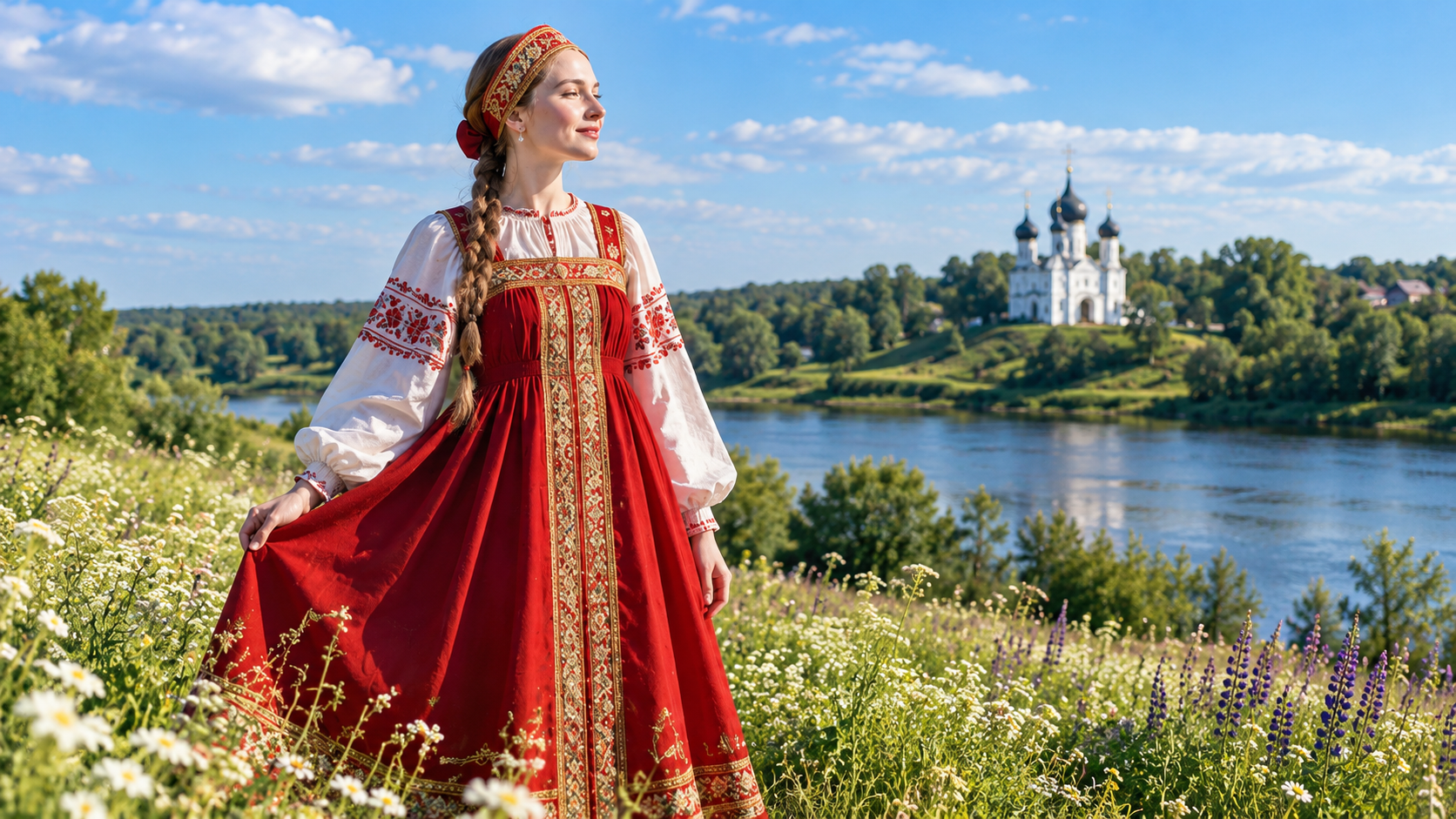
The sarafan (сарафа́н), characterized by its vibrant colors and beautiful decorations, is one of Russia’s most representative traditional garments for women.
Historically, it was widely worn in rural Russia and was used on various occasions, from everyday activities to festive celebrations.
Its shape and decorations varied according to region and historical period, reflecting the traditional lifestyles and cultural heritage of Russia.
Even today, the sarafan is worn during folk dances and traditional events, remaining an important symbol of Russian folk culture.
In this article, I will explain the characteristics and history of the sarafan, its regional variations, and its relationship with modern Russian culture.
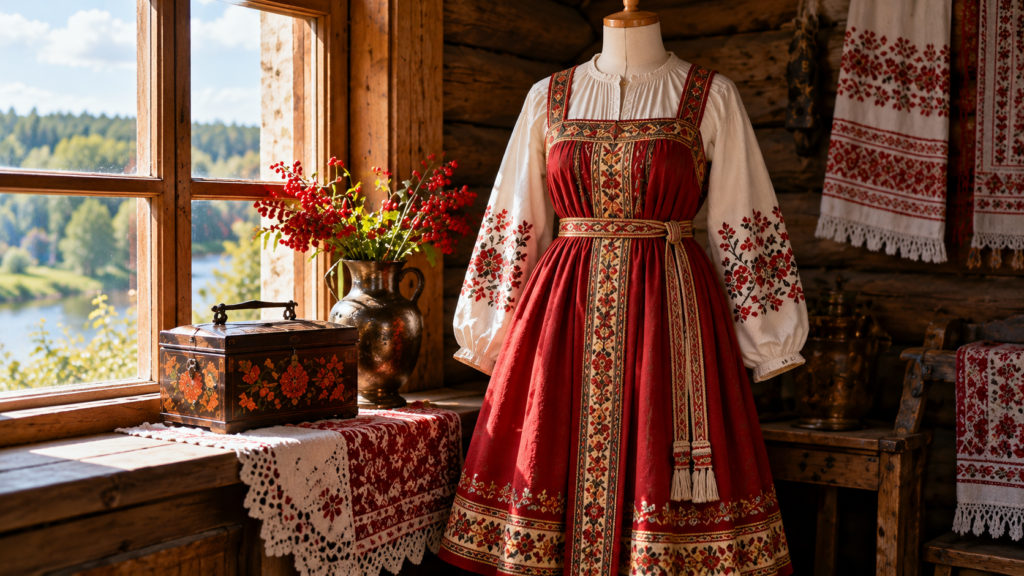
The sarafan (сарафа́н) is a traditional Russian garment worn by women.
It is generally a long, sleeveless garment with shoulder straps, characterized by a loose silhouette that widens toward the hem.
In traditional Russian clothing, the sarafan was commonly worn over a shirt called a руба́ха.
The руба́ха had long sleeves and was sometimes decorated with embroidery around the neckline and cuffs. The sarafan was worn over this shirt, often accompanied by a belt or decorative accessories to complete the outfit.
Various materials and colors were used to make sarafans, with differences depending on whether they were intended for everyday wear or festive occasions. Festive sarafans, in particular, often featured luxurious fabrics and elaborate decorations that reflected regional traditions and aesthetic preferences.
Thus, the sarafan was both a practical garment used in everyday life and an expression of regional traditions and cultural aesthetics.
The history of the sarafan dates back to medieval Russia.
The term “sarafan” already appeared in Russian written records in the fourteenth century. However, it originally referred to a long garment worn by men rather than the sleeveless women’s clothing commonly associated with the term today.
Over time, the garment’s shape and function changed, and by the sixteenth and seventeenth centuries, it had become widely recognized as a form of women’s clothing.
During this period, sarafans were worn by women from various social classes, including noblewomen, urban residents, and rural women.
In the early eighteenth century, Peter the Great introduced reforms promoting Western European clothing as part of his efforts to modernize Russia.
As a result, Western-style dresses became increasingly common at court and among the upper classes in cities. In rural areas, however, traditional clothing continued to be passed down, and the sarafan became increasingly associated with ordinary people.
In northern and central Russia, in particular, the sarafan became firmly established as a representative garment for women. Durable and practical sarafans were worn in everyday life, while more elaborately decorated versions were reserved for special occasions such as festivals and weddings.
By the nineteenth century, the sarafan had become widely recognized as a symbol of Russian rural culture.
During this period, interest in Russian history and folklore also increased, and traditional garments such as the sarafan began to appear in paintings and theatrical performances.
In this way, the sarafan gradually expanded its role from an everyday garment to a symbol of Russian traditional culture.
The materials used to make sarafans varied according to the wearer’s living conditions, economic circumstances, and the intended purpose of the garment.
For everyday clothing, relatively durable and practical fabrics such as linen and cotton were commonly used. In rural areas, homespun linen and other locally produced textiles were often used to make practical sarafans.
For festive clothing, more expensive fabrics such as silk and brocade were sometimes used.
Wealthier households also favored glossy fabrics and decorations made with gold thread, resulting in particularly elaborate sarafans.
Common decorative elements included:
Embroidery often featured geometric patterns and plant motifs, with distinctive designs varying from region to region. Ribbons and decorative trimmings were also sometimes added to the hem, bodice, and shoulder straps.
Color was another important characteristic of the sarafan.
Red, in particular, has traditionally been associated with beauty and celebration in Russian culture. Sarafans made from red fabric or decorated with red elements were therefore common among festive garments.
Other colors, including blue, green, and white, were also used, with preferred color combinations varying according to region and historical period.
Thus, the materials and decorations of sarafans reflected not only practical considerations but also regional traditions, aesthetic preferences, and social status.
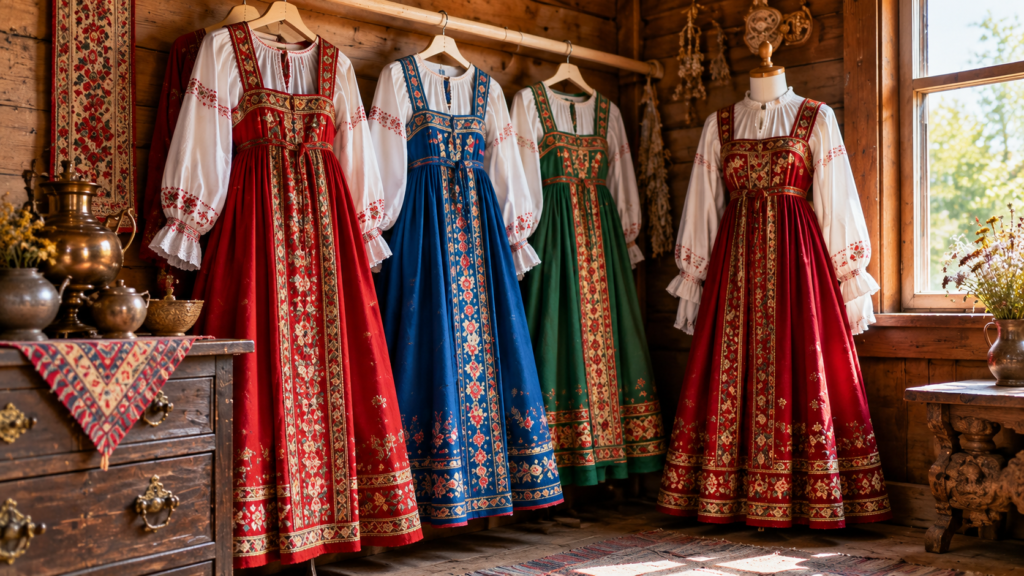
Traditional Russian clothing varied considerably in shape, materials, and decoration depending on the region.
The sarafan was particularly widespread in northern and central Russia.
In northern Russia, sarafan-based clothing traditions developed in regions such as Arkhangelsk and Vologda.
In these areas, long sarafans were combined with embroidered shirts, while festive garments were sometimes made from luxurious fabrics such as silk and brocade.
In colder regions, additional garments were also worn over the sarafan according to the season, reflecting adaptations to the local climate.
Sarafans were also widely worn in central Russia, where colors, patterns, and tailoring methods differed from one locality to another.
In southern Russia, by contrast, a skirt-like garment wrapped around the waist, known as the понёва, was widely used.
The понёва was primarily associated with married women and was often made from checked woolen fabric. It was generally worn with a long shirt.
These regional differences were connected not only to climate and everyday customs but also to cultural traditions and clothing practices passed down through generations.
Traditional Russian women’s clothing can therefore be broadly divided into two major types: clothing centered on the sarafan and clothing centered on the понёва.
In this way, traditional garments can also provide valuable clues about the wearer’s region of origin and cultural background.
The sarafan was often worn together with traditional headdresses.
One of the most famous examples is the кокóшник, a traditional Russian headdress for women.
The кокóшник existed in various shapes, including semicircular, fan-shaped, and pointed designs, with distinctive regional variations.
Some were richly decorated with fabric, beads, pearls, and gold thread, and they were worn on special occasions such as festivals and weddings.
The shape and customs associated with the кокóшник also varied according to region and historical period. These headdresses could indicate a woman’s marital status and social position.
In traditional Russian society, women’s headdresses were closely connected to age and marital status.
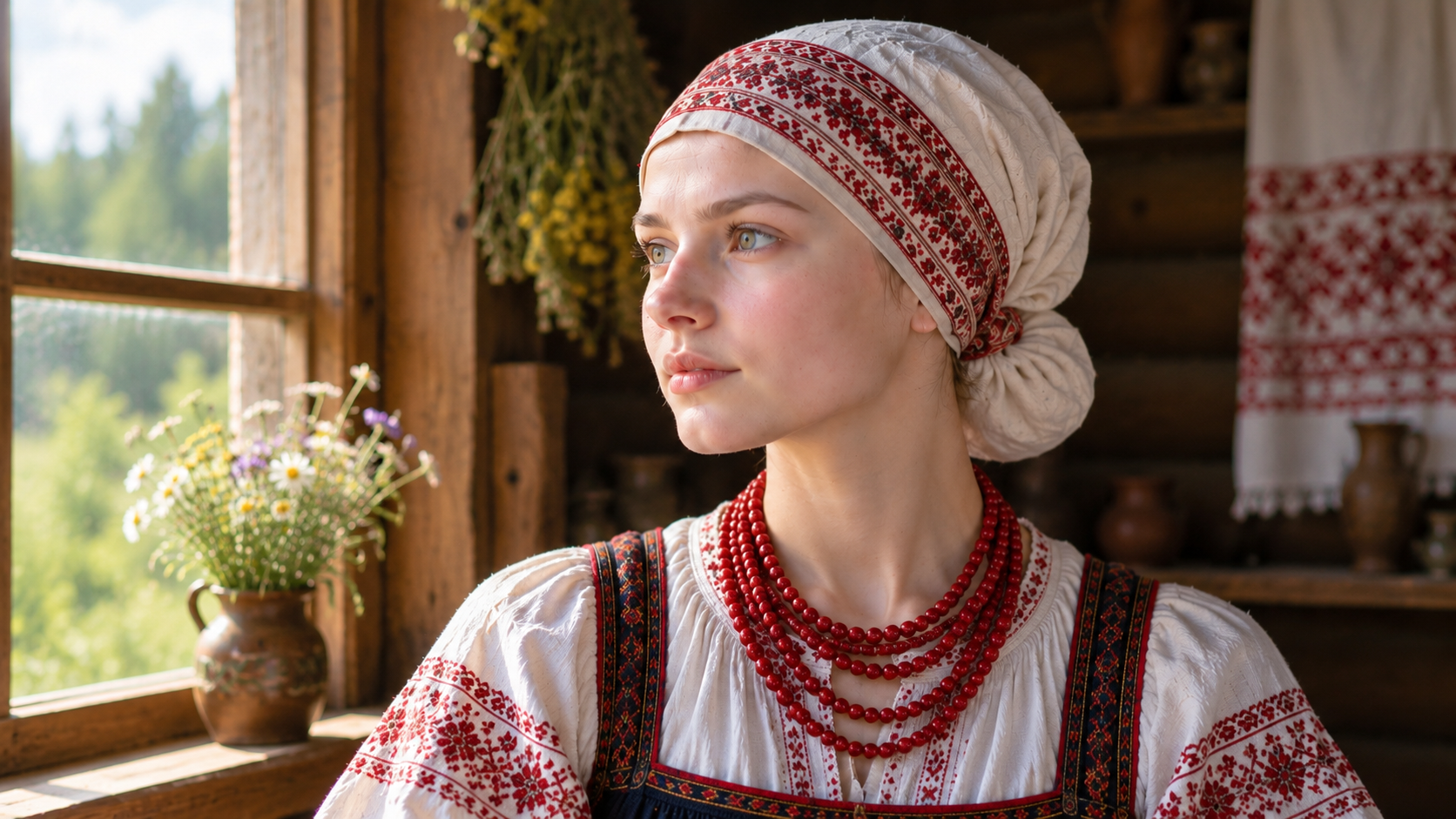
Unmarried women sometimes wore headdresses that left their hair visible, while married women generally covered their hair.
Married women, in particular, sometimes covered their hair with a cloth cap called a пово́йник and wore a decorative headdress over it.
These customs reflected traditional values that associated covering a woman’s hair with propriety and modesty.
Headdresses therefore served not merely as decorative accessories but also as important indicators of a woman’s social position and regional culture.
Today, the image of a woman wearing a sarafan together with an elaborate кокóшник has become one of the most recognizable representations of traditional Russian clothing.
Today, sarafans are primarily worn during folk dances, cultural events, and theatrical performances.
In Russian folk dance ensembles, women can often be seen performing in brightly colored sarafans.
Sarafans are also sometimes worn during traditional Russian circle dances known as хорово́д, where their wide, flowing skirts enhance the visual beauty of the dancers’ movements.
Traditional garments, including sarafans, are also worn at festivals and regional events celebrating folk culture.
These events provide opportunities to introduce historical clothing and customs while passing regional cultural traditions on to future generations.
Furthermore, ethnographic museums throughout Russia preserve and exhibit traditional garments from different regions, allowing visitors to learn about the shapes, decorations, and materials of historical sarafans.
At the same time, traditional sarafan designs have also influenced contemporary fashion.
Embroidery, folk patterns, and loose silhouettes are incorporated into modern designs as expressions of Russian cultural heritage.
In Russian, the word сарафа́н also has a modern meaning beyond its traditional association with folk clothing. It can refer to an ordinary sleeveless dress.
For example, a lightweight summer dress may be called a ле́тний сарафа́н.
Thus, while the sarafan continues to be preserved as a symbol of Russian traditional culture, its name and design also remain part of modern everyday life.
The sarafan is a traditional Russian garment for women, generally consisting of a long, sleeveless dress with shoulder straps.
The most important points are as follows:
Sarafans reflect regional lifestyles, aesthetic preferences, and cultural traditions developed over many centuries.
Having been worn on occasions ranging from everyday activities to festive celebrations, the sarafan remains an important garment for understanding the traditional lifestyles and cultural heritage of Russia.