#66 Khokhloma Painting | Russian Wooden Tableware and Decorative Techniques
Yuri Miyajima Russian Forest

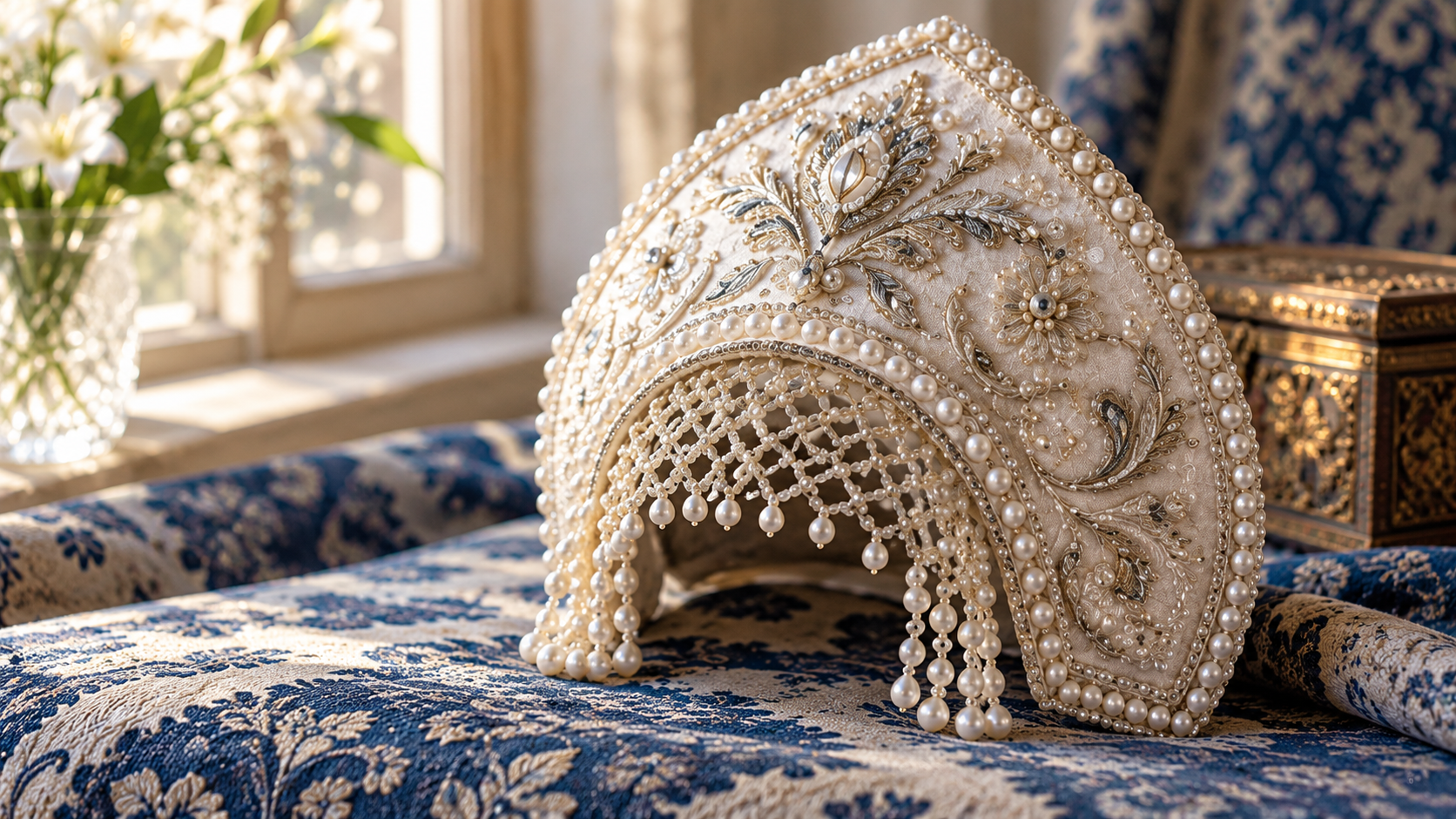
The kokoshnik (коко́шник), characterized by its elaborate decorations and distinctive shape, is one of the most recognizable traditional women’s headdresses in Russia.
The kokoshnik is a decorative headdress adorned with fabric, beads, pearls, gold thread, and other materials. It comes in various shapes, including semicircular, fan-shaped, and pointed designs.
In the past, Russian women wore kokoshniks on special occasions such as festivals and weddings, and different styles and decorations developed according to region and historical period.
In traditional Russian society, women’s headdresses also served to indicate their marital status and social position, and the kokoshnik was closely associated with these cultural traditions.
In this article, I will explain the characteristics and history of the kokoshnik in detail.
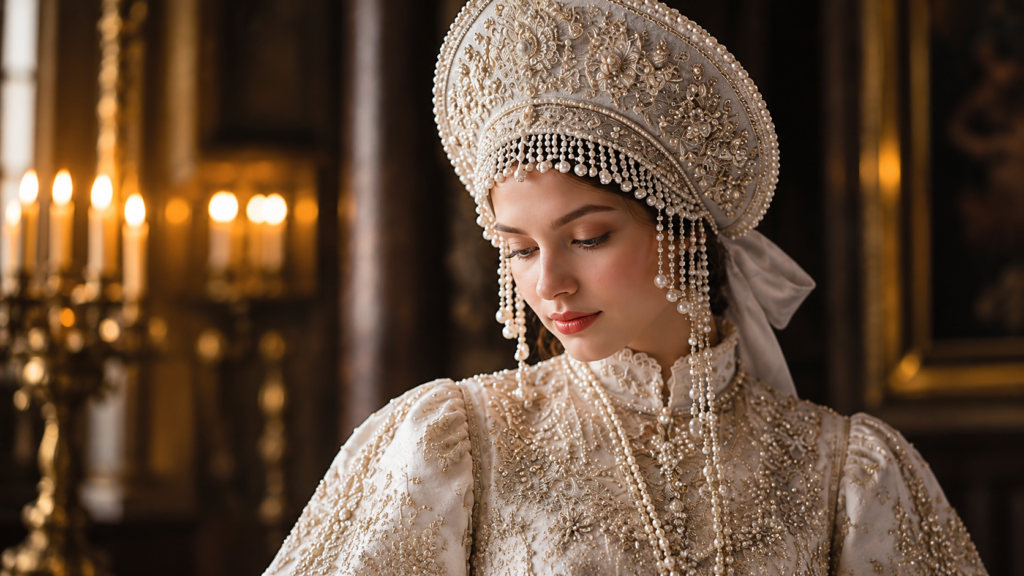
The kokoshnik (коко́шник) is a traditional Russian women’s headdress.
It is characterized by a rigid structure that decorates the upper part of the head and is often richly embellished with fabric, beads, pearls, gold thread, and other decorative materials.
Kokoshniks come in various shapes, including semicircular, fan-shaped, and triangular designs, with regional and historical differences in their appearance. Some feature a large decorative element above the forehead, while others have structures designed to cover much of the head.
The foundation of a kokoshnik was sometimes made from thick fabric, cardboard, or similar materials to maintain its shape. This foundation could then be covered with silk, brocade, or other fine textiles. Additional decorations made from pearls, beads, and gold thread gave the headdress an elaborate appearance suitable for festive occasions.
Different methods were used to secure the kokoshnik to the head. Some designs featured ties fastened at the back of the head, while others used fabric to hold the headdress in place. Certain styles also included strings of pearls or beads hanging around the forehead or decorative fabric attached to the back.
The kokoshnik was sometimes worn together with traditional garments such as the sarafan (сарафа́н). By coordinating the colors and decorations of the headdress and clothing, women could create an elegant and elaborate traditional outfit.
In wealthy households, particularly luxurious kokoshniks were made using expensive materials, sometimes serving as visible expressions of the wearer’s wealth and social standing.
Thus, in addition to its decorative beauty, the kokoshnik was a headdress that reflected regional traditions and the social position of women.
In Russia, women have long followed customs of wearing different headdresses according to their age and marital status.
Married women, in particular, were generally expected to cover their hair, and various types of headdresses developed, including fabric caps and elaborate decorative headwear.
The term kokoshnik already appears in Russian written sources from the seventeenth century.
At that time, different regions of Russia maintained their own traditional clothing styles, and the kokoshnik was worn as a festive headdress for women.
In the early eighteenth century, Peter the Great introduced reforms that encouraged the adoption of Western European clothing styles.
As a result of these reforms, Western-style clothing became increasingly common at the imperial court and among the urban upper classes, while traditional headdresses continued to be preserved primarily in rural communities and among the general population.
In the second half of the eighteenth century, Catherine the Great demonstrated an interest in Russian traditional culture, and clothing inspired by Russian folk dress began to appear at court.
Catherine herself was depicted in portraits wearing Russian-style clothing and headdresses, and traditional dress became one means of expressing Russia’s distinctive cultural identity.
During the nineteenth century, interest in Russian history and folk culture grew further, bringing renewed attention to traditional clothing, including the kokoshnik.
In particular, patriotic sentiment increased following Napoleon’s invasion of Russia in 1812, and Russian-style clothing incorporating sarafans and kokoshniks attracted growing interest among upper-class women.
In 1834, during the reign of Emperor Nicholas I, regulations concerning women’s court dress were established, and dresses and headdresses inspired by traditional Russian clothing became part of official court attire.
These court costumes incorporated headdresses modeled on the kokoshnik, with different styles prescribed for married and unmarried women.
Such court attire remained in use until the Russian Revolution of 1917, and the kokoshnik also became one of the decorative elements associated with Russian imperial court culture.
During the nineteenth century, painting and performing arts inspired by Russian traditional culture also developed, and women wearing kokoshniks appeared in various artistic works.
In this way, the kokoshnik gradually expanded beyond its traditional role as a headdress indicating a woman’s marital status and social position to become a symbol of Russian history and national culture.
In traditional Russian society, women’s headdresses were closely connected to their marital status.
Unmarried and married women wore their hair differently and used different types of headdresses. Headwear therefore served as an important visual indication of a woman’s marital status.
Unmarried women often wore their hair in a single braid and decorated it with ribbons, flowers, or other ornaments. They also sometimes wore headdresses that left the upper part of the head or portions of the hair visible.
Married women, on the other hand, generally covered their hair and wore fabric caps or decorative headdresses when going outside. This custom reflected traditional values that associated covering a married woman’s hair with propriety and modesty.
The kokoshnik is traditionally known as a headdress worn by married women. On special occasions such as festivals and weddings, women wore elaborate kokoshniks decorated with pearls, gold thread, and other ornaments.
Married women also sometimes covered their hair with a fabric cap called a povoinik (пово́йник), over which they wore a decorative headdress.
In some regions, wedding ceremonies included rituals in which the bride’s hairstyle and headdress were changed from those associated with unmarried women to those worn by married women.
These rituals symbolized a woman’s transition to a new social position through marriage and held considerable significance in traditional Russian wedding culture.
Furthermore, in some regions, women who had recently married wore particularly elaborate headdresses, while older women gradually adopted styles with more subdued decorations.
Thus, headdresses such as the kokoshnik were more than decorative accessories. They also served to indicate a woman’s marital status, age, and social position.
The kokoshnik is a traditional Russian women’s headdress distinguished by its elaborate decorations and distinctive shapes.
Its main characteristics can be summarized as follows:
Traditional Russian headdresses reflect regional aesthetic preferences, decorative craftsmanship, and cultural traditions developed over many centuries.
The kokoshnik is one of the most recognizable symbols of this traditional culture and remains an important headdress for understanding Russian history, women’s lives, and the characteristics of traditional Russian clothing.