#69 Rubakha | Traditional Russian Shirt
Yuri Miyajima Russian Forest

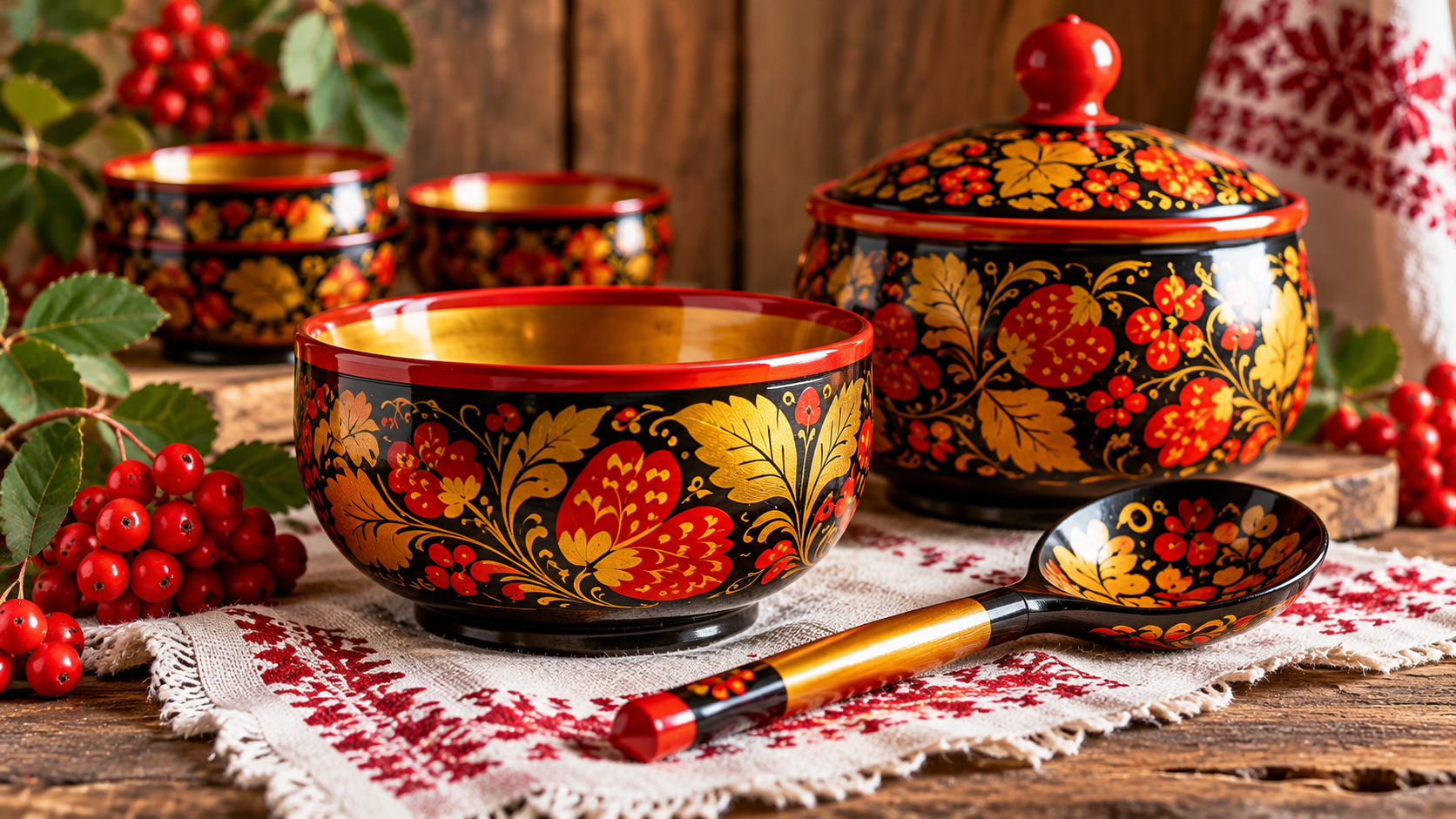
Russia has numerous traditional crafts that have been passed down through generations. One of these is Khokhloma painting (хохломска́я ро́спись), a decorative art characterized by its vivid red, black, and gold colors.
Khokhloma painting is a traditional Russian decorative technique used to paint plant motifs and other patterns on wooden tableware and everyday objects. Although its appearance is distinguished by a brilliant golden finish, it employs a unique production method that creates a gold-like appearance without using actual gold.
Its origins date back to the second half of the seventeenth century, when the craft developed primarily in the region that is now Nizhny Novgorod Oblast.
Today, Khokhloma tableware and decorative objects remain widely recognized as representative examples of Russian folk art and are appreciated both within Russia and internationally.
In this article, I will explain the origins and history of Khokhloma painting, its distinctive colors and patterns, traditional production techniques, and cultural significance in modern times.
Khokhloma painting (хохломска́я ро́спись) is a traditional woodworking decoration technique that developed in Russia.
Also known in Russian as Khokhloma (хохлома́), it is a craft characterized by colorful patterns painted on wooden tableware and everyday objects.
Typical products include:
These products are decorated with combinations of red, black, and gold.
One of their most distinctive features is the use of flowing, curved patterns depicting plant leaves, flowers, and berries. These elaborate designs evoke the natural beauty of Russia.
Another defining characteristic of Khokhloma painting is its use of metallic powder to create a golden shine on wooden surfaces without using actual gold. This unique technique allows wooden objects to retain their light weight while acquiring the luxurious appearance of metalwork.
Khokhloma painting originally developed as a technique for decorating wooden tableware used in everyday life. Wooden spoons and bowls were familiar household items in Russia, and decorative painting transformed them into objects that combined practical functionality with artistic beauty.
Over time, production techniques and decorative styles became more sophisticated, and Khokhloma painting began to be applied not only to tableware but also to furniture and ornamental objects.
Today, it is recognized as one of the traditional folk crafts that symbolize Russian culture and is appreciated both domestically and internationally as a souvenir and a form of decorative art.
Khokhloma painting originated in the second half of the seventeenth century.
Its birthplace is generally considered to be the area along the left bank of the Volga River in what is now Nizhny Novgorod Oblast (Нижегоро́дская о́бласть), in western Russia.
This region was surrounded by extensive forests, and the production of wooden tableware and everyday objects had long been an important local activity. Wooden spoons and bowls were widely used in daily life, and local craftsmen developed techniques for woodworking and surface decoration.
Against this background of woodworking traditions, a distinctive technique emerged that involved decorating wooden objects with vivid patterns and giving them a golden appearance.
The development of Khokhloma painting is also believed to have been influenced by techniques used in the production of icons, or sacred religious paintings, in the Russian Orthodox Church.
In the mid-seventeenth century, reforms concerning worship and religious practices were introduced within the Russian Orthodox Church. Some members of the Old Believers (старообря́дцы), who opposed these reforms, moved to forested areas along the Volga River and elsewhere to escape persecution.
It is believed that some of these communities included craftsmen skilled in religious painting and gold-colored decoration. The techniques they brought with them are thought to have combined with established local woodworking traditions, contributing to the development of the distinctive decorative methods associated with Khokhloma painting.
During the eighteenth and nineteenth centuries, production techniques became increasingly refined, and Khokhloma products spread throughout Russia.
Trade along the Volga River was particularly active, allowing wooden products manufactured in surrounding villages to be transported to markets across the country. The village of Khokhloma was one of these trading centers, where decorated wooden tableware produced in nearby settlements was collected and sold.
By the nineteenth century, distribution networks had expanded further, and Khokhloma products began reaching markets outside Russia as well as those within the country.
During the twentieth century, workshops became more organized and production systems were developed. As a result, Khokhloma painting continued to evolve as a craft industry while preserving its traditional techniques.
The name Khokhloma (хохлома́) comes from the village of Khokhloma (Хохлома́), located in what is now Nizhny Novgorod Oblast.
The village was once an important center for trading wooden products and handicrafts.
From the second half of the seventeenth century through the eighteenth century, wooden tableware, spoons, and other objects were produced in surrounding villages and brought to the market in Khokhloma.
Craftsmen in the region specialized in various stages of production, including woodworking and decorative painting. Merchants then transported the finished products to different parts of Russia.
The village of Khokhloma thus became an important trading center supporting the distribution of these handicrafts.
Consequently, wooden tableware and decorative objects produced in the surrounding region came to be known as Khokhloma, after the village where they were traded.
In other words, the name Khokhloma originated not so much from a single location where the craft was produced, but from the commercial center where products were collected and distributed to other regions.
The Russian word ро́спись means decorative painting or painted ornamentation. Therefore, хохломска́я ро́спись can be understood as “the decorative painting technique associated with Khokhloma.”
Today, the name is widely used beyond its original geographical context to refer to the distinctive woodworking decoration technique characterized primarily by gold, red, and black.
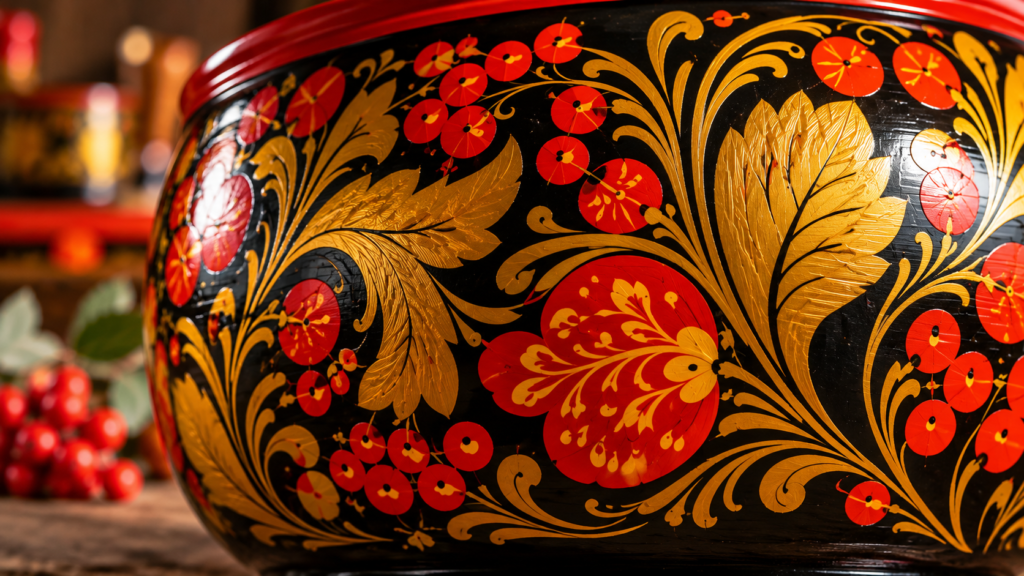
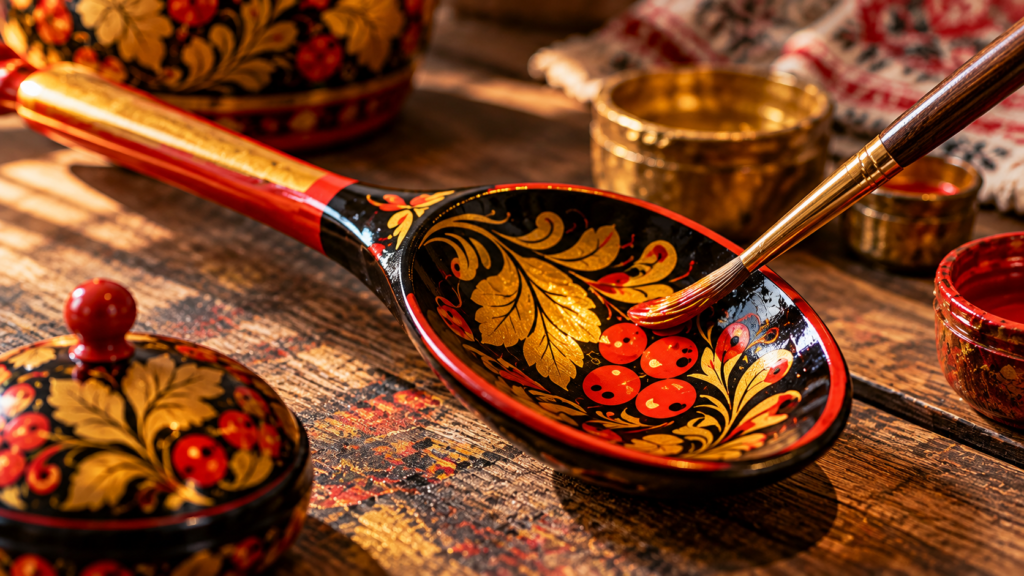
The most recognizable feature of Khokhloma painting is its vivid color scheme, dominated by gold, red, and black. The combination of these colors gives wooden objects an elaborate and striking appearance.
Plant leaves, flowers, and berries are particularly common motifs, and flowing, curved designs are used to express the beauty of nature.
Typical motifs include:
These patterns feature slender stems and leaves painted in flowing curves, creating the impression of plants growing naturally.
One of the most representative decorative styles is the grass pattern (тра́вка), in which grass leaves and stems are depicted using graceful, continuous brushstrokes.
Red berries, particularly rowan berries and strawberries, are also widely used in traditional designs because they stand out vividly against gold and black backgrounds.
Some works incorporate birds and other animals among the plant motifs, creating decorations that evoke the richness of the natural world.
Through its combination of vivid colors and plant-inspired patterns, Khokhloma painting expresses a distinctive form of beauty closely associated with the natural environment of Russia.
One of the most remarkable aspects of Khokhloma painting is its ability to create a golden appearance without using actual gold.
In the traditional production process, metallic powder is applied to the surface of a wooden object. Decorative patterns are then painted over the prepared surface, followed by finishing and heat treatment.
This technique produces wooden tableware and decorative objects with a beautiful metallic shine.
The production process can be divided into the following main stages.
The first stage involves carving and shaping wood into tableware or decorative objects.
Wood species that are relatively easy to work with, such as linden, are commonly used. Linden is comparatively soft and suitable for detailed woodworking, making it a traditional material for wooden tableware.
Wooden spoons and bowls are shaped using lathes and carving tools.
After shaping, the wood is thoroughly dried and its surface is smoothed. This preparation helps ensure that subsequent coatings and decorative painting can be applied evenly.
In the traditional process, a primer containing clay or similar materials is applied to the surface of the shaped wooden object.
This treatment helps smooth the wood and provides a suitable base for the coatings applied later.
The surface is then treated with drying oils, such as those derived from linseed oil.
Drying oils react with oxygen in the air and gradually harden, forming a protective layer on the wooden surface.
This preparation is also important for ensuring that the metallic powder adheres properly.
Next, fine metallic powder is applied to the wooden surface.
Traditionally, tin powder was used, while aluminum powder is commonly used in modern production.
The metallic powder is rubbed into the surface using cloth or similar materials, giving the entire wooden object a metallic shine.
At this stage, the surface has a silvery appearance.
This silver-colored layer forms the foundation for the golden shine that will emerge during the later stages of production.
Once the metallic powder has been applied, decorative patterns are painted using red, black, and other colors.
Craftsmen use brushes to create motifs depicting plants, berries, and other natural elements.
In Khokhloma painting, skilled brushwork is used to produce flowing curves representing grass, leaves, flowers, and berries.
The painting process varies depending on the decorative technique. Some methods involve painting patterns directly onto a golden background, while others involve coloring the surrounding areas so that the golden motifs remain visible.
These techniques require considerable skill, and variations in brushwork give each finished piece its own distinctive appearance.
After the decorative painting is completed, a transparent finishing material is applied.
Traditional methods used oil-based finishes, while modern production may also employ specialized transparent coatings.
The object is then heated in a furnace, allowing the coating to harden and transforming the appearance of the silver-colored metallic layer into a golden finish.
This effect occurs because the finishing material develops a yellowish tint during heat treatment. When combined with the reflective silver-colored layer beneath it, the surface takes on an appearance similar to gold.
Thus, the golden color of Khokhloma painting is produced through the combination of metallic reflectivity and the color of the transparent coating.
Khokhloma painting has two major traditional decorative techniques.
These are known as upper painting and background painting.
The main difference lies in whether patterns are painted over a golden background or whether the background is colored to make golden patterns stand out.
Upper painting is a technique in which decorative patterns are painted in red, black, and other colors over a golden background.
Large areas of the golden surface remain visible, while motifs such as grass, leaves, and berries are added.
One of the most representative styles within this technique is the grass pattern (тра́вка), which uses combinations of fine, curved lines to depict plants.
In grass patterns, the movement of the brush is used to create slender leaves and stems, producing light and graceful decorations that resemble naturally growing vegetation.
Red berries and flowers may also be incorporated to create more elaborate designs.
Because much of the golden background remains visible, upper painting generally produces bright and decorative works.
Background painting is a technique in which the surrounding areas are painted black or red while golden decorative patterns are left visible.
The outlines of plants, berries, and other motifs are drawn first. The areas around them are then filled with color, allowing the golden patterns to stand out against the background.
This technique makes it possible to depict relatively large leaves, flowers, and berries, giving the overall decoration a bold and substantial appearance.
A decorative style known as Kudrina (кудри́на) is also associated with this type of background painting.
Kudrina is characterized by golden curved lines resembling plant vines and spirals. The surrounding areas are colored red, black, or other shades, creating intricate and elaborate patterns.
In this way, background painting emphasizes the contrast between dark or red backgrounds and golden motifs, producing works that combine a relatively subdued overall impression with a sense of luxury.
Khokhloma painting is closely connected to traditional Russian food culture.
Wooden spoons and bowls have been widely used in everyday life in Russia for centuries.
In regions with abundant forests, wood was a readily available material that could be shaped into tableware and cooking utensils.
Wooden spoons were used for eating soups and porridge, while wooden bowls were used to serve food and ingredients.
Khokhloma painting developed as a technique for adding beautiful decorations to these practical wooden objects.
Wooden spoons, in particular, are among the most representative Khokhloma products.
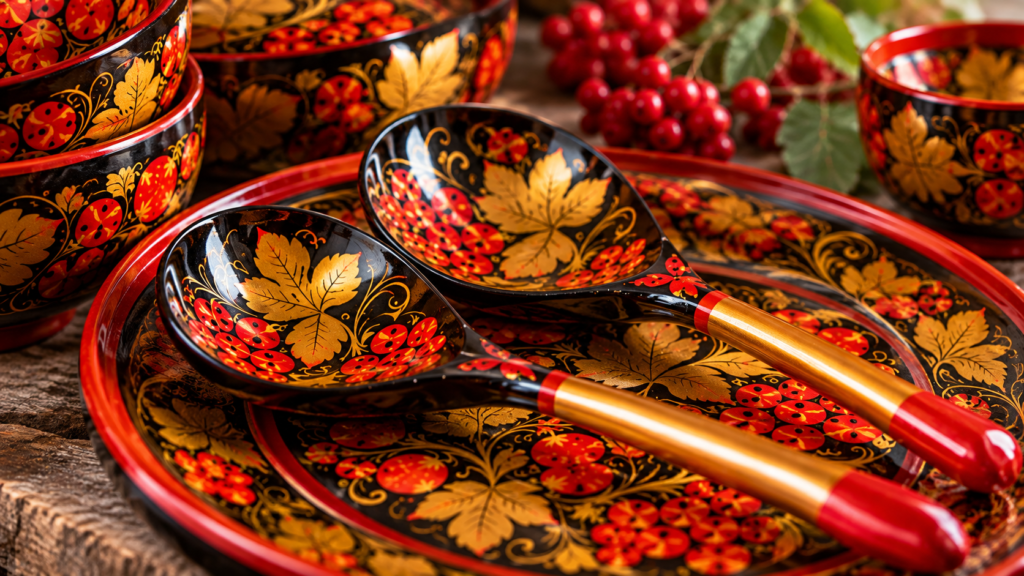
Khokhloma spoons often feature red and black plant motifs painted over a golden surface. They are appreciated not only as practical utensils but also as decorative objects and souvenirs.
Khokhloma painting has also traditionally been applied to plates, deep bowls, cups, and other tableware.
These objects were used in everyday life, while their elaborate decorations also helped create a more colorful and attractive dining table.
Russia has a long tradition of warmly welcoming guests and offering them food and drinks.
Beautifully decorated tableware, including Khokhloma products, has therefore also become associated with traditional Russian dining culture.
Furthermore, Khokhloma patterns frequently incorporate natural motifs such as strawberries, rowan berries, flowers, grass, and leaves.
These designs evoke Russia’s rich natural environment and add decorative beauty to everyday tableware.
In this way, Khokhloma painting developed as a craft that combined practical wooden tableware with traditional decorative art.
Today, Khokhloma products include both items intended for use as tableware and objects designed primarily for decoration.
When using Khokhloma products to serve food, it is important to check the intended purpose and care instructions for each item.
Khokhloma painting is a traditional Russian woodworking decoration technique that developed in the second half of the seventeenth century in what is now Nizhny Novgorod Oblast.
The main points can be summarized as follows:
Khokhloma painting emerged from the combination of woodworking traditions based on Russia’s abundant forest resources and the decorative skills developed by local craftsmen.
Its vivid colors and distinctive production techniques reflect the traditional way of life and artistic sensibilities of Russian culture.