#78 Kasha | Grain Dish at the Heart of Russian Cuisine
Yuri Miyajima Russian Forest

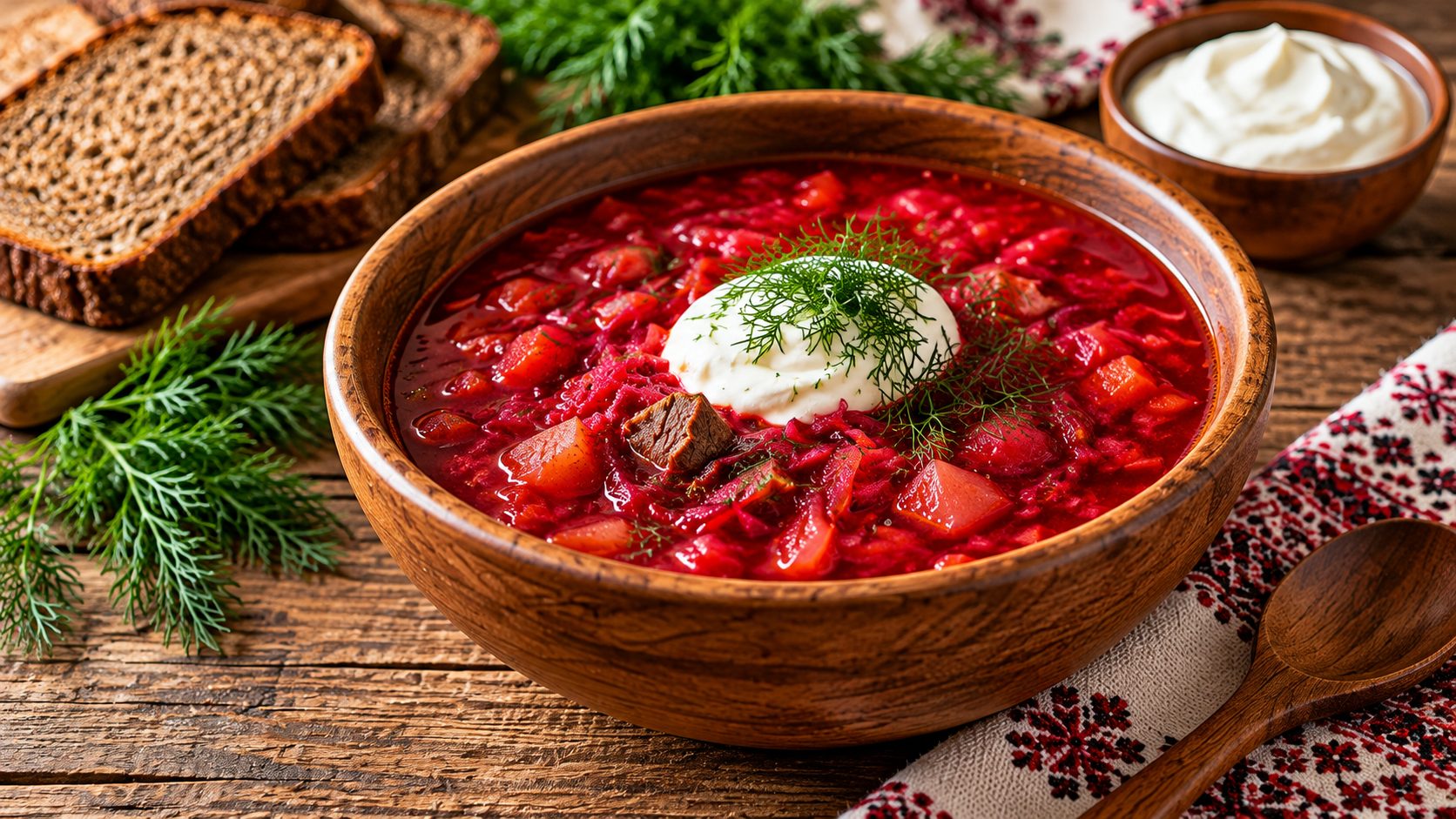
Borscht (борщ) is a traditional soup that has long been enjoyed throughout Eastern Europe. Characterized by its vibrant red color and rich vegetable flavors, it is commonly served in various countries and regions, including Russia, Ukraine, Belarus, and Poland.
One of the principal ingredients responsible for the distinctive red color of borscht is beetroot. The natural sweetness of beetroot combines with the mild acidity of ingredients such as tomatoes and vinegar to create the soup’s characteristic flavor.
Today, borscht is widely recognized as one of Eastern Europe’s representative dishes. However, exploring its history reveals its close connections with regional food cultures, agriculture, and everyday family life.
Borscht also occupies a particularly important place in Ukrainian food culture. In 2022, the “Culture of Ukrainian Borscht Cooking” was inscribed on UNESCO’s List of Intangible Cultural Heritage in Need of Urgent Safeguarding.
In this article, I will introduce the main characteristics of borscht, explore its historical origins, and explain how the dish differs across countries and regions.
Borscht (борщ) is a traditional Eastern European soup prepared by simmering vegetables, meat, and other ingredients.
There are many varieties of borscht, but beetroot is the central ingredient in the red borscht that is widely known today.
Typical ingredients include:
These ingredients are simmered in meat stock or vegetable broth and seasoned with salt, spices, and other seasonings.
When meat is used, a common method is to prepare a stock from the meat first, then add chopped vegetables and simmer them together. Beetroot, carrots, and onions may also be sautéed separately before being added to the soup to bring out their natural sweetness and aroma.
The characteristic flavor of borscht comes from the natural sweetness of beetroot and the moderate acidity provided by tomatoes, vinegar, or similar ingredients. Meat-based versions have a rich, savory flavor, while vegetable-based versions tend to be relatively light.
Borscht is also commonly served with smetana (смета́на), a cultured dairy product similar to sour cream.
The white color of smetana creates a beautiful contrast with the red soup, while its rich texture and mild acidity add depth to the flavor. Borscht may also be garnished with herbs such as dill and served with bread.
Although borscht is most often eaten hot, some regional varieties are served cold.
Borscht is a familiar home-cooked dish, and its ingredients, seasonings, and preparation methods vary between regions and households. As a result, the dish reflects the distinctive food culture of each locality.
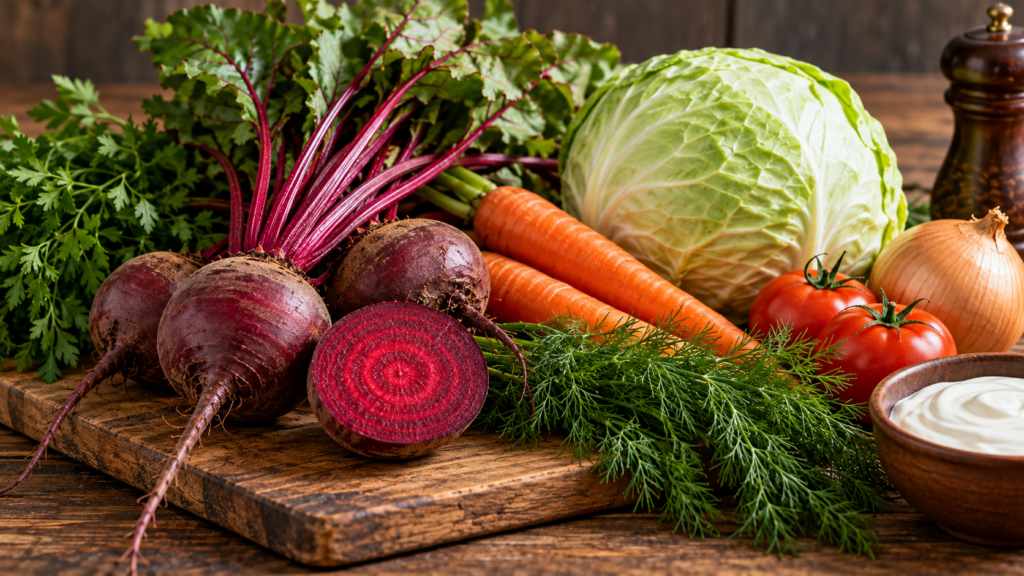
Beetroot is one of the defining ingredients of borscht.
Beetroot is a root vegetable belonging to the genus Beta in the amaranth family, Amaranthaceae. Its deep reddish-purple root is eaten as a vegetable. Known as свёкла in Russian, beetroot has long been a familiar ingredient in Eastern European cuisine.
Its characteristic red color comes from natural pigments called betalains. In particular, beetroot contains betacyanins, which produce reddish-purple colors. When beetroot is cooked, these pigments are released into the broth, giving borscht its distinctive vibrant red appearance.
Beetroot also has a natural sweetness and becomes tender when cooked. When combined with vegetables such as cabbage, potatoes, and carrots, it produces a soup with a pleasant balance of sweetness and savory flavors.
There are several ways to prepare beetroot for borscht. It may be cut into thin strips and sautéed before being added to the soup, or it may be cooked in advance and then incorporated into the broth. These different methods affect the flavor and texture of the beetroot, as well as the color of the finished soup.
Vinegar, lemon juice, tomatoes, and other acidic ingredients are also sometimes added to borscht. Moderate acidity helps balance the overall flavor of the soup and maintain the vivid red color of the beetroot.
Beetroot can be cultivated in relatively cool climates and stored for a certain period after harvesting. For this reason, it has long been an important ingredient in Eastern European households, where winters are often lengthy, alongside vegetables such as cabbage and potatoes.
These vegetables were valued because they could be used during the colder months and became important ingredients in warming soups, including borscht.
Thus, beetroot contributes not only the beautiful red color of borscht but also its distinctive sweetness and flavor. The widespread use of beetroot in borscht is closely connected with Eastern Europe’s climate, agricultural practices, and traditions of food preservation.
Borscht has a long history, and its name is associated with a plant traditionally used as food in Slavic regions.
The name “borscht” is believed to derive from a Slavic word referring to a type of hogweed, a plant belonging to the carrot family, Apiaceae. In Russian, hogweed and related plants are known as борщеви́к.
In earlier periods, people in Eastern Europe used the young leaves and stems of these plants as food. One traditional practice involved chopping the leaves and stems, soaking them in water, and allowing them to ferment. The resulting sour liquid was then used to prepare soup.
Such sour soups are considered among the early forms that contributed to the development of modern borscht.
Historical records from the sixteenth century indicate that dishes associated with borscht were known in areas corresponding to present-day Ukraine, Russia, Poland, and neighboring regions.
For example, Домостро́й, a sixteenth-century Russian household manual, contains references to the cultivation and use of hogweed and related plants. This indicates that the plants associated with the name borscht formed part of the food culture of the period.
As the cultivation and culinary use of beetroot expanded across Eastern Europe, red borscht made with beetroot gradually developed, and different regions established their own preparation methods.
The natural sweetness and vibrant red color of beetroot introduced new characteristics to soups that had traditionally emphasized sour flavors. Ingredients such as cabbage, carrots, and meat were also incorporated, contributing to the development of the hearty, vegetable-rich borscht commonly recognized today.
Throughout these changes, Eastern European traditions of incorporating fermented foods and sour ingredients into cooking continued to be passed down.
In this way, borscht developed over many centuries from earlier soups that made use of readily available wild plants. Its ingredients and preparation methods gradually changed, eventually giving rise to the many varieties enjoyed today.
In Ukraine, borscht has long been enjoyed both as an everyday home-cooked meal and as a traditional dish served at family gatherings and celebrations.
Many households have their own recipes passed down through generations, with cooking methods often taught by parents to their children. As a result, borscht has become one of the dishes that symbolize family connections.
Ukraine is also a geographically extensive country, and ingredients and preparation methods vary between regions.
For example, some varieties of borscht are prepared with pork or beef, while others incorporate mushrooms or fish. Meatless versions made primarily with vegetables are also common and have traditionally been eaten during religious fasting periods.
In addition to vegetables such as beetroot, cabbage, and potatoes, beans are used in certain regions. Methods of adding acidity also vary, producing distinctive flavors in different households and local communities.
In Ukraine, borscht is sometimes served with small bread rolls called pampushky (Ukrainian: пампушки).
Pampushky may be flavored with garlic and oil, and eating them alongside borscht complements the rich flavors of the soup.
These food traditions have been passed down not only as methods of preparing meals but also as cultural practices that express connections within families and local communities.
On July 1, 2022, UNESCO inscribed the “Culture of Ukrainian Borscht Cooking” on its List of Intangible Cultural Heritage in Need of Urgent Safeguarding.
This inscription concerns not simply borscht as a dish but the cultural practices associated with its preparation and consumption in Ukraine, including cooking methods, food traditions, and connections with local communities.
The inscription on the urgent safeguarding list was also influenced by the threat that war posed to everyday life and the transmission of traditional food culture.
The recognition highlights the importance of borscht preparation and dining traditions to Ukrainian communities and their cultural identity.
Borscht developed over a long period in Eastern Europe, including the territory of present-day Ukraine, and gradually became established in neighboring countries.
Its spread was closely connected with population movements, trade, and interactions between states.
From the Middle Ages through the early modern period, political control and national borders changed repeatedly across territories corresponding to present-day Ukraine, Poland, Lithuania, and Belarus.
During the period of the Polish–Lithuanian Commonwealth in particular, people across extensive territories shared political and economic connections, and their food cultures developed through mutual influence.
Vegetables such as beetroot and cabbage had also been cultivated in Eastern Europe for centuries. Their suitability for the regional climate and their availability to ordinary households were among the reasons that borscht became widely enjoyed.
From the eighteenth century onward, population movements within the Russian Empire, followed by migration and the exchange of culinary traditions in urban areas during the Soviet period, also contributed to the spread of borscht across a broad geographical area.
Against this historical background, borscht is now enjoyed in countries including:
However, the characteristics of the dish differ between regions.
For example, some varieties are hearty soups containing generous amounts of meat and vegetables, while others are served as clear red broths. There are also varieties of borscht that emphasize ingredients other than beetroot.
These differences have developed in response to regional agriculture, the availability of ingredients, religious customs, and traditions of home cooking.
The spread of borscht reflects the long history through which Eastern European countries have shared culinary traditions while developing their own distinctive regional dishes.
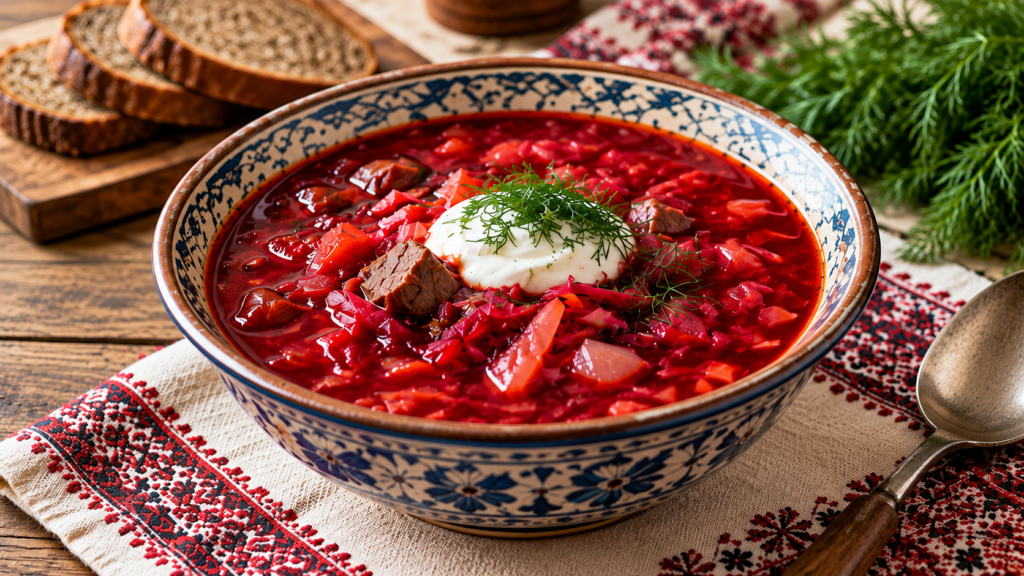
Borscht is also one of the most widely recognized soups in Russia.
It is enjoyed as a home-cooked dish and is also served in cafeterias and restaurants, making it a familiar part of everyday meals.
Red borscht commonly prepared in Russia contains ingredients such as beetroot, cabbage, potatoes, carrots, and onions.
Beef or pork is often used to prepare the stock, producing a hearty soup that combines the natural sweetness of vegetables with the savory richness of meat.
A common preparation method involves sautéing beetroot, carrots, onions, and other vegetables before adding them to the pot. Tomato paste, vinegar, or similar ingredients may also be added to create moderate acidity and bring out the soup’s vibrant red color.
Borscht is sometimes served with smetana (смета́на) or garnished with herbs such as dill (укро́п).
Dill is frequently used in Russian cuisine and adds a fresh aroma to borscht. Bread is also a common accompaniment, and rye bread, including varieties of dark bread, pairs particularly well with the soup.
In Russia, eating soup at lunchtime is a widespread custom. In traditional meals, soup may be served as the first course (пе́рвое блю́до), followed by a second course (второ́е блю́до), such as a meat or fish dish.
Borscht is one of the representative soups served as part of this meal structure.
It is also commonly prepared in large quantities as a home-cooked dish that can be eaten over several days.
Families may prepare a large pot of borscht and reheat it the following day or later. As the soup rests, its flavors become more integrated, allowing the tastes of the vegetables and meat to spread throughout the broth.
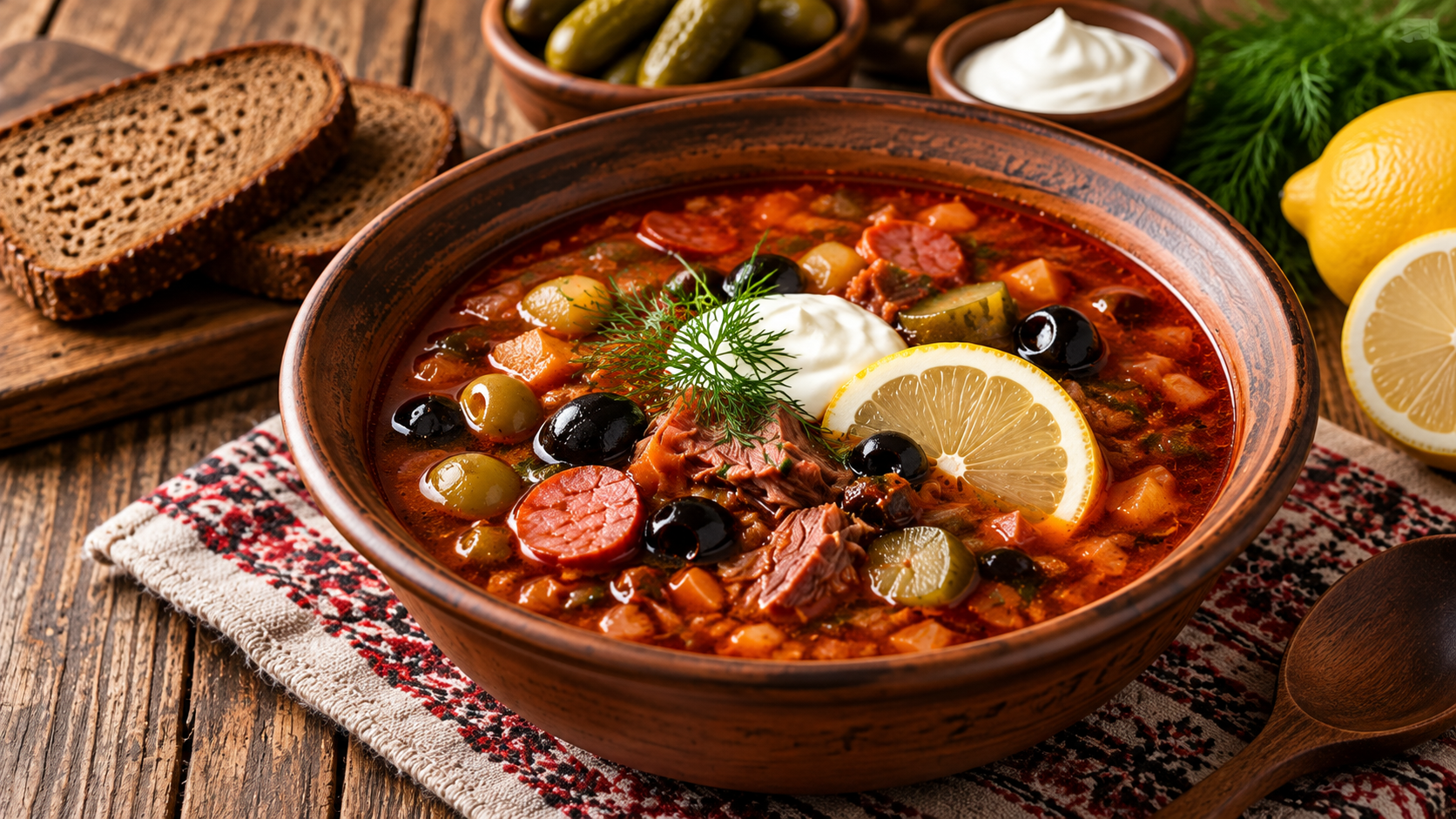
Russia has many other traditional soups besides borscht, including shchi (щи), which is primarily made with cabbage, and solyanka (соля́нка), which often contains meat, preserved ingredients, and other flavorful additions.
Alongside these dishes, borscht forms part of Russia’s longstanding soup culture.
Borscht has also developed in distinctive ways in Poland, Lithuania, and Belarus, reflecting the culinary traditions of each region.
In Poland, dishes corresponding to borscht are known as barszcz. One of the most representative varieties is barszcz czerwony, a red soup made with beetroot.
Polish red borscht is sometimes served as a clear broth that emphasizes the flavor and acidity of beetroot. Its appearance and serving style can differ considerably from the hearty, vegetable-rich borscht commonly found in Ukraine and Russia.
At Christmas Eve dinners in particular, red borscht served with small filled dumplings called uszka is a well-known traditional dish.
Uszka are often filled with mushrooms and other ingredients. Their name means “little ears” in Polish, referring to their shape.
Poland also has a sour soup known as white borscht (barszcz biały), which is made using fermented grains or similar ingredients. Its ingredients and flavors differ from those of red borscht, and various preparation methods have been passed down through regional and family traditions.
Lithuania, meanwhile, has a cold beetroot soup called šaltibarščiai.
This dish combines beetroot with fermented dairy products such as kefir and is characterized by its vibrant pink color. Cucumbers, dill, and other ingredients are often added, and it may be served with boiled eggs and potatoes.
Because it is served cold, šaltibarščiai is particularly popular during the summer months.
In Belarus, both hot borscht made with beetroot and cold beetroot soups are enjoyed. Cold beetroot soup is known in some areas as халаднік and is a familiar dish during warmer weather.
In this way, borscht and related dishes have developed their own distinctive characteristics across Eastern Europe.
Even when beetroot is the principal ingredient, differences in serving temperature, additional ingredients, methods of adding acidity, and accompaniments create a wide variety of flavors and dining traditions.
Borscht is a traditional soup that developed through the long history and culinary traditions of Eastern Europe.
Today, it is widely recognized as a red soup made with beetroot. However, exploring its history reveals deep connections with wild plants traditionally used as food, regional agriculture, and food preservation practices.
Its main characteristics can be summarized as follows:
In Ukraine, borscht has been passed down as an important dish symbolizing connections within families and local communities. In neighboring countries such as Russia and Poland, various forms of borscht have also become established according to local culinary traditions.
Learning about the history of borscht provides an opportunity to understand how the people of Eastern Europe have made use of regional ingredients and preserved their culinary traditions within families and communities over generations.