#26 Russian Patronymics
Yuri Miyajima Russian Forest

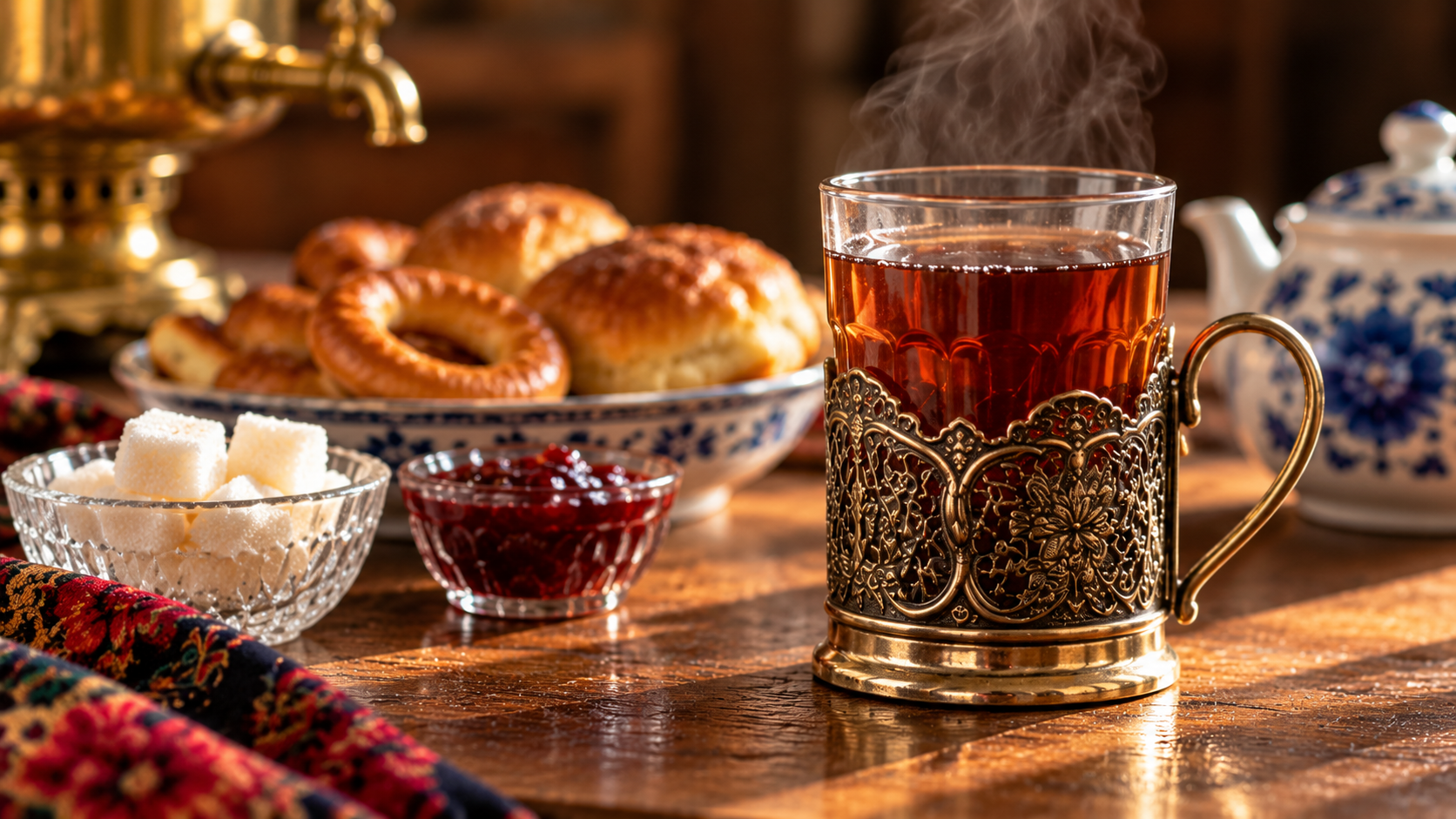
Tea is rooted in everyday life in Russia. Families and friends often gather around a table to enjoy tea and conversation, making tea drinking an important tradition that brings people together.
Russian tea culture also has several distinctive features, including the samovar, a traditional device used to heat water, and the practice of diluting strongly brewed tea with hot water.
These customs have developed over time in close connection with Russia’s history, climate, and way of life.
In this article, I will explore the history of Russian tea culture, traditional methods of preparing and drinking tea, and the foods commonly enjoyed alongside it.
Russian tea culture has developed around the tradition of bringing people together to enjoy tea, conversation, and moments of relaxation.
Tea is one of the essential beverages of everyday life in Russia and is enjoyed on various occasions, including breakfast, after meals, and during breaks at work.
The Russian language has several expressions related to tea:
In Russia, where many regions experience extremely cold weather, hot tea has long been appreciated as a familiar beverage that provides warmth and an opportunity to relax.
Tea drinking is a common activity not only at home but also in workplaces and gatherings among friends.
Furthermore, offering tea to guests is a traditional custom in Russia, and tea plays an important role in welcoming visitors and expressing hospitality.
Thus, tea is both an everyday beverage and an important part of social interaction in Russian culture.
Tea was introduced to Russia around the seventeenth century.
During this period, Russia began encountering tea through diplomatic relations and trade with China and Mongolia.
A well-known historical account describes how, in 1638, a Russian envoy received tea leaves as a gift from a Mongolian ruler and brought them back to Tsar Michael Romanov. This story is often cited as one of the representative accounts of tea’s introduction to Russia.
Initially, tea was a rare imported commodity consumed mainly at the imperial court and among wealthy people. It was also believed to have health benefits and was sometimes treated as a medicinal beverage.
As trade with China developed during the second half of the seventeenth century, tea began to be imported into Russia more regularly.
Overland trade routes connecting China and Russia were particularly important.
Tea leaves were transported by caravans using camels and other pack animals, passing through Mongolia and Siberia before reaching various parts of Russia.
In 1727, Russia and the Qing Empire concluded the Treaty of Kyakhta, which established a framework for trade near their border. Subsequently, the border trading center of Kyakhta became an important location for importing tea from China.
As tea imports increased during the eighteenth and nineteenth centuries, tea gradually became more accessible, and the custom of drinking it spread, particularly in urban areas.
During the nineteenth century, tea drinking became increasingly common among merchants and urban households. By this time, the practice of using a samovar to heat water and enjoying tea with family members and guests had also become widespread.
Furthermore, improvements in transportation networks from the late nineteenth century to the early twentieth century made the transportation and distribution of tea more efficient, allowing it to reach an even larger portion of the population.
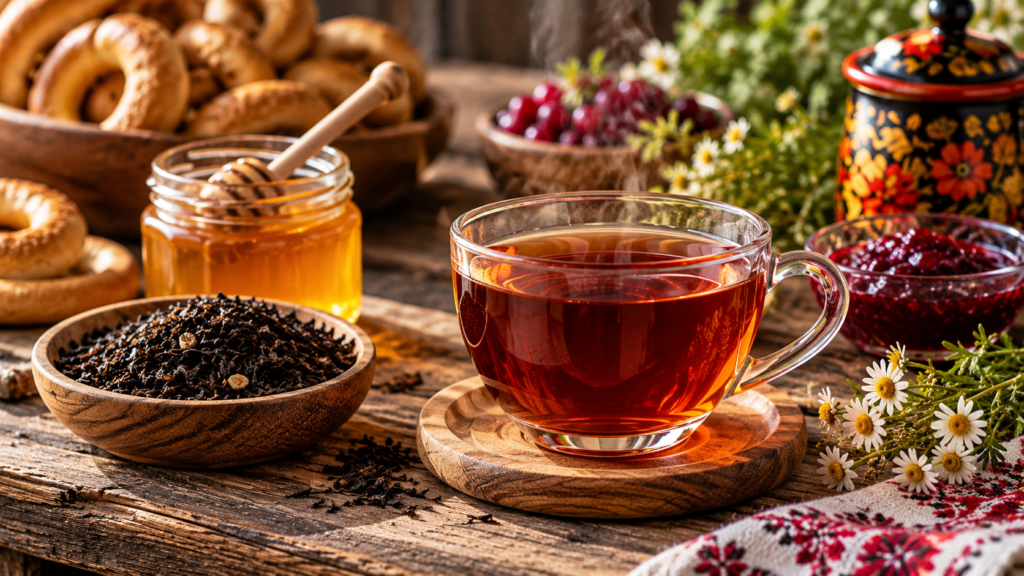
Black tea has traditionally been widely enjoyed in Russia. Tea, which initially spread through trade with China, eventually became an established part of everyday life.
In Russian, black tea is called чёрный чай. The expression literally means “black tea,” referring to the appearance of the tea leaves.
Some common types of tea and ways of serving tea in Russia include:
Black tea is particularly common during family tea gatherings and when entertaining guests.
It is also customary to sweeten tea with sugar or honey. Black tea served with a slice of lemon is another popular choice.
Herbal teas are also consumed, using a variety of plants such as mint, chamomile, and rosehips.
Today, a wide range of teas is available in Russia, including black tea, green tea, and many other varieties, allowing people to choose according to their preferences.
One traditional Russian method of preparing tea involves brewing a strong tea concentrate and diluting it with hot water when serving.
This strongly brewed tea is called зава́рка in Russian. The term refers to concentrated tea prepared by steeping tea leaves in hot water, although depending on the context, it can also refer to the tea leaves used for brewing.
In the traditional method, a relatively large quantity of tea leaves is placed in a small teapot, and hot water is added to produce a strong infusion.
A small amount of зава́рка is then poured into a cup, followed by additional hot water to adjust the strength according to personal preference.
This method allows each person to choose their preferred tea strength, even when everyone is served from the same teapot.
Those who prefer stronger tea can use more зава́рка, while those who prefer a lighter taste can add more hot water.
Preparing concentrated tea in advance also makes it convenient to enjoy several cups.
Traditionally, a samovar was used to provide the hot water needed for this method. Today, electric kettles and other modern appliances are also commonly used.
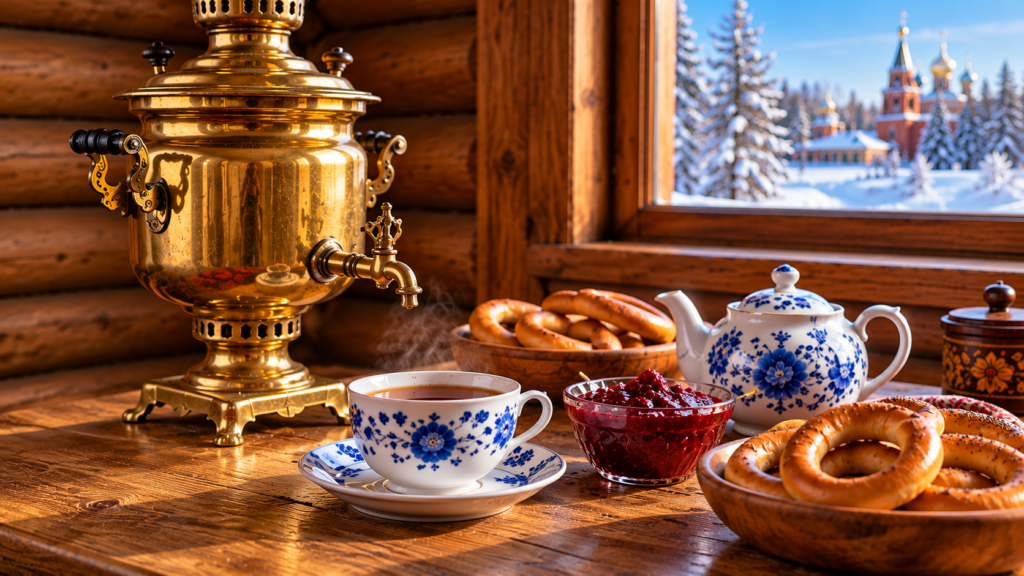
One of the most recognizable symbols of Russian tea culture is the samovar (самова́р).
The samovar has traditionally been used to heat water for making tea and keep it hot.
Samovar production developed in Russia during the eighteenth century, and these devices became widespread in households and among merchants during the nineteenth century. The city of Tula, known for its metalworking industry, became particularly famous as a center of samovar production.
A traditional samovar heated by charcoal or other solid fuels consists of a metal container with a central tube designed to hold the fuel.
Charcoal or small pieces of wood are burned inside this tube, and the resulting heat warms the water surrounding it.
A tap is fitted near the bottom of the container, allowing hot water to be dispensed whenever needed.
A small teapot can also be placed on top of the samovar, where the concentrated tea prepared inside can be kept warm.
When serving tea, a small amount of strong tea is poured from the teapot into a cup. Hot water is then added from the samovar’s tap to achieve the desired strength.
The samovar was not only a practical household device but also a symbol of family gatherings and domestic life.
In nineteenth-century Russia, it was common for family members and guests to gather around a samovar, enjoying tea while engaging in conversation.
Such scenes were frequently depicted in Russian literature and paintings, making the samovar a symbol of domestic warmth and social interaction.
Today, electric samovars are also available, and the samovar continues to be appreciated as an object that preserves the traditions of Russian tea culture.
In Russia, it is customary to serve sweet foods alongside tea.
During tea gatherings at home, cookies, sweet breads, and preserves may be placed on the table and enjoyed while family members and friends engage in conversation.
Some representative examples include:
Among these foods, варе́нье has a particularly close connection with Russian tea culture.
Варе́нье is a type of preserve made by cooking fruits such as strawberries, raspberries, and cherries with sugar. The fruit often retains much of its original shape and is enjoyed together with a sweet syrup.
During tea gatherings, варе́нье may be served in a small dish and eaten a little at a time with a spoon. It can also be added directly to tea to provide sweetness and a fruity flavor.
Another traditional Russian accompaniment to tea is пря́ник.
This baked confection is made from dough containing ingredients such as honey, sugar, and spices. Its shape and ingredients vary by region.
Пря́ник from the Tula region is particularly famous, and some varieties contain sweet fillings such as jam.
Су́шки, on the other hand, are small, ring-shaped baked snacks with a firm texture.
Their low moisture content makes them suitable for storage, and they are sometimes dipped into tea to soften them before eating.
Other easily prepared or readily available sweets, such as пече́нье and конфе́ты, are also commonly enjoyed with tea.
Russian tea culture began developing after tea was introduced through contacts with China around the seventeenth century. Over the centuries, it became deeply established in the everyday lives of Russian people.
The main points discussed in this article can be summarized as follows:
Today, electric kettles and tea bags are also widely used, and the methods of preparing tea and the varieties available have become increasingly diverse.
Nevertheless, the tradition of gathering around tea and enjoying conversation with family and friends continues to be an important part of life in modern Russia.