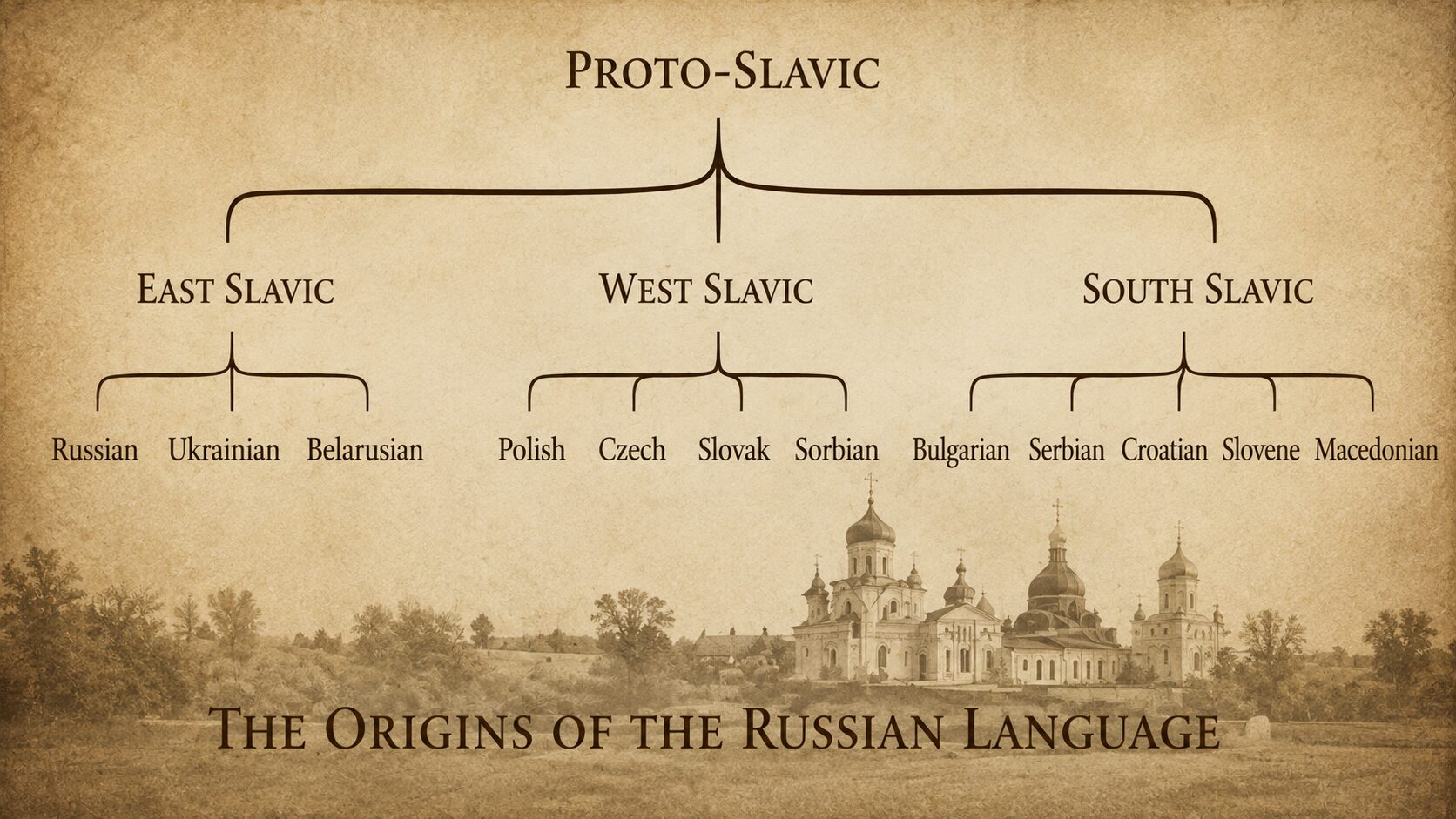
#3 The Origins of the Russian Language
Yuri Miyajima Russian Forest

When you think of the Russian alphabet, the Cyrillic alphabet is probably the first writing system that comes to mind. However, before Cyrillic was created, another writing system known as the Glagolitic alphabet was used in the Slavic world.
Today, the Glagolitic alphabet is rarely used in everyday life. Nevertheless, learning about its history allows you to gain a deeper understanding of the background from which Cyrillic emerged and how the written cultures of Russian and other Slavic languages developed.
In this article, I will explain what the Glagolitic alphabet is, how and why it was created, where it was used, and how it relates to the Cyrillic alphabet.
The Glagolitic alphabet is the oldest known Slavic writing system attested in surviving historical sources. It was created in the 9th century.
The alphabet was devised to translate the Bible and liturgical texts into a Slavic language. At that time, no widely established and unified writing system existed for representing the languages spoken by the Slavic peoples. Christian liturgy and religious texts were mainly written in Greek or Latin. As a result, it was not easy for many people to understand Christian teachings in their own language.
The Glagolitic alphabet was therefore created to represent the sounds of Slavic speech accurately. By using this writing system, translators were able to produce Slavic versions of the Bible and liturgical books, allowing people to encounter Christian teachings in their own language.
Glagolitic is a different writing system from the Cyrillic alphabet used in modern Russian. However, it is widely recognized as an important symbol of the beginning of written culture in the Slavic world.
The creation of the Glagolitic alphabet was not simply the invention of a new set of letters. It marked a major turning point that enabled Slavic to develop as a written language used in religion, education, and literature.
The Glagolitic alphabet is generally attributed to Cyril, a Byzantine missionary.
Cyril was his monastic name; he was originally known as Constantine. In the 9th century, Cyril and his elder brother Methodius were sent from the Byzantine Empire to Great Moravia.
Great Moravia was a state in Central Europe centered largely on areas that are now part of the Czech Republic and Slovakia. At the time, Slavic-speaking peoples lived in the region, but Christian worship was conducted mainly in Latin.
Cyril and Methodius therefore began translating the Bible and liturgical texts into Slavic so that local people could learn about Christianity in their own language.
To accomplish this task, however, they needed a writing system capable of representing Slavic speech. Since no widely unified alphabet had yet been established for Slavic, Cyril is believed to have devised the Glagolitic alphabet to represent its sounds.
The translation of religious texts using Glagolitic laid the foundation for a Slavic-language Christian culture. This undertaking later had a major influence on the development of literature and education throughout the Slavic world.
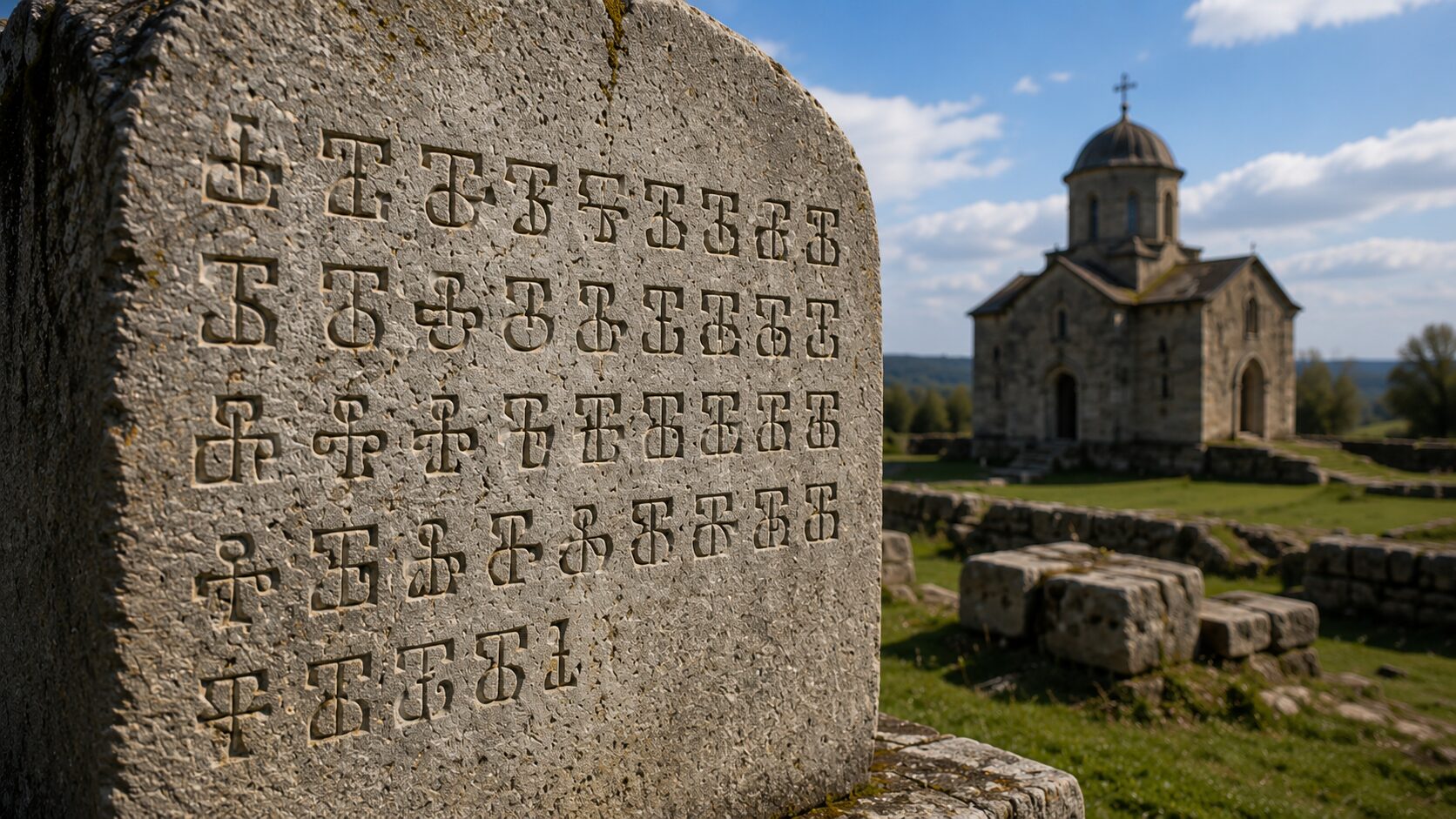
The Glagolitic alphabet looks very different from the Cyrillic alphabet used in modern Russian. It has a distinctive appearance characterized by numerous circles, curves, and complex geometric forms.
Examples of Glagolitic letters include:
As you can see, these letters look very different from both the modern Latin alphabet, such as A, B, and C, and the Cyrillic alphabet, such as А, Б, and В.
There are several theories concerning the origins of the letterforms. However, Glagolitic is generally regarded not as a simple adaptation or simplification of the Greek alphabet, but as a newly designed writing system created specifically for the sound system of Slavic.
The Glagolitic alphabet was used during the missionary work carried out by Cyril and Methodius in Great Moravia in the 9th century. They used it to translate the Bible and liturgical books into Slavic and to teach Christianity to the local population.
After the deaths of Cyril and Methodius, however, circumstances surrounding the use of Slavic in worship changed in Great Moravia. Many of their disciples were expelled from the region, and some of them moved to the First Bulgarian Empire.
In Bulgaria, these disciples continued to provide education in Slavic and to produce manuscripts. In this way, the traditions of Glagolitic and Old Church Slavonic spread to Bulgaria and other Slavic regions of the Balkans.
The Glagolitic alphabet also reached Croatia. There, it continued to be used for many centuries in Catholic liturgy and religious texts, and its tradition survived well beyond the medieval period.
Glagolitic was therefore not limited to the cultural sphere of the Eastern Orthodox Church. In parts of Croatia, it also developed as a script used to conduct Catholic worship in a Slavic language.
In Bulgaria and many other regions, however, Cyrillic gradually became more widespread from around the 10th century onward. Cyrillic was based largely on the Greek alphabet, with additional letters introduced to represent sounds found in Slavic but not in Greek.
Cyrillic later spread into the East Slavic regions and became established in territories that would eventually form modern Russia, Ukraine, and Belarus. As a result, Glagolitic was gradually replaced by Cyrillic in many areas.
Both Glagolitic and Cyrillic were used to write Slavic languages, but they differ in both appearance and historical origin.
Glagolitic is regarded as an original writing system devised by Cyril to represent the sounds of Slavic.
Early Cyrillic, by contrast, is generally thought to have developed between the late 9th century and the early 10th century in the Bulgarian literary and educational centers where the disciples of Cyril and Methodius were active. It was based on the Greek alphabet, with additional letters created for Slavic sounds that did not exist in Greek.
In other words, Glagolitic did not simply change its shape and become Cyrillic.
Their relationship can be summarized as follows:
Although the name “Cyrillic” is derived from Cyril, the generally accepted explanation today is that Cyril himself directly devised the Glagolitic alphabet, while early Cyrillic emerged within the cultural and scholarly environment in which his disciples worked.

Today, the Glagolitic alphabet is no longer used for everyday communication. Nevertheless, it has immense historical value, and many Glagolitic manuscripts, inscriptions, and religious texts are preserved as cultural heritage.
These materials are valuable historical sources for understanding the early spread of Christianity in the Slavic world, as well as the languages, religions, and cultures of the period.
In Croatia in particular, Glagolitic is highly valued as a symbol of national history and cultural identity. It can be found not only in churches and museums but also on monuments, tourist signs, logos, and in modern design.
In other Slavic-speaking regions, the alphabet is studied as the starting point of Slavic written culture in fields such as linguistics, history, and religious studies.
Even though Glagolitic is no longer commonly used, learning about it helps you understand more deeply the historical development of Cyrillic and Russian. As the starting point of written culture in the Slavic world, the Glagolitic alphabet continues to hold great historical significance.
The Glagolitic alphabet is the oldest known Slavic writing system attested in surviving historical sources, and it was created in the 9th century.
It played an important role in the development of religion, literature, and education in Slavic languages and had a major influence on the later written culture of the Slavic world.
Its main characteristics can be summarized as follows:
When you study the Cyrillic alphabet used in Russian, learning about the earlier history of Glagolitic can help you understand the development of Slavic languages and cultures from a broader perspective.
The Cyrillic alphabet that you see today did not evolve directly from Glagolitic. However, it developed within the written culture of the Slavic world that the Glagolitic alphabet had helped to establish.