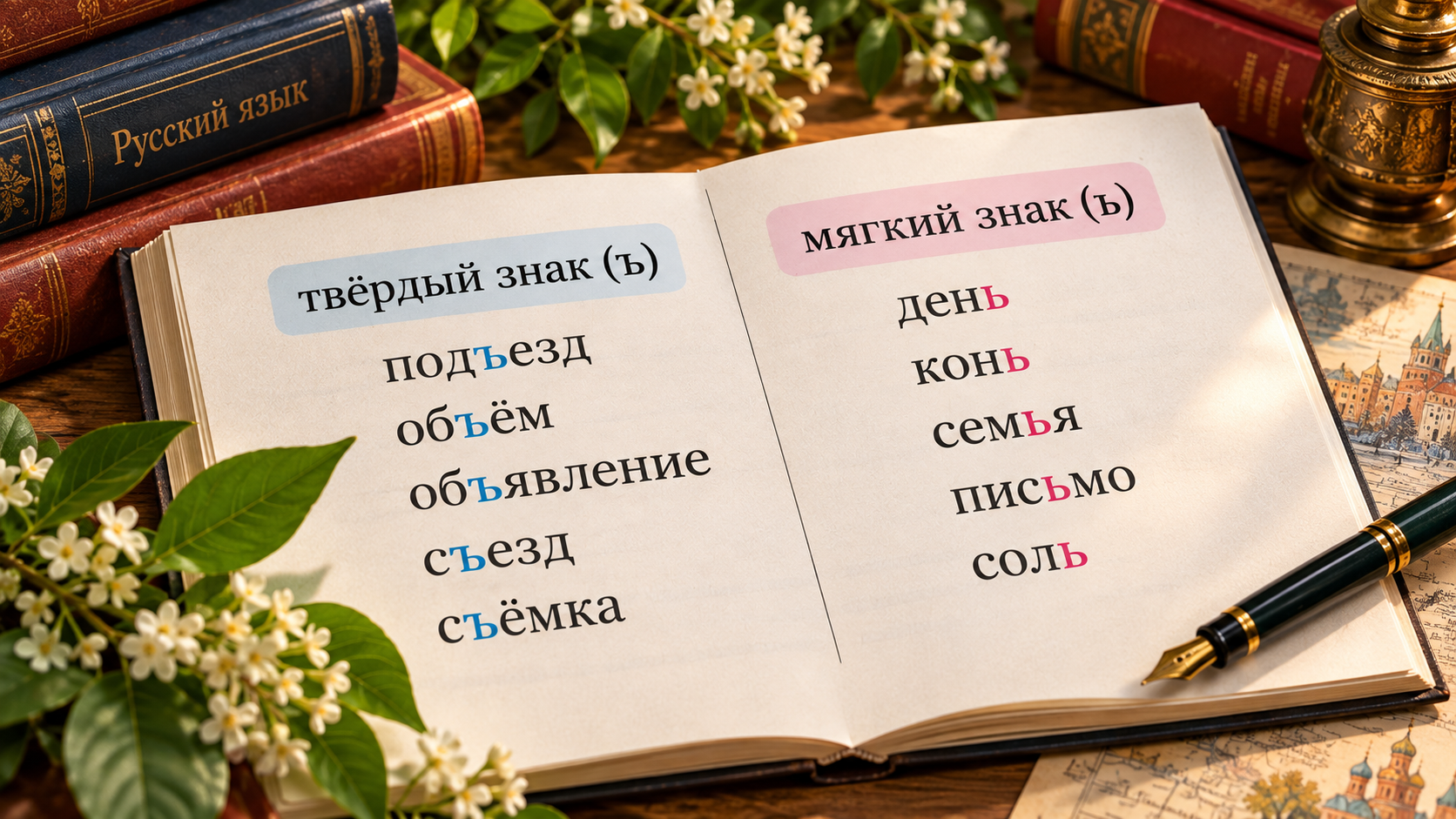
#57 The Hard Sign and Soft Sign in Russian
Yuri Miyajima Russian Forest

In Russian, the future tense is used to talk about things that will happen, such as “I will read a book tomorrow.” In English, the future can be expressed with forms such as “will + base form of the verb” or “be + going to + base form of the verb,” but the Russian future tense works somewhat differently.
This is closely connected to the distinction between the imperfective and perfective aspects of Russian verbs. The imperfective aspect focuses on features such as the process, duration, or repetition of an action, while the perfective aspect presents an action as a complete whole. In Russian, the way the future tense is formed also changes depending on which aspect is used.
For this reason, to understand the Russian future tense, it is also important to understand how verbal aspect relates to future meaning.
In this article, I will explain the Russian future tense, including the difference between the imperfective and perfective forms and the situations in which each is used.
Russian has two main types of future tense: the compound future and the simple future.
These two forms are not freely interchangeable. In most cases, the form you use depends on whether the verb is imperfective or perfective.
With imperfective verbs, Russian uses the compound future, formed with “the future tense of быть + the infinitive of an imperfective verb.”
For example, with the imperfective verb чита́ть (to read), you get:
бу́ду is the 1st-person singular future form of бы́ть, while чита́ть remains in the infinitive and does not change. Because the future meaning is expressed by combining two verbs, this construction is called the compound future.
With perfective verbs, by contrast, бы́ть is not used. Instead, the perfective verb itself is conjugated according to person. Perfective verbs do not have a grammatical present tense, so these forms are often described as non-past forms and express future meaning.
For example, the perfective verb прочита́ть (to read through / to finish reading) is used as follows:
Because only one verb is used to express the future, this is called the simple future.
This difference is closely related to verbal aspect in Russian. Imperfective verbs commonly express processes, duration, repetition, or the action itself, whereas perfective verbs present an action as a complete event. As a result, the form of the future tense changes depending on which aspect you choose.
The basic system can therefore be summarized as follows:
When learning the Russian future tense, I recommend understanding this relationship together with verbal aspect: imperfective verbs use the compound future, while perfective verbs use the simple future. This will make the later differences in usage much easier to understand.
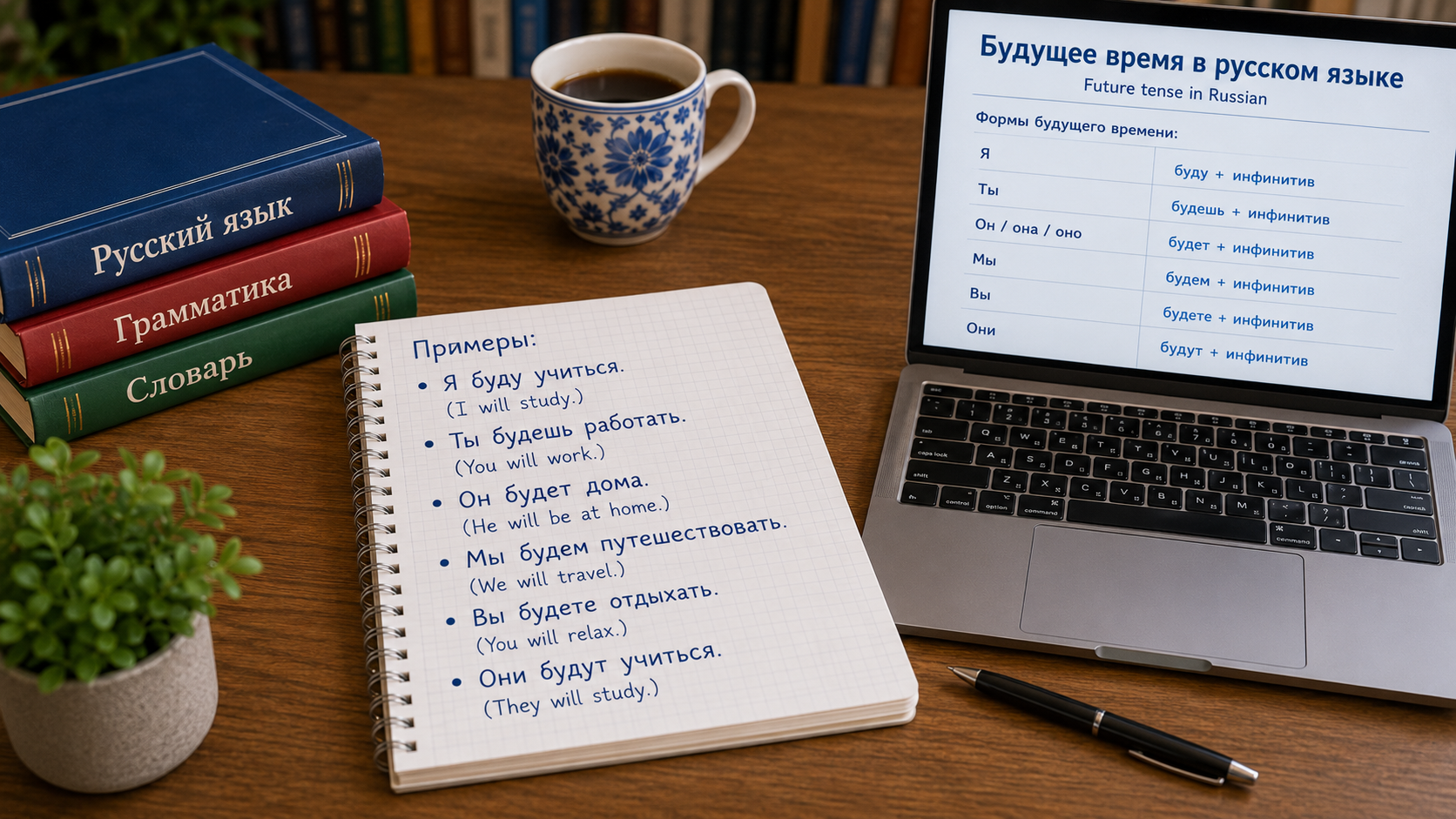
The future tense of an imperfective verb is formed by combining the future tense of бы́ть (to be) with the infinitive of the imperfective verb.
The basic structure is: “future form of быть + infinitive of an imperfective verb”
This looks somewhat similar to the English structure “will + base form of the verb,” but an important difference is that in Russian this type of future is used specifically with imperfective verbs.
For example, the future tense of чита́ть (to read) is:
| Person | Russian | English |
|---|---|---|
| I | Я бу́ду чита́ть. | I will read. |
| You | Ты бу́дешь чита́ть. | You will read. |
| He / She | Он / Она́ бу́дет чита́ть. | He / She will read. |
| We | Мы бу́дем чита́ть. | We will read. |
| You | Вы бу́дете чита́ть. | You will read. |
| They | Они́ бу́дут чита́ть. | They will read. |
Only the form of бы́ть changes according to person. The following verb, чита́ть, remains in the infinitive.
If you memorize the future forms of бы́ть: бу́ду → бу́дешь → бу́дет → бу́дем → бу́дете → бу́дут, you can apply the same pattern to many different imperfective verbs.
The imperfective future is often used when the focus is on the process, duration, repetition, or occurrence of an action in the future.
For example:
Here, the focus is on the fact that the activity of reading continues for a period of time.
Similarly:
In this sentence, the imperfective future expresses an action that will be repeated in the future.
In this way, the compound future does more than simply place an action in the future. It can also present that action as continuing, repeated, or viewed as an ongoing process.
With perfective verbs, you do not need to add бы́ть as you do with the imperfective future. Instead, the perfective verb itself is conjugated according to person, and its non-past form expresses future meaning.
For example, прочита́ть (to finish reading / to read through) is conjugated as follows:
| Person | Russian | English |
|---|---|---|
| I | Я прочита́ю. | I will finish reading. |
| You | Ты прочита́ешь. | You will finish reading. |
| He / She | Он / Она́ прочита́ет. | He / She will finish reading. |
| We | Мы прочита́ем. | We will finish reading. |
| You | Вы прочита́ете. | You will finish reading. |
| They | Они́ прочита́ют. | They will finish reading. |
These forms look very similar to the present-tense conjugation of imperfective verbs. However, perfective verbs do not have a grammatical present tense, so forms such as прочита́ю refer to a future event: “I will finish reading.”
Perfective verbs present an action not as an ongoing process, but as one complete event. For this reason, the perfective future often emphasizes that the action will be carried out and brought to a particular result or completion.
In this way, the future meaning of a perfective verb is expressed by its non-past form. Understanding this distinction from the imperfective future is one of the key points in learning how the Russian future tense works.
The two Russian future forms differ not only in how they are formed. The choice between the imperfective and perfective aspect also reflects how the speaker views the future action.
The imperfective aspect is mainly used when attention is focused on the process, duration, repetition, or activity itself. Rather than emphasizing whether the action reaches a result, it focuses on the fact that the activity takes place.
For example:
Here, the sentence simply tells you that the speaker will be engaged in reading in the evening. It does not indicate whether the book will be finished.
By contrast, the perfective aspect presents an action as a completed whole and focuses on its completion or result.
Compare:
Here, the focus is not simply on the activity of reading, but on reaching the endpoint of the action and completing the book.
Let us look at another pair:
Because писа́ть is imperfective, the first sentence focuses on the activity or process of writing the letter. In contrast, the second sentence uses the perfective verb написа́ть, which presents the writing of the letter as a completed event.
In this way, even when referring to the same future situation, Russian chooses a different aspect depending on whether the speaker is focusing on the process or activity itself, or on the completed event and its result.
By using verbal aspect in this way, Russian can express clearly how the speaker conceptualizes an action.
In Russian, a future event does not always have to be expressed with a future-tense form. In particular, the present tense of an imperfective verb may be used for actions that are already planned or scheduled, especially in the near future.
For example:
The verb е́ду is the present-tense form of the imperfective motion verb е́хать, which means “to travel in one direction by vehicle.”
Because the sentence contains за́втра (tomorrow), the present-tense verb is understood from context as referring to a future plan.
In this way, Russian can use the present tense instead of the future tense when an action has already been arranged or decided.
Here are some more examples:
In both sentences, the verbs are grammatically in the present tense, but expressions such as в суббо́ту (on Saturday) and ве́чером (in the evening) show that the actions refer to future plans.
English has a somewhat similar pattern. For example, you can say: I’m leaving tomorrow.
Here, the present progressive is used to refer to an arranged future event. Russian and English do not follow exactly the same grammatical rules, but I think this comparison can help you understand the basic idea.
However, this does not mean that any imperfective present-tense verb can automatically be used with future meaning. This usage normally appears in contexts involving movement, arrangements, schedules, or other actions that are already concretely planned.
The Russian future tense is formed differently depending on whether the verb is imperfective or perfective.
The main points can be summarized as follows:
In Russian, when you talk about future events, the way you view an action is reflected in the form of the verb.
Understanding how the future tense works will therefore also help you understand the distinction between the imperfective and perfective aspects. When learning new Russian verbs, I recommend paying attention to their aspect as well as their meaning.