#58 The Role of Stress in Russian
Yuri Miyajima Russian Forest

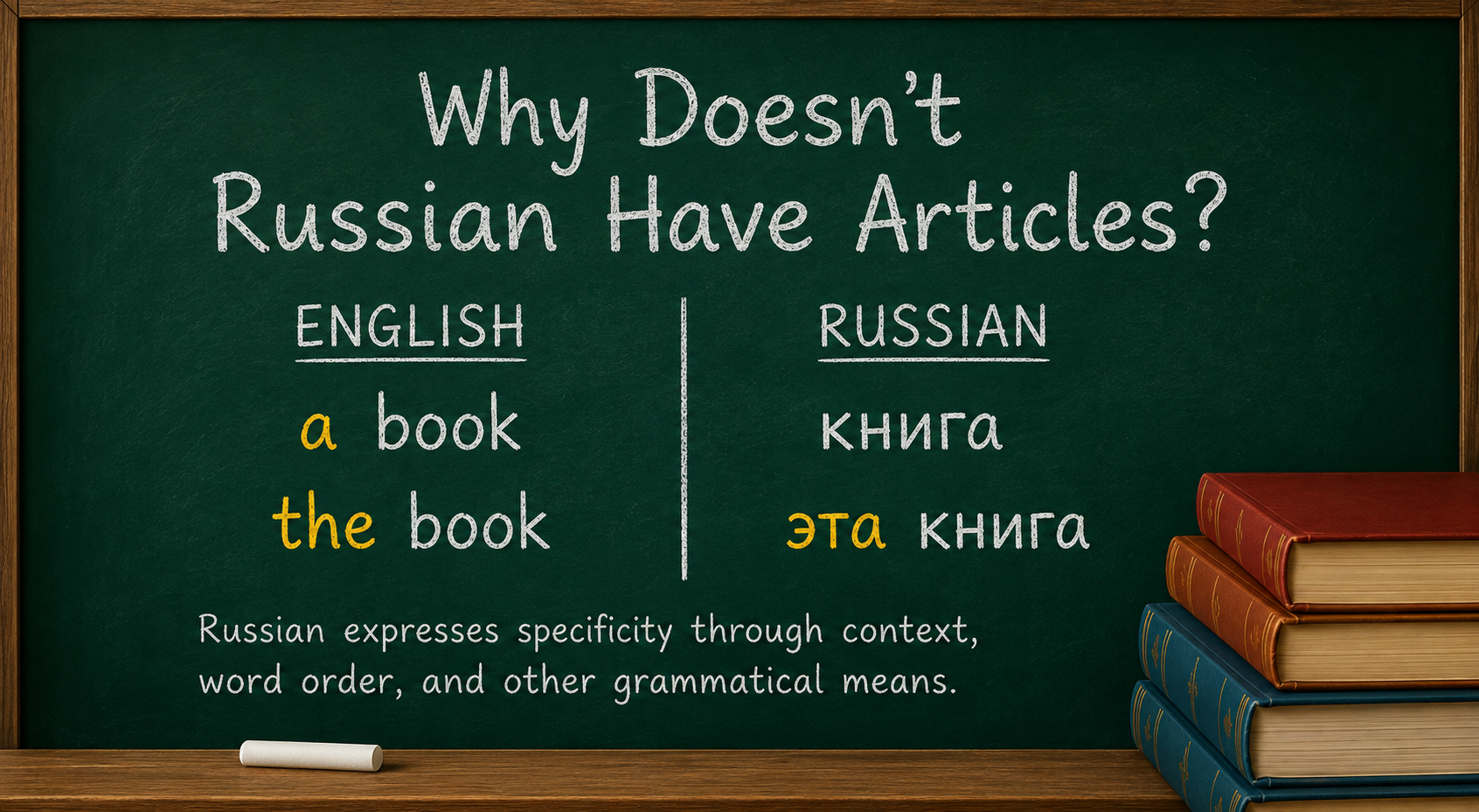
In English, articles such as a / an and the are placed before nouns. For example, a book and the book both contain the same noun, book, but they differ in whether the book is indefinite or refers to a specific one.
Russian, on the other hand, has no articles that directly correspond to English a / an or the. The word кни́га, meaning “book,” can be used in a sentence without placing an article before it.
However, this does not mean that Russian cannot distinguish between specific and non-specific things. Instead, Russian uses word order, context, demonstratives, and other elements to express information that English often conveys through articles.
In this article, I will explain why Russian has no articles, focusing on its historical development, grammatical characteristics, and differences from English.
One of the characteristics of Russian is that it has no articles corresponding to the definite and indefinite articles of English.
In English, an article is often required when you use a noun. For example, if you want to say “I bought a book,” you would say I bought a book, placing the indefinite article a before book. If you are referring to a particular book that has already been mentioned, you would normally use the definite article the, as in the book.
In Russian, however, there is no need to place this kind of article before a noun. The noun is simply used on its own.
As you can see, there is no word corresponding to an article before кни́гу, the accusative form of кни́га (book).
An important point is that Russian nouns themselves do not contain a distinction equivalent to English a / an and the. Depending on the context, кни́гу, for example, may correspond to either a book or the book.
If a book is being mentioned for the first time in a conversation, English would normally use I bought a book. If both the speaker and listener already know which book is being discussed, English would use I bought the book.
In Russian, however, both meanings can be expressed with: Я купи́л кни́гу.
The form кни́гу itself does not contain a distinction like English a and the. Information such as whether the speaker and listener know which book is being discussed, or whether the book is being introduced into the conversation for the first time, is primarily inferred from the surrounding context.
The same applies to other nouns.
If маши́на (car) refers to a car being introduced into the conversation for the first time, it is close in meaning to English a car.
On the other hand, if both the speaker and listener already know which car is being discussed, as in the following sentence, маши́на can correspond to English the car.
In this way, Russian does not always explicitly mark definiteness or indefiniteness by attaching an article to the noun. Instead, it conveys the necessary information through context and various other grammatical and communicative elements.
Russian does not lack articles because an earlier article system disappeared. Rather, a system of definite and indefinite articles comparable to that of English never developed historically.
Russian belongs to the Slavic branch of the Indo-European language family. Proto-Slavic, its linguistic ancestor, did not have a systematic article system like modern English a / an and the for marking whether a noun was definite or indefinite.
Old East Slavic, which developed later, also did not develop an article system comparable to English, and this characteristic was inherited by modern Russian.
English also did not originally have the same article system that it has today. In Old English, the modern system of articles had not yet fully developed. Over time, demonstratives became grammaticalized and eventually developed into the modern definite article the. The indefinite articles a / an, meanwhile, developed from a word meaning “one.”
In other words, the difference between English and Russian is the result of the two languages developing different grammatical systems over time. English established an article system, while Russian retained a system without articles.
This feature is not unique to Russian. It is shared by many Slavic languages, including Ukrainian, Belarusian, Polish, and Czech.
However, Bulgarian and Macedonian have what are known as postposed definite articles, in which an element corresponding to the definite article is attached after the noun or a related word. This means that even within the Slavic language family, some languages have articles while others do not.
In Russian, word order also plays an important role in conveying information alongside context.
English relies heavily on word order to indicate grammatical roles such as subject and object, so its word order is relatively restricted. Russian, by contrast, uses noun case endings to indicate grammatical relationships, which allows considerably more flexibility in word order.
Russian can therefore change word order to organize information that is already known and information that is being newly introduced, thereby changing the focus and nuance of a sentence.
In a neutral sentence, information that is already known or serves as the topic tends to appear earlier, while important new information often appears later.
For example:
In this sentence, на столе́ (on the table) serves as the starting point, while кни́га (book) is introduced as new information: what is on the table. For this reason, the sentence is close in meaning to English There is a book on the table.
By contrast:
Here, кни́га appears at the beginning of the sentence. This tends to suggest that the book is already the topic of discussion and that its location, “on the table,” is the new information. In this context, the sentence is close to English The book is on the table.
This comparison shows that some of the information expressed through articles in English can instead be conveyed through context and word order in Russian.
Russian does not have a definite article, but when you want to clearly indicate a particular person or object, you can use demonstratives such as э́тот (this) and тот (that).
The demonstrative э́тот changes according to gender, number, and case as follows:
| Case | Masculine | Feminine | Neuter | Plural |
|---|---|---|---|---|
| Nominative | э́тот | э́та | э́то | э́ти |
| Genitive | э́того | э́той | э́того | э́тих |
| Dative | э́тому | э́той | э́тому | э́тим |
| Accusative | э́тот / э́того | э́ту | э́то | э́ти / э́тих |
| Instrumental | э́тим | э́той | э́тим | э́тими |
| Prepositional | э́том | э́той | э́том | э́тих |
The demonstrative тот declines as follows:
| Case | Masculine | Feminine | Neuter | Plural |
|---|---|---|---|---|
| Nominative | тот | та | то | те |
| Genitive | того́ | той | того́ | тех |
| Dative | тому́ | той | тому́ | тем |
| Accusative | тот / того́ | ту | то | те / тех |
| Instrumental | тем | той | тем | те́ми |
| Prepositional | том | той | том | тех |
For example:
By adding э́ту, the speaker makes it clear that they mean “this book,” rather than some other book.
These demonstratives change according to gender, number, and case. In particular, you should note that the accusative forms of masculine singular and plural demonstratives vary according to whether the noun is animate or inanimate.
There is also a difference in distance between э́тот and тот. In basic usage, э́тот corresponds to “this” and refers to something relatively close to the speaker, while тот corresponds to “that” and refers to something farther away.
In actual conversation, however, these words are not used only for physical distance. They can also help distinguish between different people or objects being discussed.
At the same time, even where English requires the, Russian often uses the noun alone without a demonstrative.
Russian has no indefinite article corresponding to English a / an. Therefore, even when you mention a person or object for the first time, you normally use the noun without adding an article.
For example:
There is no word corresponding to an indefinite article before соба́ку (dog). Depending on the context, the sentence can simply mean “I saw a dog,” “I saw some dog,” or “I saw one dog.”
However, when you specifically want to express the meaning of “a certain,” “some,” or “one particular,” Russian can use words such as оди́н and како́й-то.
The word оди́н originally means “one,” but in some contexts it can also mean “a certain” or “some.”
Here, оди́н челове́к does not necessarily emphasize that there was exactly one person. Instead, it can introduce a new person into the narrative, much like “a certain person” or “someone.” This use is also common when introducing characters in stories and folktales.
You can also use како́й-то to express a clearer indefinite meaning such as “some,” “a certain,” or “some kind of.”
In this case, the speaker does not identify who the man is, or perhaps does not know much about him.
However, оди́н and како́й-то are not exact equivalents of the English indefinite article a / an.
In English, an article is normally required before a singular countable noun when it is indefinite, as in a dog. In Russian, however, simply using соба́ка is often sufficient.
In other words, Russian does not require you to place something before a noun simply because the noun is indefinite. Normally, the meaning is understood from context, while words such as оди́н and како́й-то are used when the indefinite meaning needs to be emphasized more explicitly.
Russian does not have articles corresponding to the definite and indefinite articles of English.
The main points can be summarized as follows:
The absence of articles is one of the major grammatical differences between Russian and English. Some of the functions performed by articles in English are instead handled by context, word order, and other expressions in Russian.
Understanding these differences can be very helpful when you learn how to construct sentences naturally in Russian.