#20 Russian as an International Language
Yuri Miyajima Russian Forest

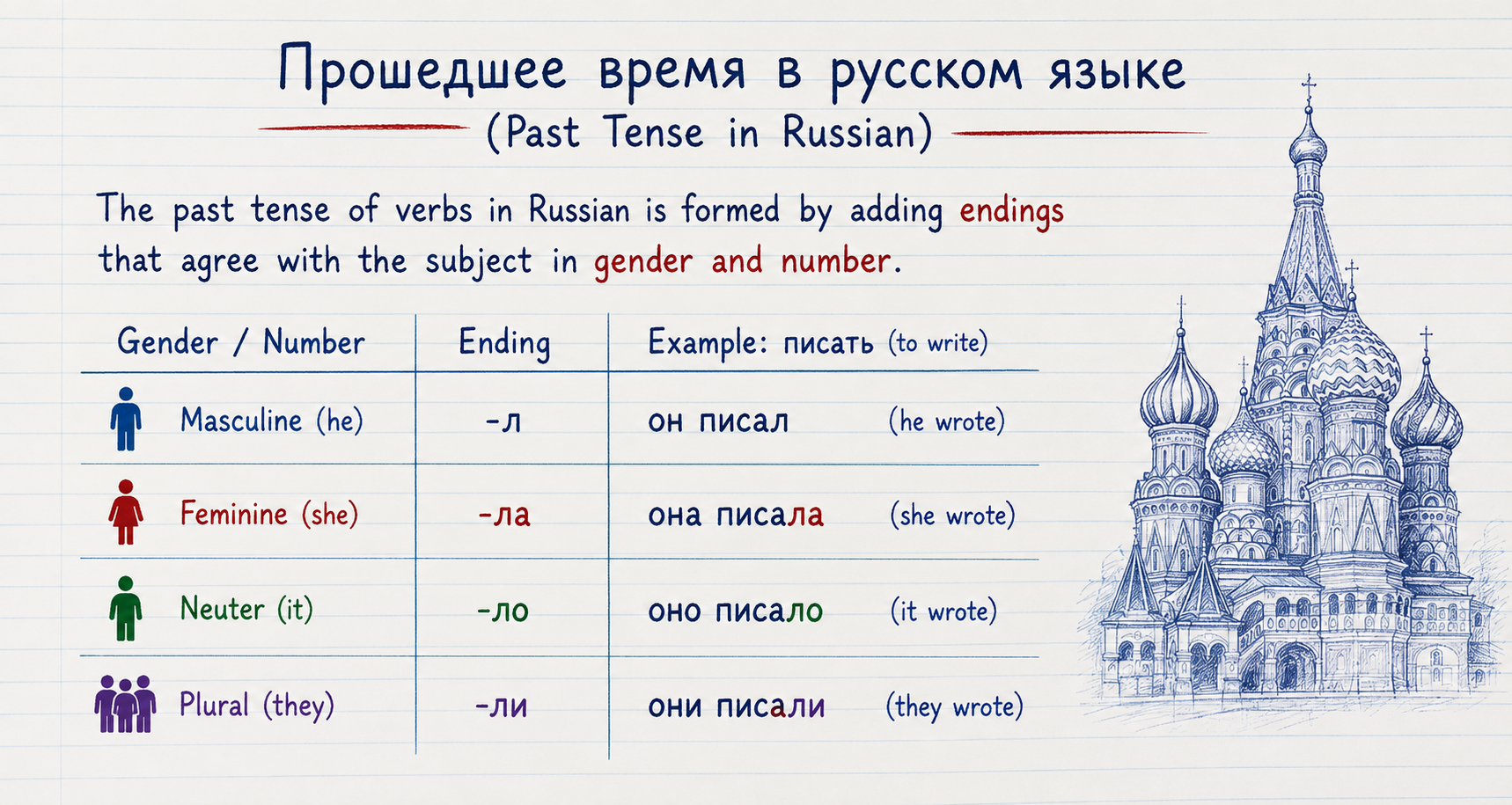
In Russian, the past tense is used when talking about past events or states, as in a sentence such as “I read a book yesterday.”
In English, the form of the past tense generally does not change when the subject changes. Russian works a little differently: the ending of the verb changes according to the gender and number of the subject.
For example, the verb рабо́тать, meaning “to work,” becomes рабо́тал when referring to a male subject and рабо́тала when referring to a female subject.
In the Russian present tense, the form of the verb changes according to the person of the subject. The past tense, however, follows a relatively simple system.
In this article, I will explain how the Russian past tense works, how to form it, how it changes according to gender and number, and how it is used in actual sentences.
The Russian past tense is used to describe actions that were performed in the past, events that occurred in the past, and past states.
The past tense is often used together with expressions referring to the past, such as вчера́ (yesterday), на про́шлой неде́ле (last week), and в про́шлом году́ (last year). However, if it is already clear from the context that an event took place in the past, you can use the past tense without such time expressions.
One of the most important points about the Russian past tense is that its form changes according to the gender and number of the subject rather than its person.
In the present tense, verb endings change according to whether the subject is 1st, 2nd, or 3rd person, as shown below.
In the past tense, however, singular forms change according to whether the subject is masculine, feminine, or neuter. In the plural, the same form is used regardless of gender.
For example, the past tense of рабо́тать (to work) is as follows:
This system applies not only to 3rd-person subjects but also to я (I) and ты (you). For example, a male speaker says я рабо́тал for “I worked,” while a female speaker says я рабо́тала.
In other words, in the Russian present tense, the person of the subject—who is performing the action—is important. In the past tense, what determines the form of the verb is whether the subject is masculine, feminine, neuter, or plural.
The Russian past tense is generally formed from the infinitive of the verb.
With many regular verbs, you remove the infinitive ending -ть and form the past tense using -л-. The form then changes according to the gender and number of the subject.
For example, with рабо́тать (to work):
The forms according to gender and number are as follows:
| Subject | Past Tense | Ending |
|---|---|---|
| Masculine | рабо́тал | -л |
| Feminine | рабо́тала | -ла |
| Neuter | рабо́тало | -ло |
| Plural | рабо́тали | -ли |
The verb чита́ть (to read) follows the same pattern: чита́л / чита́ла / чита́ло / чита́ли
An important point here is that, unlike in the present tense, you do not need to consider person when forming the past tense. If the subject corresponds to a masculine singular form, for example, you use рабо́тал with я (I), ты (you), and он(he).
This is one of the main characteristics of the Russian past tense: the form is determined by the gender and number of the subject rather than by person.
However, there are exceptions. Some verbs undergo major stem changes in the past tense, such as идти́ (to go on foot), which becomes шёл / шла́ / шло́ / шли́. In some verbs, the masculine singular form may also lack -л.
For this reason, I recommend first learning the basic pattern with regular verbs such as рабо́тать → рабо́тал and чита́ть → чита́л, and then learning verbs with special past-tense forms individually.
In the singular past tense, you use different forms depending on whether the subject is masculine, feminine, or neuter. In the plural, however, there is no distinction according to gender, and the same form is used regardless of the gender of the subjects.
For many verbs, the plural past-tense form ends in -ли.
For example, with рабо́тать (to work), the masculine form is рабо́тал, while the feminine form is рабо́тала.
When the subject is plural, however, рабо́тали is used whether the group consists only of men, only of women, or of both men and women.
The same rule applies when a noun is the subject.
In all of these examples, the past-tense form игра́ли is used.
In this way, the Russian past tense distinguishes masculine, feminine, and neuter forms in the singular, while using only one form for all plural subjects.
Many Russian verbs form the past tense according to regular patterns, but some verbs take forms that differ considerably from their infinitives.
For example, the past tense of нести́ (to carry / to take) is as follows:
The masculine form of нести́ is нёс, which does not contain the -л found in regular past-tense forms. The feminine несла́, neuter несло́, and plural несли́, however, do contain -л-.
Another example in which -л does not appear in the masculine singular form is мочь (can / to be able to).
Some verbs also undergo major changes in their stems when forming the past tense. One representative example is идти́(to go on foot).
The past tense of идти́ takes the forms шёл / шла́ / шло́ / шли́, which are difficult to predict from the infinitive alone.
Because the forms of verbs with special past tenses cannot always be predicted from the basic rules, it is helpful to memorize the infinitive together with its past-tense forms.
I recommend first becoming familiar with the regular pattern, such as рабо́тать → рабо́тал / рабо́тала / рабо́тало / рабо́тали, and then gradually learning irregular forms that appear frequently in conversation and written Russian.
The Russian past tense is used to describe past actions, events, and states.
Its main characteristics can be summarized as follows:
Because Russian past-tense forms change according to gender, their formation differs from the English past tense. However, unlike the present tense, the Russian past tense has no person-based conjugation, so the basic system itself is relatively simple.
I recommend first learning the four basic forms -л / -ла / -ло / -ли, and then becoming familiar with them by connecting subjects and verbs in actual sentences.