#39 Akanye and Okanye in Russian
Yuri Miyajima Russian Forest

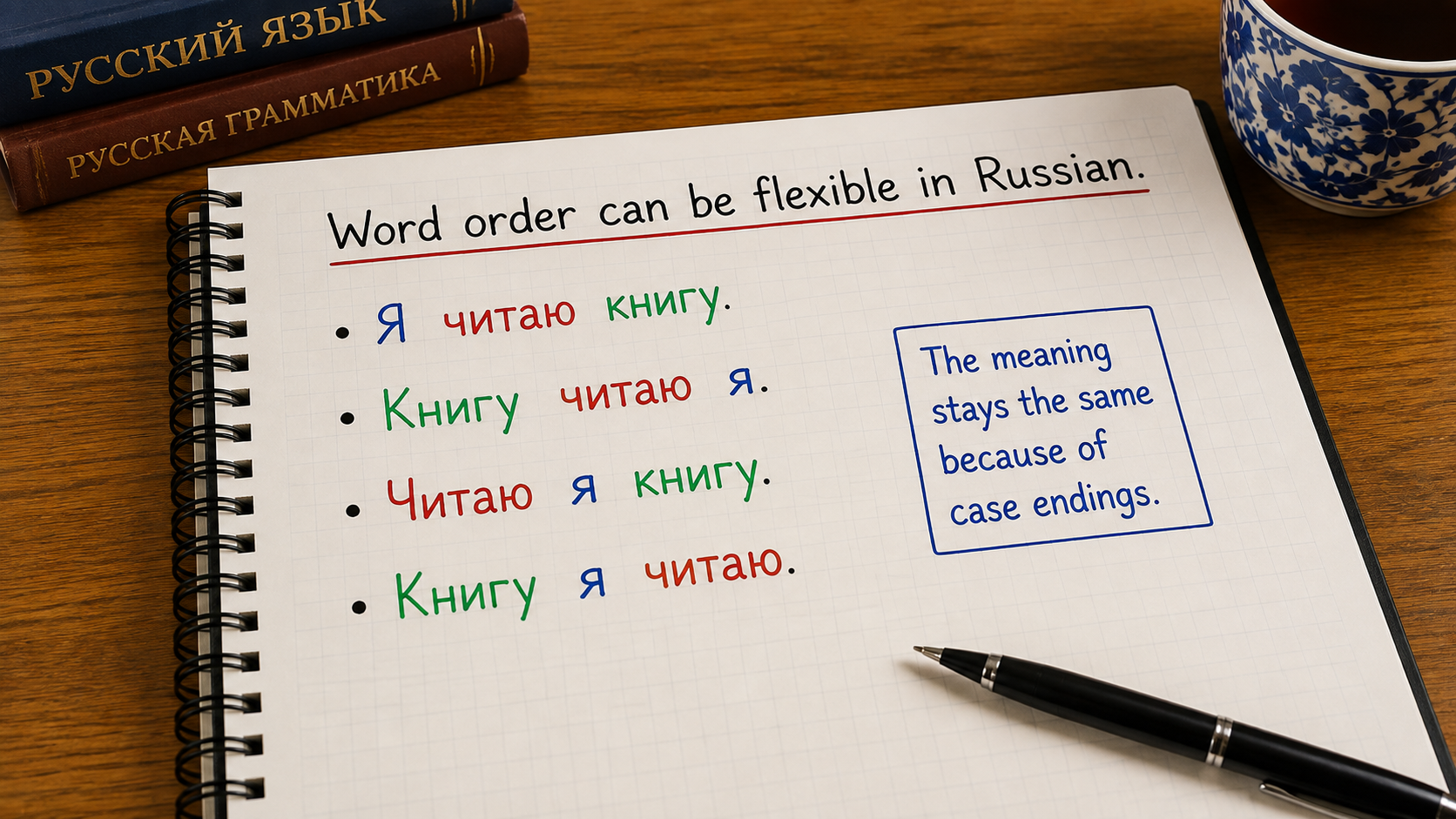
Russian case declension involves many different forms to learn, so you may find it one of the more difficult areas of Russian grammar. However, cases do more than simply change the form of nouns. They also play an essential role in the structure of Russian sentences.
One important aspect of this is their relationship with word order. In English, the subject and object are often distinguished by their position in the sentence. In Russian, by contrast, the case of a noun can indicate the grammatical role that each word plays.
As a result, Russian allows you to change the order of words relatively freely while preserving the basic meaning of the sentence.
In this article, I will explain the relationship between Russian case declension and word order, including the basic word order and the differences in nuance that can arise when the order of words is changed.
A case is a grammatical system in which the form of a noun, pronoun, or other word changes to indicate the grammatical or semantic role it plays in a sentence.
Russian nouns have six cases:
One of the most important points to understand about Russian word order is that case endings can distinguish subjects, objects, and other grammatical roles.
In Russian, the form of a noun changes depending on its role in the sentence. As a general rule, the person or thing performing an action appears in the nominative case, while the direct object of the action appears in the accusative case.
Consider the following sentence:
In this sentence, ма́ма (mother) is in the nominative case, so it is the subject performing the action of seeing. By contrast, сы́на is the accusative form of сын (son), so it is the object of the action.
Even if you change the word order as follows, the basic relationship of who sees whom does not change:
Although сы́на has been moved to the beginning of the sentence, it remains in the accusative case and therefore remains the object. Ма́ма, at the end of the sentence, is still in the nominative case and remains the subject.
In other words, you can determine the role of a word not only by where it appears in the sentence, but also by the case form it takes.
If you want to say “The son sees the mother,” the cases of the two nouns change:
Here, сын is in the nominative case, while ма́му is the accusative form of ма́ма. Although the same nouns are used, changing their case forms changes who performs the action and who receives it.
The relationship between case declension and word order becomes easier to understand when you compare Russian with English.
In English, grammatical roles such as who performs an action and who receives it are indicated mainly by word order.
For example:
In this sentence, the mother, which appears before the verb sees, is the subject, while the son, which appears after the verb, is the object.
If you reverse their positions, the person performing the action and the person receiving it are also reversed:
In Russian, however, even if you change the word order, the basic grammatical relationship remains the same as long as ма́ма remains nominative and сы́на remains the accusative form of сын.
Of course, English still preserves some distinctions between subjects and objects through pronoun forms, such as I → me, he → him, and she → her.
However, ordinary nouns generally do not change in this way. For that reason, word order such as “subject + verb + object” is particularly important in English.
Russian, by contrast, encodes information such as whether a noun is a subject or an object directly in its case form. This makes it possible to change the word order to some extent while preserving the underlying grammatical relationship.
Although Russian word order is relatively flexible, there is still a basic word order.
In general, Russian commonly follows “subject + verb + object” (SVO), just as English does.
Consider the following sentence:
The structure is: Анна (subject) + чита́ет (verb) + кни́гу (object)
This follows the same basic order as the English sentence:
When there is no particular need to emphasize one element and you simply want to state who is doing what, this SVO order is very common.
For this reason, if you are just beginning to learn Russian, I recommend first building sentences around the basic pattern of “subject + verb + object.”
Because Russian cases allow you to identify the grammatical role of each word, you can change the word order according to the information you want to highlight or the context of the conversation.
For example, the following sentence uses the basic “subject + verb + object” order and is relatively neutral:
You can also move the object to the beginning:
In this case, э́ту кни́гу (this book) is placed at the beginning as the topic of the sentence. It can carry a nuance similar to “As for this book…”
For example, if you are discussing several books and want to indicate specifically that this is the book you are reading, this order may be appropriate.
In Russian, information that has already been mentioned or is known to the listener tends to appear earlier in the sentence, while new or important information often appears later.
For example, in response to the question “Who is reading this book?”, you might say:
Here, э́ту кни́гу is already known information, while Анна, placed at the end of the sentence, is the new information being introduced.
Now consider the question “What is Anna reading?”
In this case, Anna is already the topic, and the new information is what she is reading. For that reason, Анна can appear earlier in the sentence, while рома́н (novel), which provides the new information, appears later.
In this way, the focus of a Russian sentence changes depending on the context.
Of course, Russian word order is not governed by a simple rule that given information must always come first and new information must always come last. Intonation, emphasis, style, and other factors can also affect the order of words.
Nevertheless, the general flow from known information to new information is an important principle for understanding natural Russian word order.
Because Russian nouns and other words change form according to case, you can determine their grammatical roles without relying solely on word order.
The main points can be summarized as follows:
Russian case declension can be one of the more challenging aspects of the language. However, it is precisely because Russian has this system of case endings that speakers can rearrange words while adjusting the focus and nuance of a sentence.
Once you understand that cases indicate the grammatical role of words, while word order helps control how information is presented, the structure of Russian sentences becomes much easier to see.