#25 Basic Russian Expressions for Apologizing
Yuri Miyajima Russian Forest

When you want to describe a present action or state in Russian, such as “I speak Russian” or “He works in Moscow,” you use the present tense.
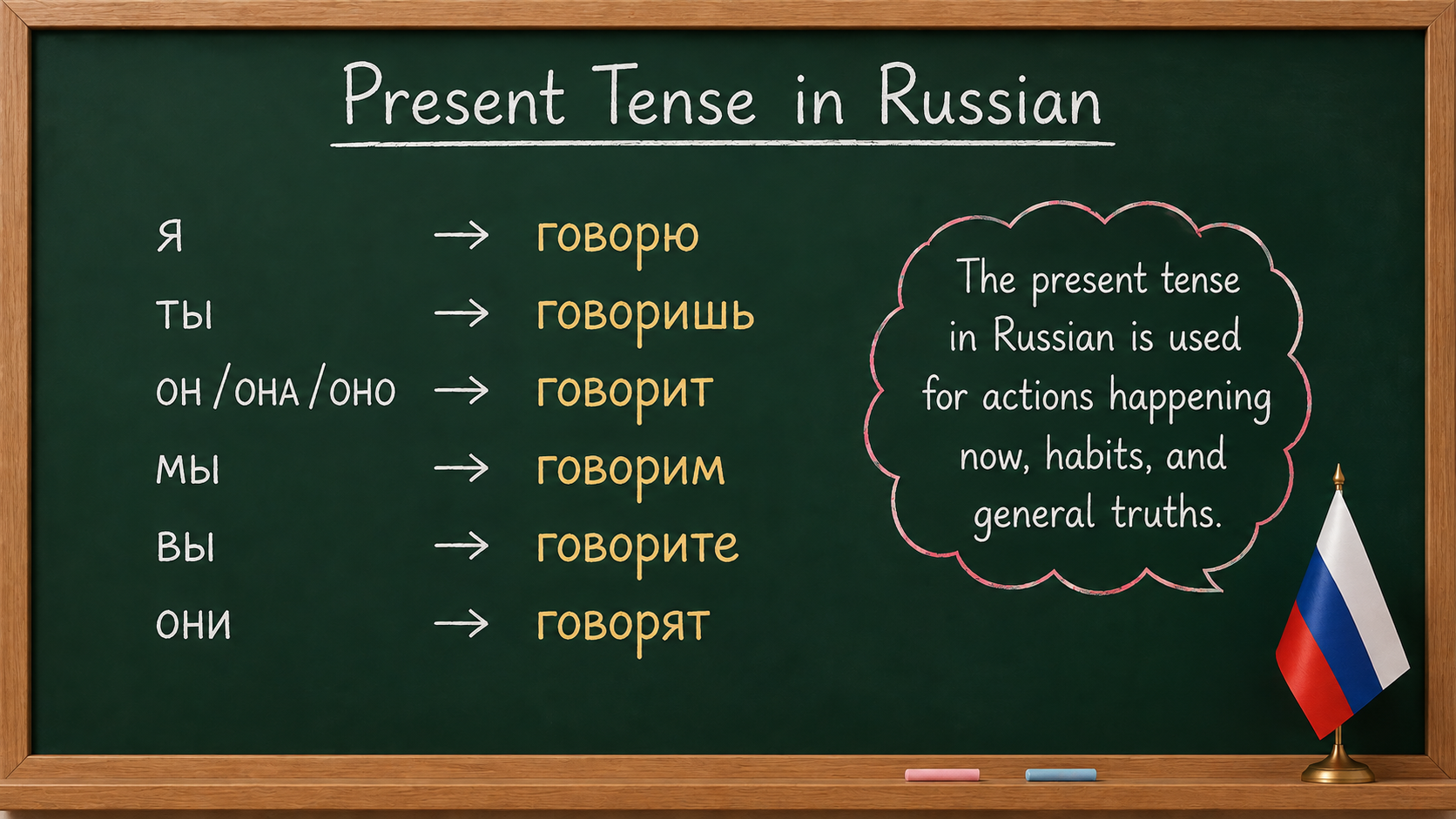
In English, you form the present tense with forms such as I work and He works. In Russian, however, the ending of the verb changes significantly depending on the subject. For example, the verb говори́ть meaning “to speak” becomes я говорю́ for “I speak” and он говори́т for “he speaks.”
At first, this may seem like a lot to memorize, but Russian present-tense verbs follow certain conjugation patterns. Once you understand how these patterns work, it becomes easier to predict how unfamiliar verbs will be conjugated.
In this article, I will explain how the Russian present tense works, including verb conjugation, the 1st and 2nd conjugations, and the situations in which the present tense is used.
The Russian present tense is used to describe actions taking place now, present states, habitual actions, and similar situations.
English distinguishes between the simple present and the present progressive, as in I read a book and I am reading a book. Russian, on the other hand, does not have a grammatical form that directly corresponds to the English present progressive.
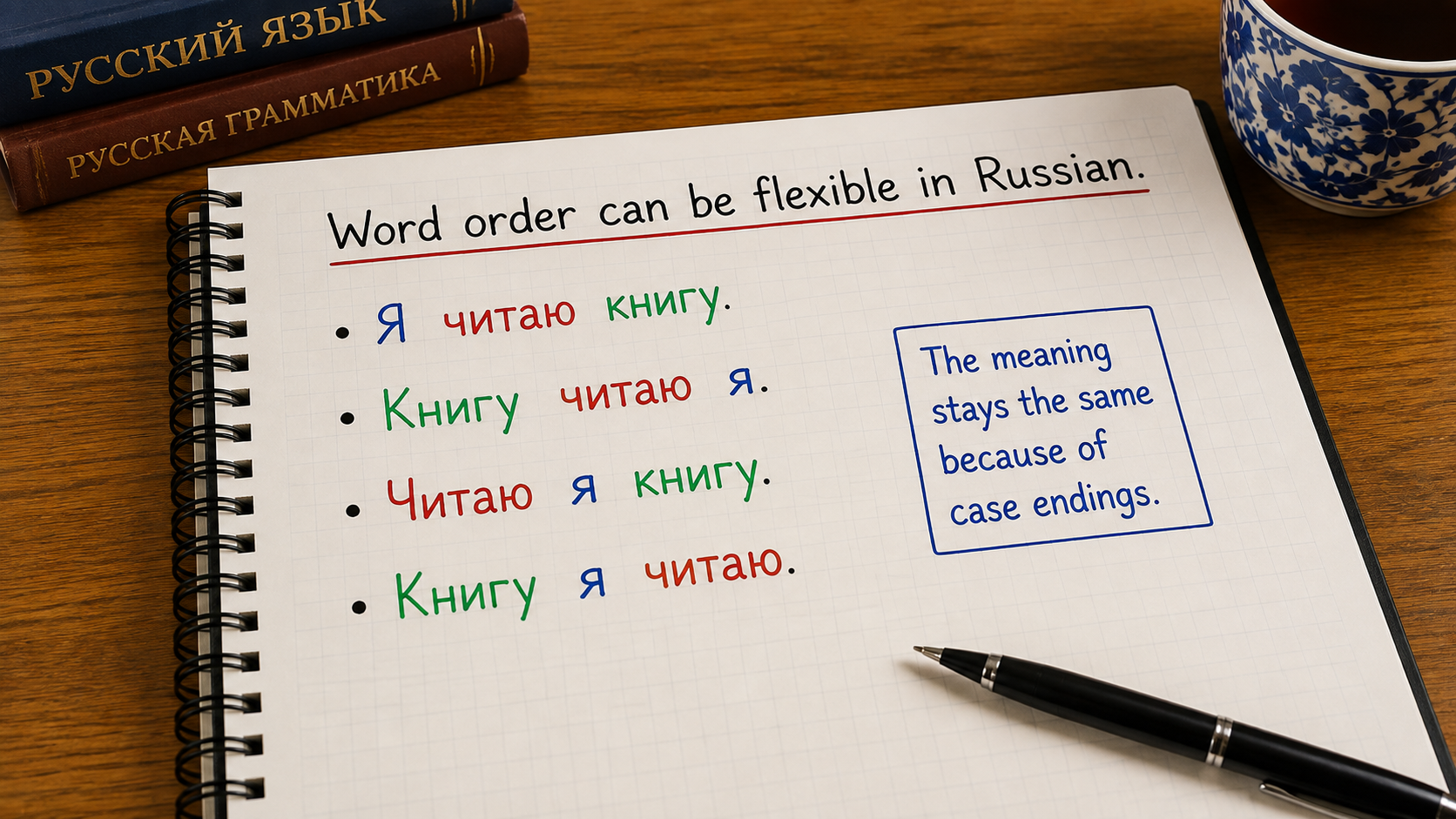
For this reason, Я чита́ю кни́гу. can mean either “I read a book” or “I am reading a book,” depending on the context.
Another important feature of Russian is that verbs are conjugated according to the person and number of the subject. In English, present-tense verbs mainly change in the 3rd person singular. In Russian, however, different endings are used for “I,” “you,” “he/she,” “we,” “you,” and “they.”
For example, чита́ть meaning “to read” changes as follows:
As you can see, even though the infinitive is the same verb, чита́ть, its form changes according to the subject, producing forms such as чита́ю, чита́ешь, and чита́ет.
However, not all Russian verbs have a true present tense expressing a present action. Russian verbs are divided into imperfective and perfective aspects, and in principle, only imperfective verbs have a present tense that refers to present actions. When a perfective verb is conjugated with the same type of personal endings, it expresses the future rather than the present.
To understand the Russian present tense, therefore, it is important to learn not only what the present tense means but also how verbs change according to the subject and how verbal aspect works. First, make sure you understand the basic principle that verb endings change according to person and number.
In the Russian present tense, verb endings change according to the person and number of the subject. These personal changes follow regular patterns and are divided into two main groups: the 1st conjugation and the 2nd conjugation.
The main difference between the 1st and 2nd conjugations is the set of personal endings used in the present tense.
For example, the 1st-conjugation verb чита́ть meaning “to read” is conjugated as follows:
| Person | Present Tense | Meaning |
|---|---|---|
| я | чита́ю | I read |
| ты | чита́ешь | you read |
| он / она́ | чита́ет | he / she reads |
| мы | чита́ем | we read |
| вы | чита́ете | you read |
| они́ | чита́ют | they read |
By contrast, the 2nd-conjugation verb говори́ть meaning “to speak” uses somewhat different endings:
| Person | Present Tense | Meaning |
|---|---|---|
| я | говорю́ | I speak |
| ты | говори́шь | you speak |
| он / она́ | говори́т | he / she speaks |
| мы | говори́м | we speak |
| вы | говори́те | you speak |
| они́ | говоря́т | they speak |
If you compare the 2nd person singular and 3rd person singular forms, for example, the 1st conjugation uses -ешь / -ет, while the 2nd conjugation uses -ишь / -ит. This means that when you encounter forms such as чита́ешь or говори́шь, the ending can help you identify which conjugation pattern the verb follows.
The 1st and 2nd conjugations are not classifications used only for forming the present tense. Russian perfective verbs use the same system of personal endings when they express the future. Understanding these two conjugation patterns will therefore also help you when you later study the future tense.
However, you cannot always determine whether a verb belongs to the 1st or 2nd conjugation simply from the ending of its infinitive. Many verbs ending in -и́ть belong to the 2nd conjugation, but there are exceptions. Conversely, some verbs that do not end in -и́ть are still 2nd-conjugation verbs.
Some verbs also undergo consonant changes in the stem when conjugated, while others follow irregular patterns.
You do not need to memorize every rule and exception at the beginning. First, understand that the personal endings differ between the 1st and 2nd conjugations. Then, as you learn the conjugation of common verbs, you can gradually become familiar with the patterns.
When you want to determine whether a Russian verb belongs to the 1st or 2nd conjugation, the ending of the infinitive is generally a useful clue.
First, many verbs ending in -и́ть belong to the 2nd conjugation. The following are typical examples:
By contrast, many verbs ending in -ать, -ять, -еть, -оть, -уть, and other endings apart from -ить, belong to the 1st conjugation.
As a general guideline, it is therefore helpful to think of verbs ending in -ить as 2nd-conjugation verbs and most other verbs as 1st-conjugation verbs.
However, there are several important exceptions to this guideline.
For example, the following verbs end in -ить but belong to the 1st conjugation:
Conversely, a number of verbs that do not end in -ить belong to the 2nd conjugation:
There are also verbs with special conjugation patterns, such as хоте́ть meaning “to want” and бежа́ть meaning “to run.”
In this way, looking at the infinitive can often help you determine whether a Russian verb belongs to the 1st or 2nd conjugation, but it does not work for every verb.
As a starting point, I recommend remembering the general rule “-ить → usually 2nd conjugation; other endings → usually 1st conjugation” and then learning the most important exceptions little by little.
The Russian present tense is used to describe actions that are repeated regularly or form part of a habit.
In sentences like these, expressions of frequency and habit such as ка́ждый день (every day), обы́чно (usually), ча́сто(often), иногда́ (sometimes), and всегда́ (always) may also be used.
The present tense can also describe generally true facts, characteristics, and natural phenomena rather than only individual habits.
In other words, the Russian present tense is used not only for actions taking place “right now” but also for habitual actions and general facts.
In this respect, Russian is similar to English. English also uses the simple present for habits and general facts, as in I read every day and The Earth revolves around the Sun.
The Russian present tense also has an important feature that differs from English: it can be used for actions that are happening right now.
In English, you distinguish between I read every day for a habit and I am reading now for an action currently in progress, using the simple present in the first case and the present progressive in the second.
Russian, however, has no construction that directly corresponds to the English present progressive. In general, an action in progress is expressed with the present tense of an imperfective verb.
The forms чита́ю and гото́вит used here are the same present-tense forms that can also describe habitual actions. Russian does not change the verb into a separate form equivalent to English “be + -ing.” Instead, context determines whether the action is habitual or currently in progress.
For example, Я чита́ю кни́гу. can mean either “I read a book” or “I am reading a book,” depending on the situation.
If you want to make it clear that the action is happening at the present moment, you can add a time expression such as сейча́с meaning “now.” If the sentence is an answer to a question such as “What are you doing now?”, the context alone may be enough to show that the action is currently in progress.
In other words, English distinguishes the simple present and present progressive as separate grammatical forms, whereas Russian can express both meanings with the same present-tense form, relying on context and additional words to clarify the intended meaning.
The Russian present tense has another distinctive feature that differs from English: the way the verb быть meaning “to be” is treated.
In English, you use the verb be to connect a subject with a noun or adjective, as in I am a student and She is a doctor.
In Russian, however, when you describe a person’s or thing’s identity, status, or characteristic in the present tense, быть, the equivalent of the English verb be, is normally not expressed.
In a sentence such as Я студе́нт., there is no verb corresponding to “am” between я and студе́нт, but the sentence is still complete and naturally expresses a present state.
The same principle applies when the predicate is an adjective. You do not place a verb equivalent to English is between the subject and the adjective.
However, this omission of быть is characteristic of the present tense. In the past and future tenses, forms of быть normally appear in the sentence.
Even in the present tense, есть can appear in certain constructions expressing existence. One of the most common examples is the construction meaning “there is” or “to have.”
In this way, быть meaning “to be” is normally omitted when expressing an “A is B” relationship in the present tense, while forms of быть appear in the past and future and in certain constructions expressing existence or possession.
An important point in understanding the Russian present tense is its relationship with verbal aspect.
Russian verbs are broadly divided into two aspects: imperfective and perfective.
Imperfective verbs can describe actions as ongoing, continuing, or repeated, so they can also be used for actions currently in progress.
For example, чита́ть in Я чита́ю кни́гу. (I am reading a book) is imperfective. Here, it describes the action of reading as something currently taking place.
Perfective verbs, on the other hand, focus on the completion or result of an action, or on the action as a complete event.
For example, one perfective counterpart of чита́ть meaning “to read” is прочита́ть, meaning “to read through” or “to finish reading.”
When прочита́ть is conjugated, it takes the following forms:
In form, these use the same type of personal endings as the present tense of imperfective verbs. In meaning, however, they refer to the future rather than the present.
For example, Я прочита́ю э́ту кни́гу. means “I will read this book” or “I will finish reading this book.” It does not mean that you are reading the book at this moment. Instead, it refers to a future action that will be carried through to completion.
This is because the perfective aspect presents an action as a complete whole. Since an action currently in progress has not yet reached completion, perfective verbs do not normally describe such ongoing present actions.
Therefore, when you want to describe an action currently in progress in Russian, you use an imperfective verb, as in:
By contrast, when you want to describe a future action that will be completed, you use a perfective verb:
In this sense, perfective verbs do not have a true present tense. Their forms with present-type personal endings express the future instead.
The future tense of an imperfective verb is formed with “the future tense of быть + the infinitive” and is generally called the compound future. A perfective verb, by contrast, is conjugated with the same type of personal endings as the present tense and expresses the future by itself. This is called the simple future.
The Russian present tense is used to describe habits, states, general facts, and actions currently in progress.
Its main features can be summarized as follows:
The present tense is one of the most important grammatical systems to learn when you begin studying Russian.
The different personal endings may seem complicated at first, but once you understand the basic patterns of the 1st and 2nd conjugations, you will be able to apply them to many different verbs. If you also understand how the present tense relates to verbal aspect, you will have a strong foundation for learning the Russian past and future tenses as well.