#26 Russian Patronymics
Yuri Miyajima Russian Forest
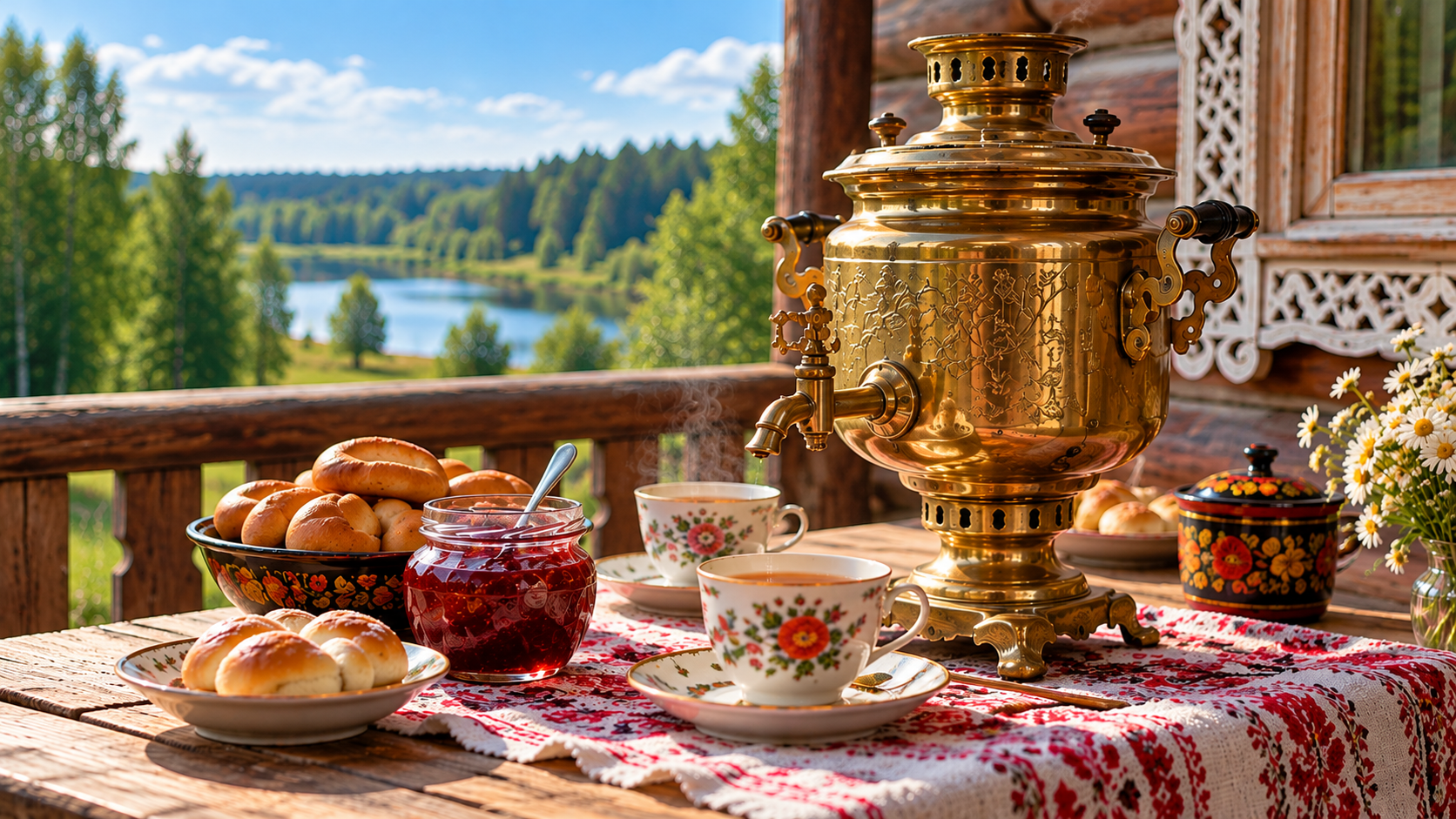
Tea is deeply rooted in everyday life in Russia. It has long been enjoyed on various occasions, including family gatherings, conversations with friends, and visits from guests.
One of the most recognizable symbols of Russian tea culture is the samovar (самова́р).
A samovar is a traditional water boiler used primarily to heat water for making tea. In the past, samovars were used in many households and were often placed at the center of the dining table. The image of family members and guests gathering around a samovar to drink tea has become a familiar representation of traditional Russian life.
How does a samovar heat water, and why did it become such an important part of Russian tea culture?
In this article, I will explore the history and structure of the samovar, traditional Russian tea-drinking customs, and the role of the samovar in everyday Russian life.
A samovar (самова́р) is a traditional water boiler that has been widely used in Russia.
A typical samovar is made of metal, with a main body that serves as a water container and a tap near the bottom for dispensing hot water. Samovars come in various shapes, including cylindrical and urn-shaped designs, and generally have a lid at the top.
Materials such as brass and copper have traditionally been used, and some samovars feature decorative designs on their surfaces. They also vary in size, ranging from small household models to large ones capable of providing hot water for many people.
In a traditional fuel-burning samovar, a combustion tube runs through the center of the body. Charcoal or other fuel is burned inside this tube to heat the surrounding water.
This structure allows a relatively large quantity of water to be heated at once and dispensed through the tap whenever needed. Some samovars also have a place on top for a teapot, allowing the tea to remain warm. This makes them particularly suitable for the Russian custom of enjoying tea over an extended period.
The name самова́р is associated with the Russian words сам (self) and вари́ть (to boil, to cook). The word therefore conveys the idea of something that “boils by itself” or “heats water by itself.”
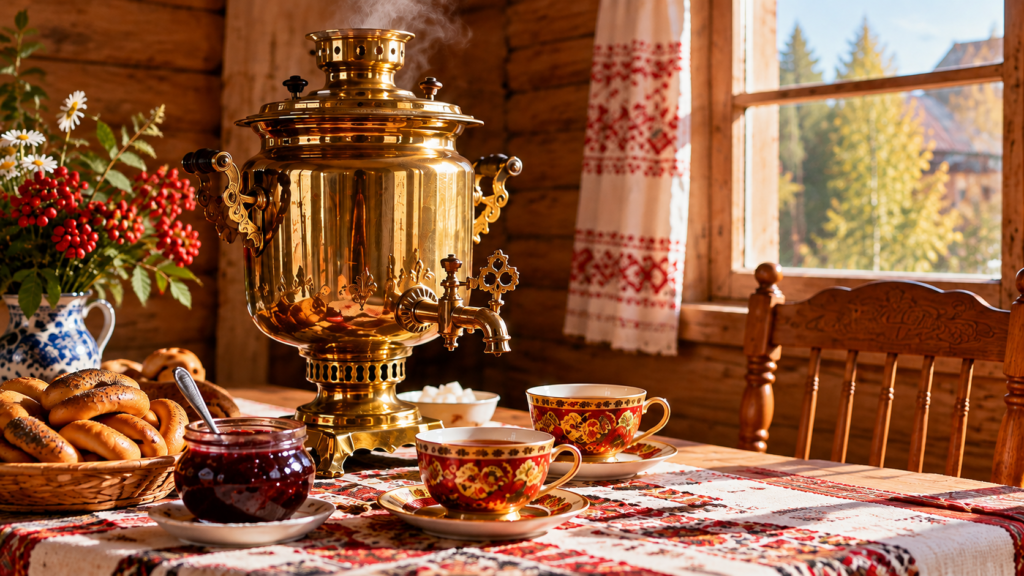
Tea was introduced to Russia and began to be consumed at the imperial court and in other privileged circles around the seventeenth century.
At that time, tea reached Russia from China and was initially enjoyed mainly by wealthy people, including members of the court and the aristocracy.
As trade between Russia and China developed and tea imports increased, the custom of drinking tea gradually spread, particularly in urban areas.
The samovar became increasingly popular alongside the development of this tea culture.
There are several theories concerning the origins of the samovar, but production is believed to have begun in regions such as the Urals during the eighteenth century. The Urals were an important center of metalworking at the time, and these skills were also applied to the manufacture of samovars.
Samovar production subsequently spread to other parts of Russia. One of the most famous centers of production was Tula (Ту́ла), a city in central Russia.
Tula had long been known for weapons manufacturing and metalworking. In 1778, the brothers Ivan and Nazar Lisitsyn are said to have established a workshop there to manufacture samovars.
Their workshop is recognized as one of the notable early examples of samovar production in Tula.
During the nineteenth century, the samovar industry in Tula developed further, producing a wide variety of designs and sizes.
Initially, samovars were used mainly in wealthy households. However, as production increased and tea became more widely available, samovars gradually became popular among a broader range of social classes.
They also came to be used in inns, eating establishments, and other places outside the home.
In this way, the samovar became widespread in nineteenth-century Russia and established itself as one of the most recognizable symbols of Russian tea culture.
The defining feature of a traditional fuel-burning samovar is the combustion tube located in the center of its body.
The main body of the samovar serves as a water container, with a metal tube running vertically through its center. Fuel is burned inside this tube, and the resulting heat warms the surrounding water.
To use a traditional samovar, the first step is to fill its main body with water.
Next, fuel such as charcoal or small pieces of wood is placed inside the central tube and ignited. Air needed for combustion enters from below, while the hot gases produced by the burning fuel rise through the central tube.
As the fuel burns, the metal walls of the tube become hot, transferring heat to the surrounding water. The water inside the samovar gradually heats up until it reaches boiling point.
Once the water has boiled, the tap near the bottom of the samovar can be opened to pour hot water into a cup or another container.
Some samovars also have a space on top where a teapot can be placed.
In Russia, there is a traditional custom of preparing strong tea in a teapot and diluting it with hot water from the samovar. By placing the teapot on top of the samovar, the heat rising from the water boiler can help keep the tea warm.
This arrangement is particularly well suited to the custom of family members and guests spending long periods enjoying tea together.
Today, electric samovars are also available.
In Russian, an electric samovar is called электри́ческий самова́р.
An electric samovar uses an internal electric heating element to heat water, allowing it to operate without charcoal or other combustible fuel. Compared with traditional fuel-burning models, electric samovars are easier to use and are better suited to many aspects of modern daily life.
Russian has a word specifically associated with the custom of drinking tea: чаепи́тие.
This word is related to чай (tea) and пить (to drink), and refers to the act of drinking tea or the time spent enjoying it.
Traditional Russian чаепи́тие was more than simply an opportunity to quench one’s thirst. It was also a social occasion when people gathered to enjoy conversation.
When families gathered around the table or invited friends and relatives to visit, tea was often accompanied by sweets, jam, honey, and other treats.
One distinctive feature of Russian tea culture is the custom of drinking tea with sugar or jam. Some people enjoy eating small spoonfuls of jam while drinking tea, while others add jam directly to their tea.
In the past, the samovar often occupied a central place during these tea gatherings.
In the traditional Russian method of preparing tea, a strong tea concentrate is brewed in a teapot and then diluted with hot water from the samovar. This concentrated tea is called зава́рка in Russian.
First, a small amount of зава́рка is poured into a cup. Hot water from the samovar is then added to dilute it. This allows each person to adjust the strength of the tea according to personal preference.
With a large samovar, family members and guests can refill their cups with hot water as often as they wish, enjoying tea at their preferred strength.
Serving tea to guests is also closely connected with traditional Russian hospitality. Offering tea to visitors and gathering around the table to talk about recent events, family matters, and everyday life have long provided important opportunities to strengthen personal relationships.
Tea time has therefore been valued not only as a short break but also as an opportunity to relax, enjoy conversation, and spend time together.
In this way, the samovar served not merely as a device for heating water but also as an important part of family gatherings and the tradition of welcoming guests.
The samovar is a traditional water boiler that has played an important role in Russian tea culture.
Samovars began to be manufactured in Russia during the eighteenth century, and by the nineteenth century, they were being used in a variety of settings, including private homes, inns, and eating establishments.
The main points discussed in this article can be summarized as follows:
The samovar is closely connected with these traditions and remains an important symbol for understanding Russian history, everyday life, and traditional customs of hospitality.