#49 Animate and Inanimate Nouns in Russian
Yuri Miyajima Russian Forest

In Russian, a variety of related words can be formed from a single word.
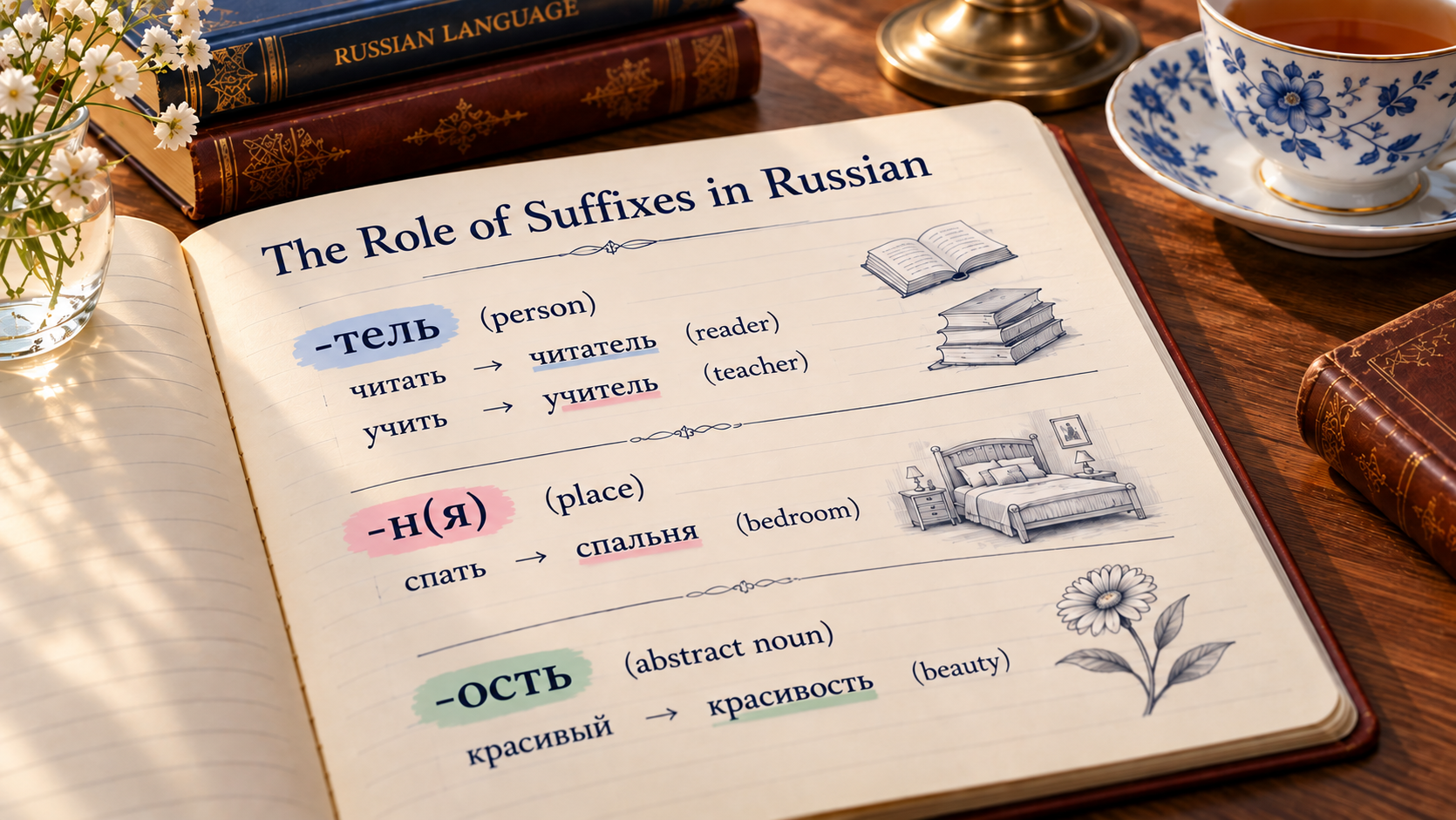
For example, чита́ть (to read) and чита́тель (reader), as well as учи́ть (to teach) and учи́тель (teacher), share similarities in both meaning and form.
One of the elements involved in forming such words is the “suffix.” In Russian, a suffix is called су́ффикс. It is added toward the end of a word and can be used to form new words or change their meaning or part of speech.
Russian has a wide variety of suffixes. They are used to form many types of words, including nouns referring to people and professions, adjectives expressing qualities, and verbs describing actions. Some suffixes also add nuances such as smallness or affection and are closely connected with everyday speech and affectionate forms of personal names.
Understanding how suffixes work makes it easier to learn related words together. They can also provide clues to the meaning of unfamiliar words.
In this article, I will explain the roles that suffixes play in Russian words by introducing common suffixes and specific examples.
In Russian, new words with related meanings can be formed by adding particular elements toward the end of existing words. One of the elements used for this purpose is the suffix.
For example, the noun чита́тель (reader) is formed from the verb чита́ть (to read) with the suffix -тель.
Similarly, suffixes can be used to form nouns referring to people associated with the actions expressed by verbs.
Suffixes can also be used to form nouns expressing abstract concepts from words describing qualities, or to form adjectives meaning “related to a particular country” from country names.
In this way, Russian suffixes play an important role in forming words with new meanings or parts of speech while maintaining a semantic connection with the original word.
Some Russian suffixes are used to form nouns meaning “a person who performs a particular action” from words associated with actions or activities.
One common suffix used to form such nouns is -тель.
As these examples show, -тель is frequently used in nouns referring to people associated with the actions expressed by verbs.
Other suffixes used in nouns referring to people include -ник and -ист.
These suffixes are used not only for people associated with particular actions but also in nouns related to professions, activities, areas of specialization, and affiliation.
For this reason, when you encounter endings such as -тель, -ник, or -ист, recognizing that the word may refer to a person can provide a useful clue when trying to understand unfamiliar vocabulary.
In Russian, suffixes can be added to nouns referring to professions, roles, activities, and other categories of people to form words specifically referring to women.
For example, учи́тель (teacher) has the feminine form учи́тельница (female teacher).
Some nouns referring to people that end in -ник have feminine forms containing -ниц-.
The suffix -к(а) is also frequently found in feminine forms.
As these examples show, many Russian nouns referring to people have masculine and feminine forms, with suffixes frequently used to distinguish between them.
Some words referring to people, however, use entirely different words for men and women rather than forming the feminine form from the masculine form with a suffix.
For this reason, rather than applying a single suffix to every noun, it is useful to learn common masculine and feminine pairs individually, such as студе́нт → студе́нтка and учи́тель → учи́тельница.
In Russian, suffixes can be used to form nouns referring to places where particular actions take place or places associated with particular activities.
For example, спа́льня (bedroom) is related to the verb спа́ть (to sleep).
Forms containing -льн(я) can similarly be found in nouns referring to places associated with particular actions.
Чита́льня refers to a place for reading, while кури́льня refers to a place for smoking.
Some nouns referring to places or facilities also contain -лищ(е).
Храни́лище refers to a place where things are stored, while учи́лище refers to an educational institution. These are examples of nouns referring to places or facilities that are related to words expressing particular actions.
Various suffixes are used to form Russian nouns referring to places. Learning these suffixes together with representative words can provide clues when you encounter the name of an unfamiliar place or facility.
Russian also uses suffixes to form “abstract nouns,” which express qualities, states, actions, or processes as concepts.
One common suffix is -ость. It is primarily used to form nouns expressing a quality or state from adjectives and related words.
In these examples, the qualities expressed by the adjectives become nouns denoting a particular quality, state, or concept through forms containing -ость.
Russian can also form nouns referring to actions, processes, or their results by adding particular suffixes to verbs. Common examples include -ение and -ание.
These nouns may refer to the original action itself, its process or result, or a more specific meaning that has developed from it.
For example, образова́ние can mean either “formation” or “education,” depending on the context. Similarly, собра́ние is related to the idea of gathering but is widely used in Russian to mean a “gathering” or “meeting.”
In Russian, suffixes such as -ова- and -ева- can be used to form verbs from nouns, adjectives, and other words.
For example, adding -ова- to сове́т (advice) produces the verb сове́товать (to advise).
The suffixes -ова- and -ева- can similarly be seen in verbs such as the following:
Suffixes such as -ива- and -ыва- are also frequently involved in forming new imperfective verbs from perfective verbs.
Russian distinguishes between the perfective aspect, which presents an action as a complete event, and the imperfective aspect, which can focus on features such as the progress, duration, or repetition of an action. Suffixes are therefore also involved in the formation of aspectual pairs.
In Russian, suffixes can be used to express the small size of an object or feelings of familiarity and affection toward a person or object. Such forms are generally known as “diminutives.”
For example, adding -ик to дом (house) produces до́мик.
Other examples include:
Russian diminutives do not always indicate physical size alone. They may also become established as common everyday words or be used to express familiarity or affection.
For example, до́мик can mean “a small house,” but depending on the context, it may also express an affectionate attitude toward the house.
Russian also has affectionate forms of personal names used when addressing people with whom the speaker has a close relationship. In addition to shortening the original name, suffixes are frequently used to create affectionate forms.
For example, Алекса́ндр has the short form Са́ша, while Мари́я has the short form Ма́ша. Suffixes can then be added to these forms to express greater familiarity or affection.
Suffixes can similarly express affection or familiarity in common nouns.
Russian therefore has a variety of suffixes associated with diminutive or affectionate meanings, including -ик, -к-, -очк-, -ечк-, and -еньк-.
The suffix used depends on the form of the original word and established patterns of usage.
Russian suffixes are elements added toward the end of words to form new words or meanings, and they occur in a wide variety of forms.
The main points discussed in this article can be summarized as follows:
Understanding the functions of suffixes makes it possible to move beyond learning each word separately and begin recognizing relationships among different items of vocabulary.
Suffixes are connected not only with the meanings of words but also with parts of speech, gender distinctions in nouns referring to people, abstract concepts, and emotional nuances. By understanding suffixes together with prefixes, you can develop a more systematic understanding of how Russian words are formed.