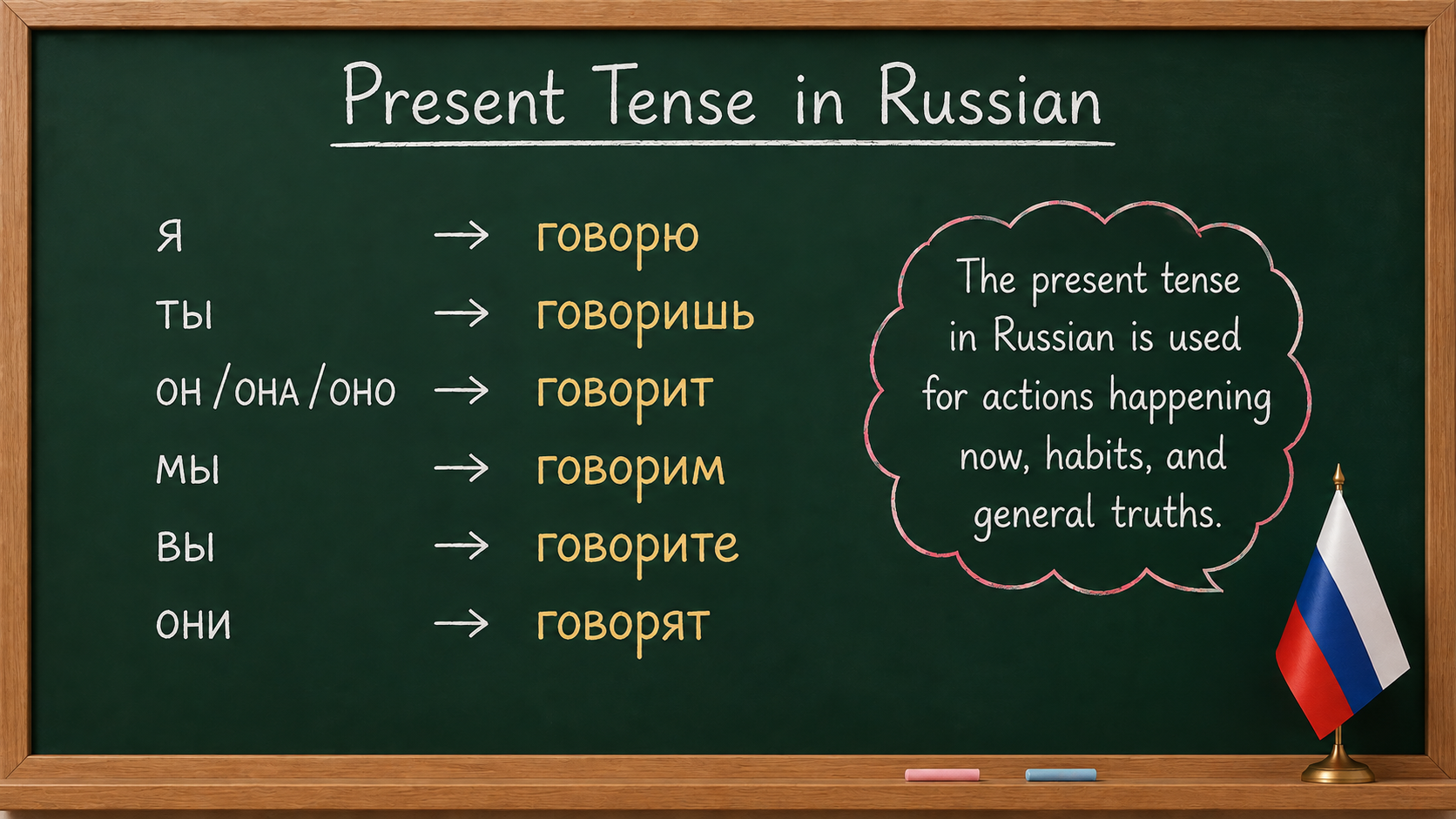
#53 How the Russian Present Tense Works
Yuri Miyajima Russian Forest

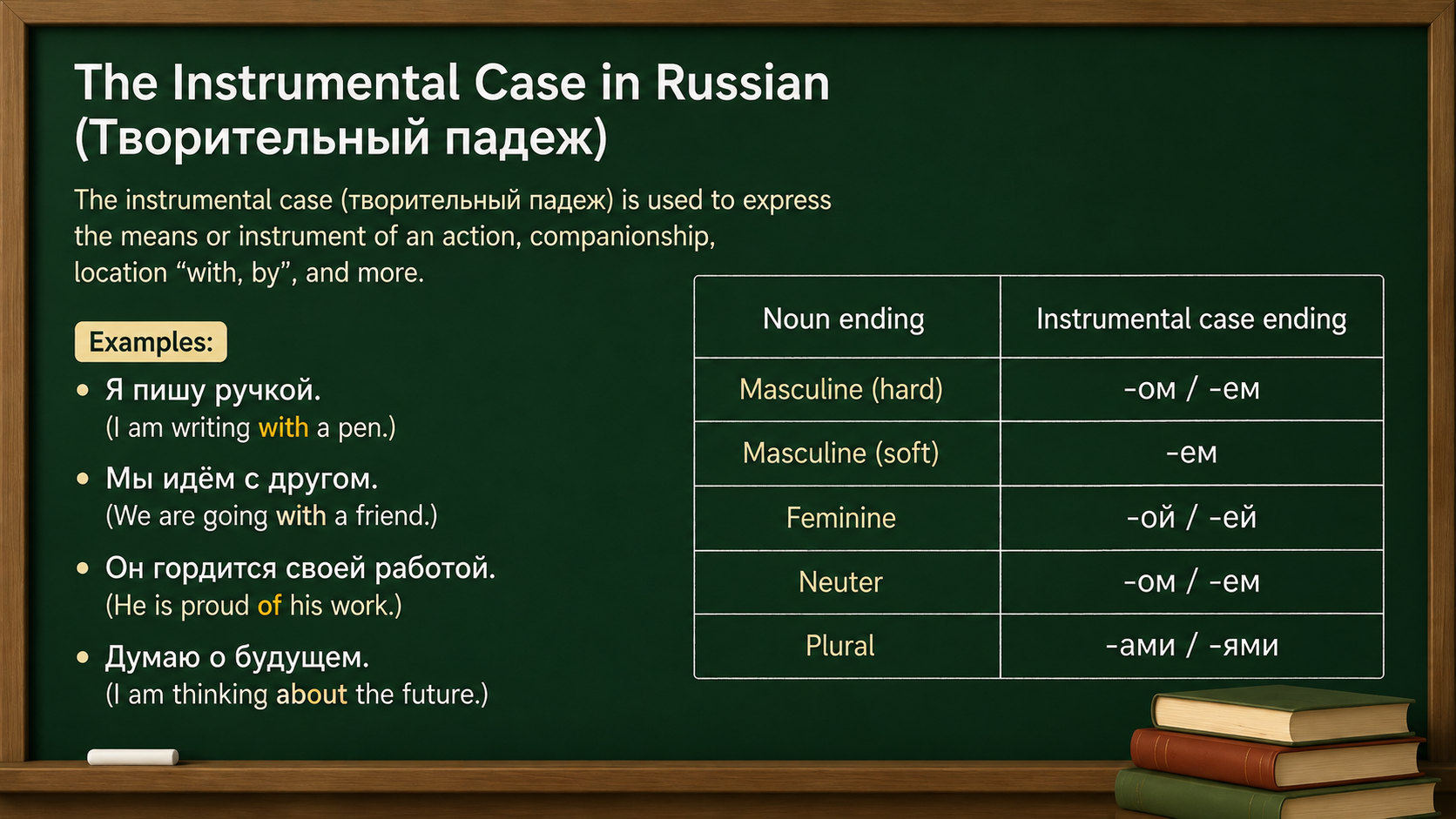
When you want to say expressions such as “talk with a friend,” “write with a pen,” or “work as a doctor” in Russian, the form of the noun changes. For example, “with a friend” becomes с дру́гом, “with a pen” becomes ру́чкой, and “to work as a doctor” is expressed as рабо́тать врачо́м.
The case used in these expressions is the instrumental case, one of the six cases in Russian.
The instrumental case has a variety of functions. In addition to expressing instruments and means, it can indicate professions, positions, and roles. It is also used after certain verbs and prepositions.
In this article, I will explain what the instrumental case is, from its basic noun endings to its main uses, with example sentences.
As its English name suggests, one of the main functions of the instrumental case is to indicate the “instrument” or “means” used to perform an action.
In the following sentence, ру́чка (pen) changes to the instrumental form ру́чкой.
Here, the instrumental case indicates the means by which the action is performed—in other words, what is used for writing.
In addition to instruments and means, the instrumental case is used after certain verbs and prepositions, in expressions of time, and to indicate the person or thing performing an action in passive constructions.
In the following sentence, друг (friend) changes to the instrumental form дру́гом. When combined with the preposition с, it means “with a friend.”
The instrumental case is also used to indicate a profession or role, as in “as a doctor.”
As you can see, the instrumental case has several different functions. For this reason, I recommend learning its major uses separately, such as “instruments and means,” “people you do something with,” and “professions and roles.”
In the instrumental case, masculine and neuter nouns generally take endings such as -ом / -ем, feminine nouns take -ой / -ей / -ью, and plural nouns take -ами / -ями.
I will first explain the basic patterns for masculine, feminine, neuter, and plural nouns.
Masculine nouns ending in a consonant generally take -ом.
Masculine nouns ending in -й or -ь may take -ем.
However, the actual ending can vary depending on factors such as the final letter and stress, so you need to check the appropriate form for individual nouns.
Feminine nouns ending in -а generally change to -ой.
Feminine nouns ending in -я generally take -ей.
Feminine nouns ending in -ь take -ью.
As you can see, with feminine nouns, you can generally determine the instrumental form by checking whether the noun ends in -а, -я, or -ь.
Neuter nouns ending in -о generally change to -ом.
Neuter nouns ending in -е, on the other hand, generally take -ем.
Thus, the basic pattern for neuter nouns is -о → -ом and -е → -ем.
In the plural instrumental case, -ами or -ями is generally used.
While instrumental endings differ considerably among masculine, feminine, and neuter nouns in the singular, plural forms are relatively straightforward, with -ами / -ями as the main endings.
However, some Russian nouns have irregular declensions. Rather than trying to memorize every exception from the beginning, I recommend starting with basic patterns such as стол → столо́м, ма́ма → ма́мой, and мо́ре → мо́рем.
One of the most common uses of the instrumental case is to indicate the instrument or means used to perform an action.
In the following sentences, каранда́ш (pencil) and нож (knife) change to their instrumental forms карандашо́м and ножо́м.
When you want to express what is used to perform an action, Russian generally places the noun representing the instrument in the instrumental case.
In English, you use the preposition with in expressions such as “write with a pencil” and “cut with a knife.” In Russian, the same relationship can be expressed simply by changing the noun itself to the instrumental case.
The instrumental case can also be used to express a means of transportation.
By placing авто́бус (bus) or по́езд (train) in the instrumental case, you can indicate the means of transportation.
However, while the instrumental case can indicate the means of transportation itself, modern Russian also commonly uses “на + prepositional case,” as in на авто́бусе (by bus) and на по́езде (by train).
The instrumental case is also used to indicate a person’s profession, position, or role.
For example, when you use the verb рабо́тать (to work) to express “to work as ~,” the profession is placed in the instrumental case.
In these examples, врач (doctor) and перево́дчик (translator) become врачо́м and перево́дчиком in the instrumental case. Here, the instrumental case indicates the profession or role in which the person works.
By contrast, when you simply state someone’s current profession with “X is a ~,” the nominative case is used.
Both types of sentences describe professions, but their grammatical structures are different. When врач is in the nominative case, it establishes the relationship “subject = doctor.” With рабо́тать, however, the instrumental case emphasizes the role in which the person works: “as a doctor.”
In this way, the instrumental case can be used to express what role or capacity a person has when performing an activity.
The instrumental case is also commonly used with the past and future forms of быть (to be) when describing professions, positions, statuses, and similar characteristics.
When you say “He is a student” in the present tense, студе́нт (student) remains in the nominative case. Note that быть is normally omitted in the present tense.
When talking about the past and saying that someone “was” something, however, you use the past forms of быть—был / была́ / бы́ло / бы́ли—and nouns indicating professions, positions, and similar roles are generally placed in the instrumental case.
Here, студе́нт → студе́нтом and учи́тельница → учи́тельницей, with both nouns changing to the instrumental case.
The instrumental case is also commonly used with the future forms of быть—бу́ду / бу́дешь / бу́дет / бу́дем / бу́дете / бу́дут—when expressing what someone will be.
The verb быть fundamentally describes the state of “being” something. If you want to express a clear change of state—“to become ~”— you can use стать (to become). A noun indicating a profession or role after стать is also placed in the instrumental case.
Thus, when you simply state someone’s current profession or status, you generally use the nominative case. When expressing a profession, status, or state with the past or future forms of быть, the instrumental case is commonly used.
The basic pattern can be summarized as follows:
If you want to express the change of state itself, as in “to become a student,” you can use “стать + instrumental case.”
The instrumental case is also used in combination with certain prepositions.
One of the most common is с. The structure “с + instrumental case” means “with” or “together with.”
The preposition с can be used not only with people but also to indicate that something is accompanied by or contains another item.
Here, с молоко́м conveys the meaning “with milk.”
However, с is not the only preposition that takes the instrumental case. Several prepositions describing spatial relationships are also commonly used with it:
These expressions can be used to indicate the position of a person or object.
However, some prepositions, such as под and за, can take cases other than the instrumental depending on their meaning. When they describe a stationary location, the instrumental case is used. When they indicate movement toward a destination, the accusative case is used instead.
In the first sentence, стол becomes the instrumental столо́м because the sentence describes the cat’s location “under the table.” In the second sentence, стол is in the accusative because the sentence describes movement to a position under the table.
The instrumental case can also indicate the person or thing that performs an action in a passive sentence.
In English, the agent in a passive construction is expressed with the preposition by. In Russian, the noun itself is generally placed in the instrumental case without a preposition.
I will compare an active and a passive sentence below.
In the active sentence, Толсто́й (Tolstoy) performs the action and is therefore the subject, so it appears in the nominative case.
When the sentence is changed to the passive, рома́н (novel) becomes the subject, while Толсто́й, the person who performed the action, changes to the instrumental form То́лстым.
The agent expressed by the instrumental case does not necessarily have to be a person. The instrumental case can also be used when an object, natural phenomenon, or other force causes an action or effect.
The basic distinction between active and passive sentences can therefore be summarized as follows:
In this way, Russian uses the instrumental case to indicate who or what performs the action in a passive construction.
The instrumental case is one of the six cases in Russian and is used to express a wide range of meanings, including instruments, means, professions, and roles.
Its main functions can be summarized as follows:
When learning the instrumental case, it is important to focus not only on how noun endings change but also on why the instrumental case is being used in a particular sentence.
The instrumental case has many different functions, but by learning each one together with practical expressions and example sentences, you will gradually develop a clearer understanding of how it is used.