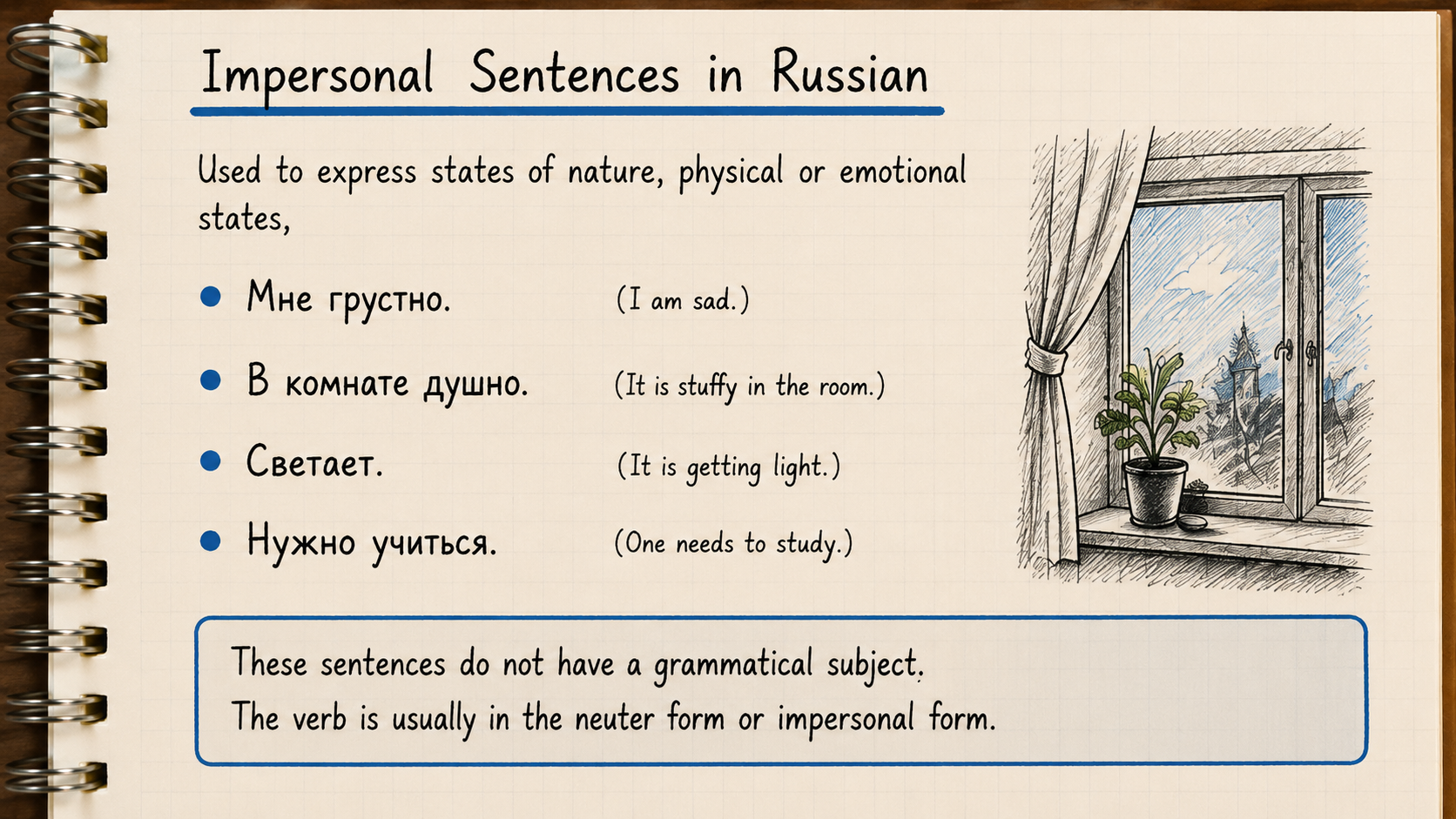
#52 Impersonal Sentences in Russian
Yuri Miyajima Russian Forest

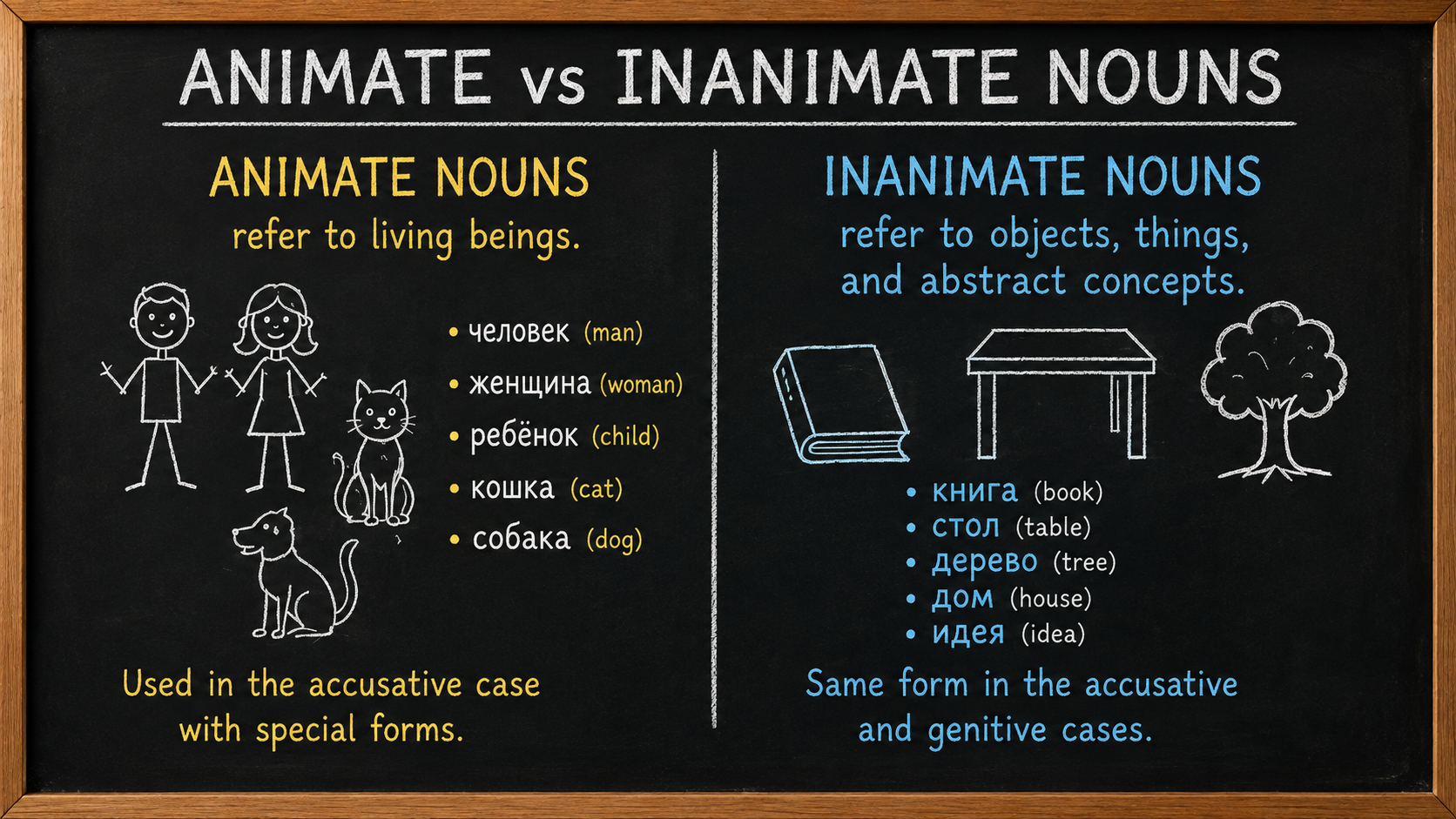
Russian nouns are divided into two grammatical categories: animate and inanimate.
As a general rule, nouns referring to people and animals are animate, while nouns referring to objects, places, and similar things are inanimate. This distinction affects the form of the accusative case.
For example, студе́нт (male student) changes to студе́нта in the accusative case, while стол (table) remains стол.
Once you understand how animate and inanimate nouns work, you no longer need to memorize every accusative form individually. Instead, you can recognize the underlying grammatical pattern.
In this article, I will explain what animate and inanimate nouns are in Russian, how you can distinguish between them, how they relate to the accusative case, and how this distinction affects case forms.
Russian nouns have a grammatical distinction between animate and inanimate nouns.
As a general rule, nouns referring to people and animals are classified as animate, while nouns referring to objects, places, plants, phenomena, and abstract concepts are classified as inanimate.
For example, the following nouns are animate:
The following nouns, on the other hand, are classified as inanimate:
Some nouns are more difficult to classify. For example, plants such as де́рево (tree) and цвето́к (flower) are treated as inanimate in Russian. Conversely, some nouns such as ку́кла (doll) are grammatically animate even though the object itself is not alive.
In Russian, whether a noun is animate or inanimate can affect its accusative form.
This distinction is particularly important with masculine singular nouns and plural nouns. As a general rule, animate nouns take an accusative form identical to the genitive, while inanimate nouns take an accusative form identical to the nominative.
Therefore, to decline Russian nouns correctly, you need to consider not only their gender and number, but also whether they are animate or inanimate.
The distinction between animate and inanimate nouns becomes especially important in the accusative case.
The accusative is mainly used to indicate the direct object of an action. For example, in sentences such as “I see a student” and “I read a book,” the nouns corresponding to “student” and “book” are in the accusative case.
In Russian, the accusative form of masculine singular nouns and plural nouns may differ depending on whether the noun is animate or inanimate.
For masculine singular nouns and plural nouns, the basic rule is:
For example, the masculine noun студе́нт (male student) is animate, so its accusative form is студе́нта, which is identical to the genitive.
By contrast, стол (table) is inanimate, so its accusative form remains стол, the same as the nominative.
This distinction also appears in the plural, not only in the masculine singular. In the plural, animacy affects the accusative form regardless of gender.
For animate plural nouns: plural accusative = plural genitive
For example, the plural nominative of студе́нт is студе́нты. Its plural genitive is студе́нтов, so the plural accusative is also студе́нтов.
For inanimate nouns: plural accusative = plural nominative
Both столы́ (tables) and кни́ги (books) have accusative forms identical to their plural nominative forms.
With masculine singular nouns and plural nouns, the accusative form changes according to animacy. With feminine singular and neuter singular nouns, however, animacy does not affect the form of the accusative.
Consider the animate feminine noun де́вушка (young woman) and the inanimate feminine noun кни́га (book).
Both nouns undergo the ordinary feminine accusative change from -а to -у.
In other words, the formation of the feminine singular accusative does not change according to whether the noun is animate or inanimate.
The same principle applies to neuter singular nouns. As a general rule, animacy does not create a separate accusative form.
Here, the accusative form of окно́ (window) is identical to its nominative form, окно́.
Therefore, the distinction expressed by the rule “animate accusative = genitive” and “inanimate accusative = nominative” directly affects masculine singular nouns and plural nouns.
When you encounter an unfamiliar noun, the easiest starting point is to ask whether it refers to a person or an animal.
As a general guide, you can classify nouns as follows:
For example, студе́нт (male student) and соба́ка (dog) are animate, while стол (table) and го́род (city) are inanimate.
Plants such as де́рево (tree) and цвето́к (flower) are also grammatically inanimate in Russian.
You can also identify animacy by examining case forms.
With a masculine singular noun, an animate noun has an accusative form identical to the genitive, while an inanimate noun has an accusative form identical to the nominative.
For example:
the form студе́нта is identical to the genitive of студе́нт, which tells you that the noun is animate.
By contrast:
the accusative стол is identical to the nominative, indicating that the noun is inanimate.
The same principle applies in the plural. Animate nouns have plural accusative forms identical to the plural genitive, while inanimate nouns have plural accusative forms identical to the plural nominative.
Russian dictionaries also often indicate whether a noun is animate or inanimate. If you are unsure about a particular noun, checking a dictionary is the most reliable approach.
Animacy is one of the grammatical systems used to classify nouns in Russian.
The main points can be summarized as follows:
The distinction between animate and inanimate nouns is essential for using the Russian accusative case correctly.
When learning Russian nouns, I recommend paying attention not only to their gender and case forms, but also to whether they are animate or inanimate.