#76 Dacha | Russia’s Beloved Tradition of Country Houses
Yuri Miyajima Russian Forest

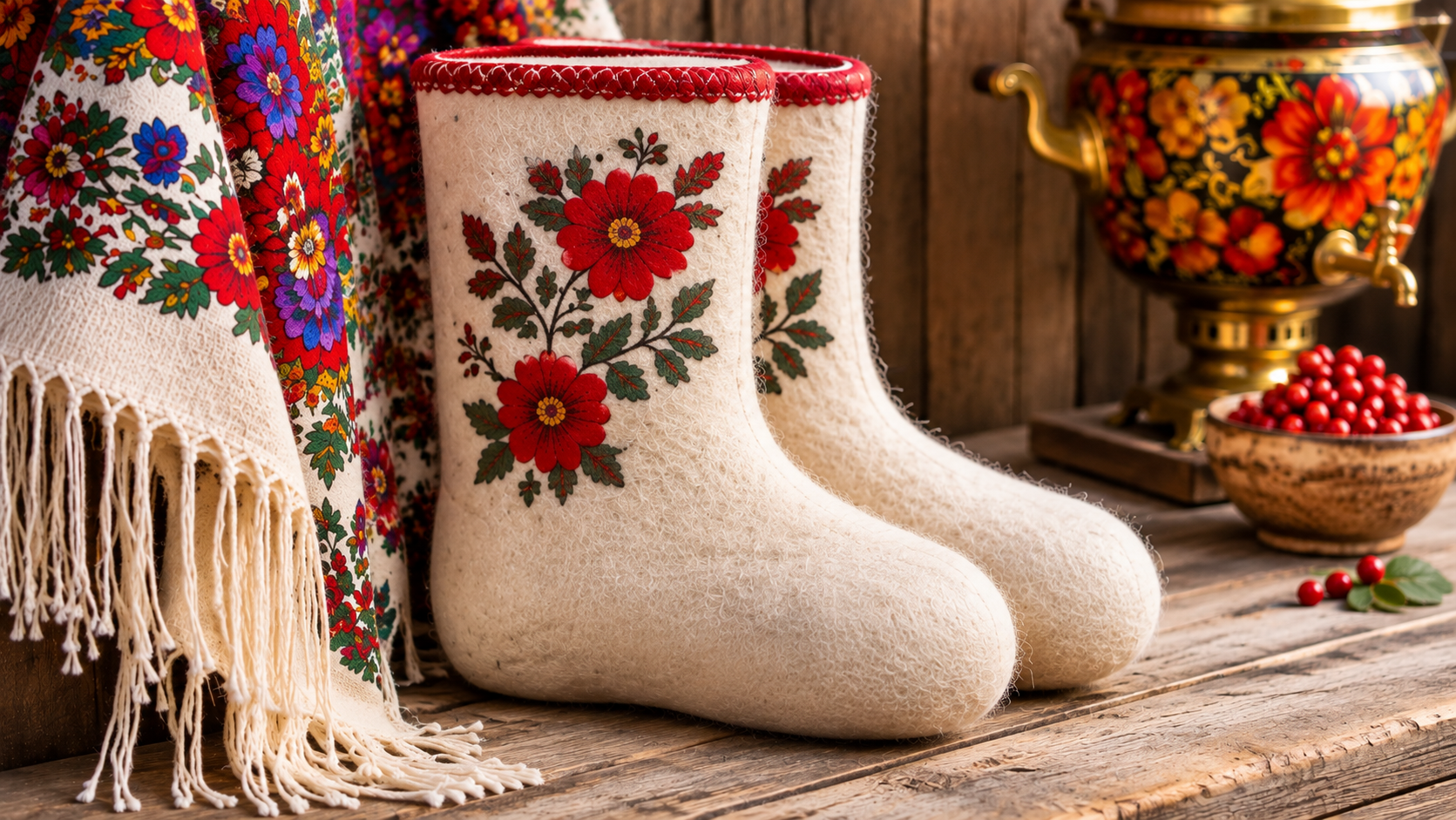
In Russia, felt boots known as valenki (ва́ленки) have long been worn to protect the feet from the severe cold of winter.
Valenki are made primarily from compressed sheep’s wool. Their excellent insulating properties have made them popular in regions with heavy snowfall and harsh winter temperatures.
In many parts of Russia, temperatures fall below freezing during winter, and regions such as Siberia experience particularly severe cold. Under these conditions, valenki developed into an important form of winter footwear that supported everyday life.
In this article, I will explain the characteristics and history of valenki, their traditional manufacturing methods, and their connection to winter life in Russia.
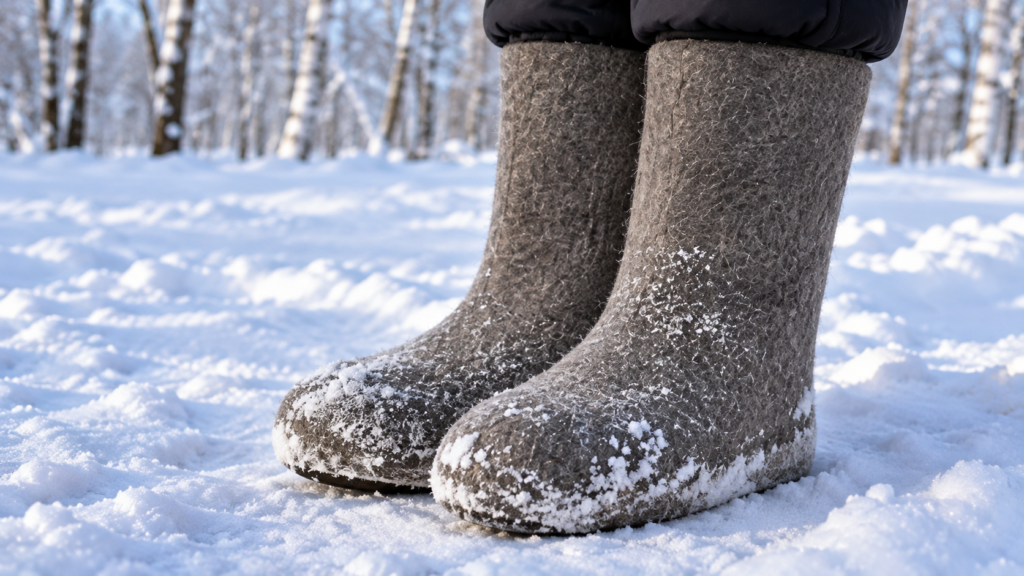
Valenki (ва́ленки) are traditional Russian winter boots made from sheep’s wool processed into felt.
The Russian word ва́ленки is plural and usually refers to a pair of boots. The singular form is ва́ленок.
One of the main characteristics of valenki is their thick felt material, which is produced by compressing sheep’s wool.
Felt is a material made by interlocking fibers such as wool. The air trapped within the material provides excellent thermal insulation.
Valenki are made by shaping this felt so that it surrounds the entire foot.
Traditional valenki have rounded toes and a tubular shape extending from the ankles to the calves.
Unlike ordinary leather boots, traditional valenki are made using a seamless, one-piece construction. They have no shoelaces or zippers and can be worn simply by slipping the feet into the openings.
Common colors include gray, white, and black, and some boots retain the natural color of the wool.
Valenki are also available in small sizes for children and have long been used as winter footwear for the whole family.
Because the thick felt surrounds the feet, valenki help keep them warm even in cold outdoor conditions. They have been particularly valued for their insulating properties in cold regions where dry snow accumulates.
In this way, valenki combine a design that takes advantage of the natural properties of wool with the practicality of footwear that is easy to put on.
The history of valenki is closely connected to the development of wool-processing techniques across Eurasia.
The technique of compressing wool to produce felt developed among nomadic peoples in Central Asia and other parts of Eurasia in ancient times.
Nomadic communities used felt to make clothing, rugs, and materials for their dwellings. In colder regions, felt footwear also came into use.
Over time, these techniques spread to territories that are now part of Russia.
For example, felt products dating from approximately the 5th to the 3rd century BCE have been discovered at archaeological sites associated with the Pazyryk culture in the Altai Mountains.
However, the shape and manufacturing methods of these early felt products differed from those of modern valenki.
Some early types of felt footwear were made by producing the foot section and the shaft separately and then sewing them together.
Seamless, one-piece boots resembling modern valenki are believed to have appeared between the late 18th and early 19th centuries.
Techniques for processing wool into footwear developed particularly in regions such as Nizhny Novgorod.
Craftsmen refined methods of compressing wool and shaping it into a single piece extending from the toe to the opening, allowing them to produce boots resembling modern valenki.
Initially, valenki were expensive footwear made by hand by skilled craftsmen.
Because production required considerable time and labor, valenki were costly, and rural families sometimes shared a single pair.
They were also regarded as valuable possessions and were sometimes passed down from parents to children.
During the 19th century, manufacturing techniques continued to develop, and valenki production flourished in regions such as Nizhny Novgorod, Yaroslavl, and Tver.
As factory production began, output increased, and valenki became widely used not only in rural communities but also in urban areas.
By the 20th century, valenki had become one of the most recognizable forms of Russian winter footwear, worn by farmers, workers, soldiers, and people from various other backgrounds.
During the Soviet period in particular, they were used in everyday life in cold regions and during winter military operations.
Today, although winter footwear made from various modern materials is widely available, valenki continue to be preserved as traditional Russian boots.

The name valenki comes from the Russian verb валя́ть.
The verb валя́ть can mean “to roll” or “to process wool or similar fibers into felt.”
Because valenki are made by repeatedly kneading and rolling wool, their name is associated with this verb.
Russian also has several related words:
The word ва́ленок is related to ва́леный, meaning “felted.”
Thus, the name ва́ленки reflects the fact that these boots are made by processing wool into felt.
Valenki are also known by different names in various regions of Russia.
One example is ката́нки.
This term comes from the verb ката́ть, meaning “to roll.”
Rolling wool repeatedly to compress it is an important part of making valenki, which explains the origin of this regional name.
Other regional terms for felt footwear have included пи́мы and чёсанки.
In many parts of Russia, winter temperatures fall below freezing.
In Siberia and northern Russia in particular, severe cold can persist for extended periods, with temperatures dropping below −30°C in some regions.
Under these conditions, keeping the feet warm is an important part of everyday life.
Valenki were practical footwear for people who spent long periods outdoors, including those working in rural communities or traveling in cold weather.
For example, rural residents continued to care for livestock, transport firewood, and clear snow throughout the winter.
Warm footwear was also essential for activities such as logging in forests and transporting goods outdoors.
Made from thick felt, valenki helped keep the feet warm during these activities.
They were also useful during periods when horse-drawn sleighs were a common means of winter transportation.
Traveling by sleigh often involved sitting in cold conditions for long periods. Because passengers moved less than they would while walking, their feet were particularly vulnerable to the cold.
Valenki helped protect the feet in these situations.
The following Russian words are also useful for understanding winter life in Russia:
In Russia, people prepare for cold weather by combining hats, gloves, thick coats, and other winter clothing.
Valenki have long been one of these essential items, helping people cope with the country’s harsh winter conditions.
Valenki have also occupied an important place in Russian culture.
In rural communities, they were essential items for winter life and were sometimes treasured as valuable family possessions.
In earlier times, producing valenki required considerable effort, making them relatively expensive. People therefore sometimes repaired their boots to extend their useful life.
Valenki were also occasionally given as gifts.
Family members and close friends sometimes exchanged them as a way of expressing the wish that the recipient would stay warm during the cold winter months.
Valenki also appear in Russian folk traditions and winter customs.
For example, Russia has a tradition of fortune-telling associated with the period between Christmas and Epiphany.
One traditional practice involved young women throwing a valenok or another type of shoe outside a gate or onto a road.
According to the custom, the direction in which the toe pointed indicated the direction from which a future husband would come.
This form of fortune-telling is regarded as one of the traditional winter customs practiced in rural Russia.
Valenki also appear in Russian folk songs.
One well-known example is the song “Ва́ленки” (Valenki).
This song is recognized as a Russian folk song about felt boots and became widely popular through performances by the singer Lidia Ruslanova (Ли́дия Русла́нова).
Its lyrics describe someone wearing worn-out valenki while trying to visit a loved one.
The song remains a familiar part of Russia’s traditional musical culture today.
Thus, valenki have been more than practical winter footwear. Their appearance in traditional customs and folk songs reflects their deep connection to Russian everyday life and culture.
Valenki are traditional Russian winter boots made by processing sheep’s wool into felt.
They developed from ancient Eurasian felting techniques, and boots resembling their modern form became widespread during the 18th and 19th centuries.
The most important points are as follows:
Valenki are a form of footwear that developed in response to Russia’s cold climate and the needs of its people.
Their manufacturing methods preserve traditional wool-processing techniques, and they have supported everyday life throughout their long history.
Learning about the history and characteristics of valenki also provides valuable insight into winter life in Russia and the traditional culture that developed in its cold regions.