#44 How to Use the Genitive Case in Russian
Yuri Miyajima Russian Forest

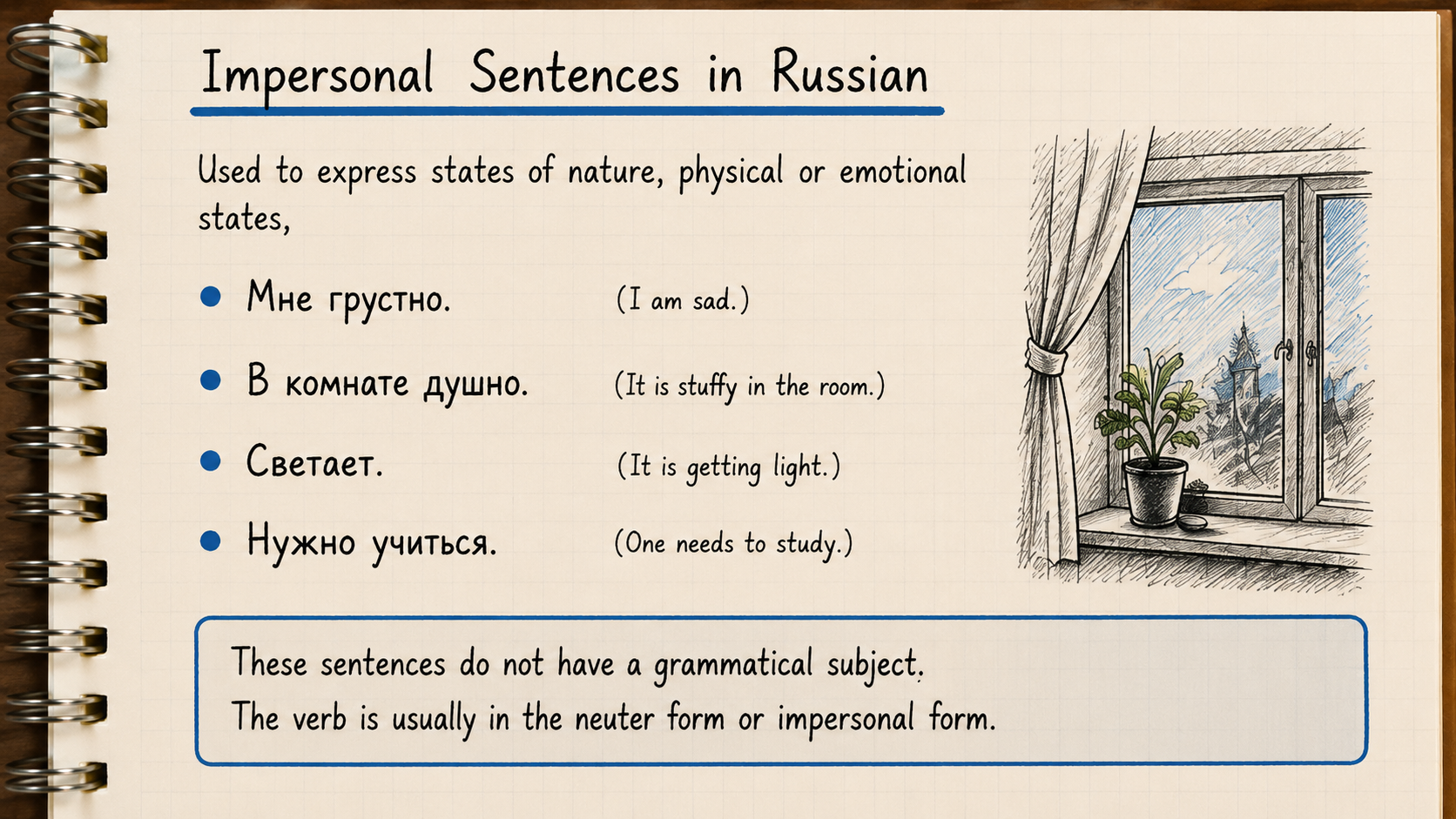
In Russian, weather, physical conditions, and personal states are sometimes expressed in ways that differ from English. One of the most common structures used for this purpose is the impersonal sentence.
For example, to say “I am cold,” you can say: Мне хо́лодно. To say “It is cold outside,” you can say: На у́лице хо́лодно. Unlike the English sentence It is cold outside, Russian does not require a formal subject such as it.
Because impersonal sentences appear frequently in Russian, they are an important grammatical structure to understand.
In this article, I will explain what impersonal sentences are in Russian, how they are formed, and some of the most common expressions used in them.
An impersonal sentence is a sentence that expresses a state, phenomenon, necessity, or similar idea without a grammatical subject.
In an ordinary sentence, there is usually a subject corresponding to “who” or “what,” and the sentence describes an action or state associated with that subject.
For example, in the following sentence, ма́льчик (boy) is the subject, while чита́ет (is reading) expresses the action.
In an impersonal sentence, however, there is no grammatical subject in the nominative case. Instead of focusing on “who does what,” the sentence focuses on the state or situation itself, such as “it is cold,” “it is dark,” or “it is necessary.”
For example, “It is cold outside” is expressed as:
There is no noun or pronoun acting as the subject of “being cold.” На у́лице indicates the location, while хо́лодно describes the condition there.
In English, a formal subject such as “it” is required in a sentence like It is cold outside. In Russian, however, На у́лице хо́лодно does not require any equivalent of English it.
In addition, when a person experiences a particular state, that person is often expressed in the dative case.
мне is the dative form of я (I). Structurally, the sentence expresses something similar to “It is cold to me” or “I feel cold.”
In other words, Russian impersonal sentences tend to focus less on “who does something” and more on “what the situation is like,” “what is necessary,” or “what is possible.”
One of the most common uses of impersonal sentences is to describe the surrounding environment or the condition of a particular place.
Common words include:
These words allow you to describe a place or environment without introducing a grammatical subject.
In these sentences, expressions such as здесь (here) and в ко́мнате (in the room) indicate where the state applies.
The same words can also describe a state experienced by a person.
For example, Здесь хо́лодно means “It is cold here,” describing the place itself, while Мне хо́лодно means “I am cold,” identifying the person who feels the cold.
In other words, with the same word хо́лодно, a location phrase can describe the surrounding environment, while a person in the dative case can indicate who experiences the state.
Impersonal sentences are not limited to physical sensations such as heat or cold. They are also commonly used to express emotions and moods.
For example:
These sentences follow the same basic structure as Мне хо́лодно.
The person experiencing the emotion or state is expressed in the dative case, followed by a word such as гру́стно (sad), весело́ (cheerful / fun), or ску́чно (boring / bored).
If it is already clear from the context who is experiencing the feeling, the dative expression can also be omitted.
These sentences still have no grammatical subject. Instead, the emotion or mood itself is being expressed.
In English, it is common to make the person experiencing the emotion the grammatical subject, as in I am sad or He is bored. Russian, by contrast, often expresses the same idea through a structure such as Мне гру́стно, literally presenting the state as something experienced “to” the person.
Russian can also use impersonal sentences to express obligation or necessity, such as “must,” “have to,” or “need to.”
Two common words are ну́жно and на́до.
The basic structure is: “dative + ну́жно / на́до + infinitive”
Once again, the person who is expected or required to perform the action is expressed in the dative case.
Both ну́жно and на́до can mean “need to,” “have to,” or “it is necessary to.” There is no major difference in their basic meaning, although на́до tends to be more common in everyday conversation.
If it is clear who should perform the action, or if no specific person needs to be identified, the dative can be omitted.
In sentences like these, the speaker does not explicitly state who must perform the action. Instead, the focus is on the action that is required in the situation. Depending on the context, the sentence may refer to a particular person or express a general necessity.
Russian also uses impersonal constructions to express possibility, permission, and prohibition, such as “can,” “may,” and “must not.”
Two commonly used words are мо́жно and нельзя́.
мо́жно can express both possibility and permission.
By contrast, нельзя́ can express either prohibition or impossibility depending on the context.
The basic structures are:
If you want to specify who is allowed, able, or forbidden to perform the action, that person is expressed in the dative case.
If it is clear from the context who is being referred to, or if a general rule is being expressed, the dative is often omitted.
For example, if you see Здесь нельзя́ кури́ть in a public facility, it does not refer to any one specific person. It expresses a general prohibition meaning that nobody is allowed to smoke there.
Both perfective and imperfective infinitives can appear after мо́жно and нельзя́. However, the choice of aspect can affect the meaning or nuance.
The imperfective aspect is commonly used when the focus is on an activity in general, an ongoing action, or a repeated action.
For example:
The imperfective verb фотографи́ровать is used here because the sentence refers to the general activity of taking photographs rather than to one specific completed action.
The perfective aspect, by contrast, is often used when the focus is on a single specific action or its completion and result.
Here, the perfective verb сфотографи́ровать refers to one specific act of taking a photograph of the painting.
With нельзя́ in particular, the distinction between the perfective and imperfective aspects can sometimes make the difference between “prohibition” and “impossibility” more noticeable.
In the following sentence, the imperfective verb кури́ть is used because smoking as an activity is prohibited.
In the next sentence, however, the perfective verb откры́ть is used.
Here, the sentence refers to the inability to achieve the result of opening the door. Therefore, нельзя́ expresses impossibility rather than prohibition.
However, you should not assume that the imperfective always indicates prohibition and the perfective always indicates impossibility. The actual meaning depends not only on verbal aspect but also on context and vocabulary.
As a general rule, remember that the imperfective aspect focuses on an activity itself or on general, repeated, or ongoing actions, while the perfective aspect focuses on a single specific action or its result.
In Russian, past-tense verbs normally change according to the gender and number of the subject.
For example, the past tense of быть (to be) is:
However, impersonal sentences do not have a grammatical subject. Therefore, when a past state is expressed, the neuter singular form is normally used.
For example:
Here, бы́ло, the neuter singular past form of быть, is used.
The same form is used when expressing a person’s emotions or condition.
An important point is that the gender or number of the person represented by мне, ему́, or нам does not affect the form бы́ло.
In impersonal sentences using a past-tense verb, the neuter singular form is generally used.
For example, even when referring to a woman, you say:
The form is бы́ло, not была́.
Likewise, even with several people:
The form remains бы́ло, rather than бы́ли.
When this type of impersonal sentence refers to the future, Russian uses бу́дет, the 3rd-person singular future form of быть.
For example:
If a particular person will experience the future state, that person is expressed in the dative case.
Thus, while the past tense uses the neuter singular form бы́ло, the future tense uses the 3rd-person singular form бу́дет.
In this type of impersonal sentence, бу́дет does not change according to the gender or number of the person expressed in the dative, just as бы́ло remains unchanged in the past tense.
Russian impersonal sentences express states, phenomena, necessity, possibility, and similar ideas without using a grammatical subject.
Their main features can be summarized as follows:
Impersonal sentences are one of the essential structures you need in order to form natural Russian sentences.
Rather than thinking of them simply as “sentences without a subject,” it is more helpful to understand them as sentences that focus on a state or situation itself rather than on a particular person or thing.