#12 The Role of the Russian Language in Russia
Yuri Miyajima Russian Forest

In Russian, the form of a noun, adjective, or other word can change depending on the role it plays in a sentence. To understand this system, the first case you should learn is the nominative case.
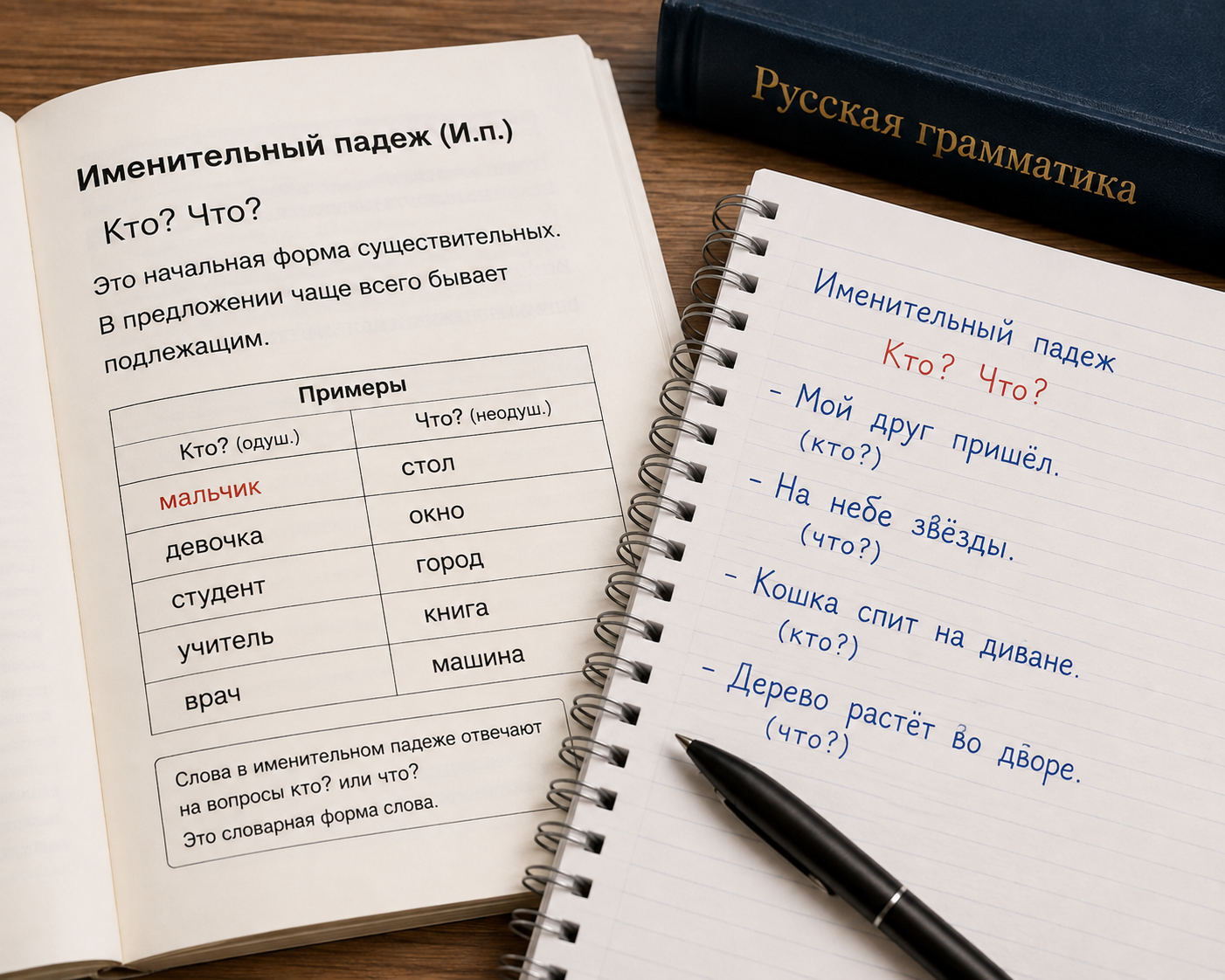
The nominative is the most basic of the 6 cases in Russian and is primarily used to indicate the subject of a sentence, corresponding to “who” or “what” performs an action or is in a particular state. In addition, the basic form of a noun listed in dictionaries is generally the nominative case.
For this reason, even when you have only just begun learning Russian, you are already encountering many words in the nominative case. Since other case forms are usually learned by comparing their endings with the nominative, it can also be considered the starting point for understanding Russian case declension.
In this article, I will explain what the Russian nominative case is, how it is used, the main features of its endings, and how it differs from the other cases.
The nominative case in Russian is used to indicate the subject of a sentence—that is, the person or thing corresponding to “who” or “what.”
It is used not only for people or things performing an action, but also for people or things that are in a particular state or simply exist, as long as they function as the subject of the sentence.
For example, in the following sentence, А́нна is in the nominative case because it indicates who is reading the book.
Likewise, in the following sentence, кни́га is in the nominative because it indicates what is lying on the table.
In this way, the nominative case forms the center of the sentence and indicates who or what the sentence is about.
The nominative is also important because it is treated as the basic form of a noun. As a general rule, nouns are listed in dictionaries in the singular nominative form.
For this reason, the nominative is not only the case used for subjects, but also the reference form you use when learning how nouns change in the other cases.
The most common use of the nominative case is to indicate the subject of a sentence.
A noun or pronoun that expresses who performs an action or what is in a certain state is generally placed in the nominative case.
As you can see, the nominative is used not only for people or animals performing actions, but also when describing the state or position of an object.
It may be easier to understand the function of the Russian nominative case by comparing it with the subject in English.
For example, in the English sentence “Anna works,” “Anna” is the subject of the verb “works.”
The same applies in Russian:
Here, А́нна is in the nominative case and functions as the subject of the sentence.
However, in English, except for certain pronouns, the form of a noun itself usually does not change depending on whether it is a subject or an object. Instead, grammatical roles are indicated mainly by word order.
In Russian, by contrast, case endings can indicate the grammatical role of a noun.
As a result, Russian has relatively flexible word order compared with English. Even when the order of words changes, the case forms can help you identify relationships such as subject and object.
The nominative case is also used in sentences where the subject and the complement refer to the same person or thing.
In an English sentence such as “He is a doctor,” “He” is the subject and “a doctor” is the complement. The sentence expresses the relationship “subject = complement.”
Russian can form the same type of sentence in the present tense. In the following example, он is the subject and врач is the complement.
Both words refer to the same person, and both он and врач are in the nominative case.
Similarly, in the following sentence, А́нна is the subject and студе́нтка is the complement, and both are in the nominative.
One characteristic of Russian is that the verb быть, meaning “to be,” is normally omitted in the present tense.
In English, you need the verb be, as in “Anna is a student.” In Russian, however, the subject and complement can be placed directly next to each other, as in “А́нна — студе́нтка.” In written Russian, a dash (—) is sometimes placed between a noun subject and a noun complement.
It is important to note, however, that a complement is not always in the nominative simply because the sentence links a subject and a complement. When быть is explicitly used in the past or future tense, the complement may appear in the instrumental case.
The nominative case has both singular and plural forms.
For example, the noun ла́мпа, meaning “lamp,” changes as follows:
In actual sentences, they are used like this:
In the first sentence, ла́мпа is singular nominative, while in the second sentence, ла́мпы is plural nominative. When the noun becomes plural, the verb also changes from стои́т to стоя́т.
The formation of the plural nominative depends on the ending of the singular nominative. The basic patterns are as follows.
However, Russian has many exceptions in the plural nominative.
For example:
These nouns have plural forms that differ considerably from their singular forms.
Some masculine nouns also take -а / -я in the plural nominative, as in:
For this reason, I recommend treating the patterns above as basic rules and learning nouns with irregular plural forms together with their singular and plural forms.
In modern Russian, when you call someone by name or address someone directly, the same form as the nominative is generally used.
Historically, Russian had a separate form known as the vocative case for direct address. Over time, however, the vocative largely disappeared, and in modern standard Russian, the nominative form is commonly used instead.
Some remnants of the old vocative can still be found in religious or archaic expressions.
For example:
The form Бо́же derives from the old vocative form of Бог, meaning “God.”
At the same time, modern colloquial Russian also uses special shortened forms of names and certain nouns when directly addressing someone.
These shortened forms are mainly used when addressing someone with whom you have a close relationship. In ordinary forms of address, you will generally use the nominative form of a name, a familiar form derived from it, or a combination of a given name and patronymic.
The nominative is the most basic of the 6 cases in Russian.
Its main characteristics can be summarized as follows.
In Russian, the form of a word helps you determine the grammatical role that the word plays in a sentence.
Learning the nominative case, which serves as the basis of the case system, is the first step toward understanding how Russian declension works.