#59 The Difference Between Perfective and Imperfective Aspects
Yuri Miyajima Russian Forest

In Russian, new words can be formed by adding certain elements to the beginning of existing words.
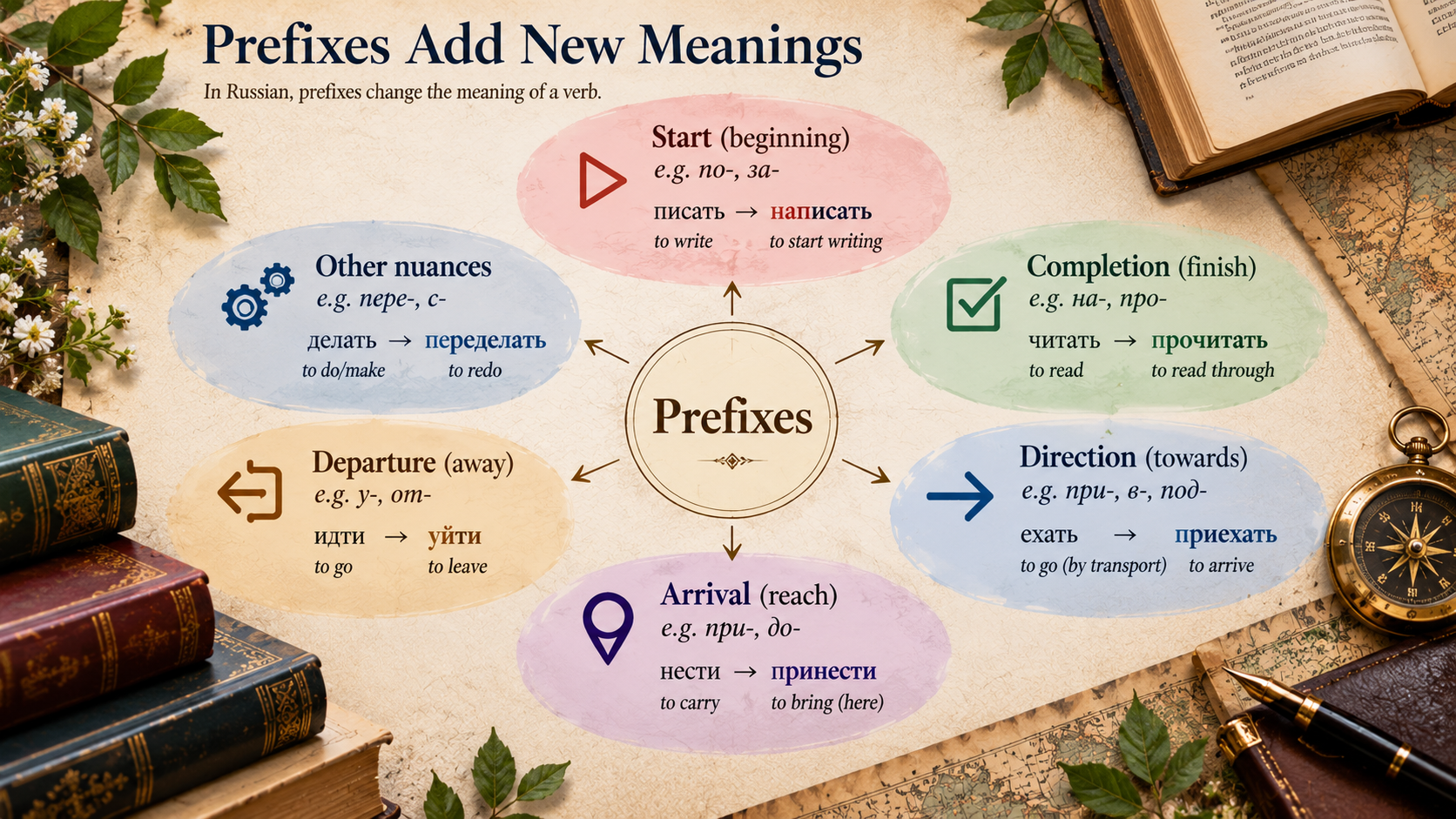
For example, adding на- to писа́ть, meaning “to write,” produces написа́ть (“to write” or “to finish writing”), while adding про- to чита́ть, meaning “to read,” produces прочита́ть (“to read through” or “to finish reading”).
An element added to the beginning of a word in this way is called a “prefix.”
Prefixes can add a wide range of meanings to the original word, including the beginning or completion of an action, direction, arrival, and departure. In Russian verbs in particular, prefixes are closely connected not only with the meaning of the verb but also with the relationship between the perfective and imperfective aspects.
In this article, I will explain the roles of prefixes in Russian, with examples of common prefixes and the words formed with them.
A Russian prefix is an element placed before a root or another part of a word to add a new meaning to the original word. The Russian word for “prefix” is приста́вка.
The part of a word that carries its central meaning is called the “root.” For example, писа́ть, meaning “to write,” contains the root пис-, which is etymologically and derivationally related to various words associated with writing, such as письмо́ (letter) and писа́тель (writer).
Russian can form many related words by adding prefixes, suffixes, and other elements to such roots.
For example, adding different prefixes to писа́ть produces the following verbs:
All of these verbs contain the common root -пис-.
By adding prefixes such as на-, за-, под-, пере-, and о-, different meanings are created, such as “to finish writing,” “to record,” “to sign,” “to rewrite,” and “to describe.”
For example, пере- can express meanings such as “across,” “from one place to another,” or “again.” When combined with писа́ть, it produces переписа́ть, meaning “to rewrite” or “to copy out.”
In this way, prefixes can preserve the basic meaning of the original word while adding meanings related to the direction, result, beginning, completion, or repetition of an action. In some combinations, the meaning develops further, producing a word with a distinct meaning that differs considerably from that of the original verb.
English also uses prefixes to modify the meanings of words. For example, adding re- to write produces rewrite, meaning “to write again.” Similarly, in Russian, adding пере- to писа́ть produces переписа́ть, which can mean “to rewrite.”
However, prefixation is particularly productive in Russian. In verbs especially, prefixes are closely connected with lexical meaning, the direction of an action, and the distinction between perfective and imperfective aspect.
For this reason, when learning Russian vocabulary, it is useful not only to view each word as an independent item but also to pay attention to which prefix has been added to which root.
Russian prefixes generally have basic meanings or underlying images associated with them.
For example, вы- can convey the idea of movement “from inside to outside,” при- can indicate arrival at or approach toward a place, and у- can indicate movement away from a place.
Understanding these basic images can make it easier to infer the meanings of verbs containing prefixes.
At the same time, a single prefix may have different meanings depending on whether it describes spatial movement or concepts such as the beginning or completion of an action.
The prefix за-, for example, has several meanings.
When used with a verb of motion, зайти́ can mean “to stop by” or “to drop in.” Depending on the direction of movement, it can also express the idea of going behind something.
The prefix за- can also be added to other verbs to indicate the beginning of an action.
Thus, the same prefix за- can relate to the direction or path of movement in зайти́, while in запе́ть and запла́кать it adds the meaning “to begin an action.”
Similar developments in meaning can be found with other prefixes.
The prefix пере-, for example, can express the ideas of “crossing” or “moving from one side or place to another.”
From this underlying image of moving from one point to another, пере- can also develop meanings related to changing something into another form or performing an action again.
In this way, prefixes can develop a variety of related meanings from their basic underlying images and add these meanings to verbs.
One of the most important aspects of Russian prefixes is their relationship with verbal aspect.
Russian verbs distinguish between the imperfective aspect, which focuses on features such as the process, duration, or repetition of an action, and the perfective aspect, which views an action as a complete whole and often focuses on its completion or result.
Adding a prefix to an unprefixed imperfective verb can produce a perfective verb.
For example, писа́ть is an imperfective verb that expresses the activity of writing itself. When на- is added, the resulting verb написа́ть is perfective and can present the writing of a letter, text, or other item as a single complete action, with attention to its result.
A similar distinction can be seen between the imperfective чита́ть and the perfective прочита́ть.
In this way, adding the prefix про- to чита́ть produces the perfective verb прочита́ть, which can present reading the book from beginning to end as a complete action.
The function of Russian prefixes can be seen particularly clearly in verbs of motion.
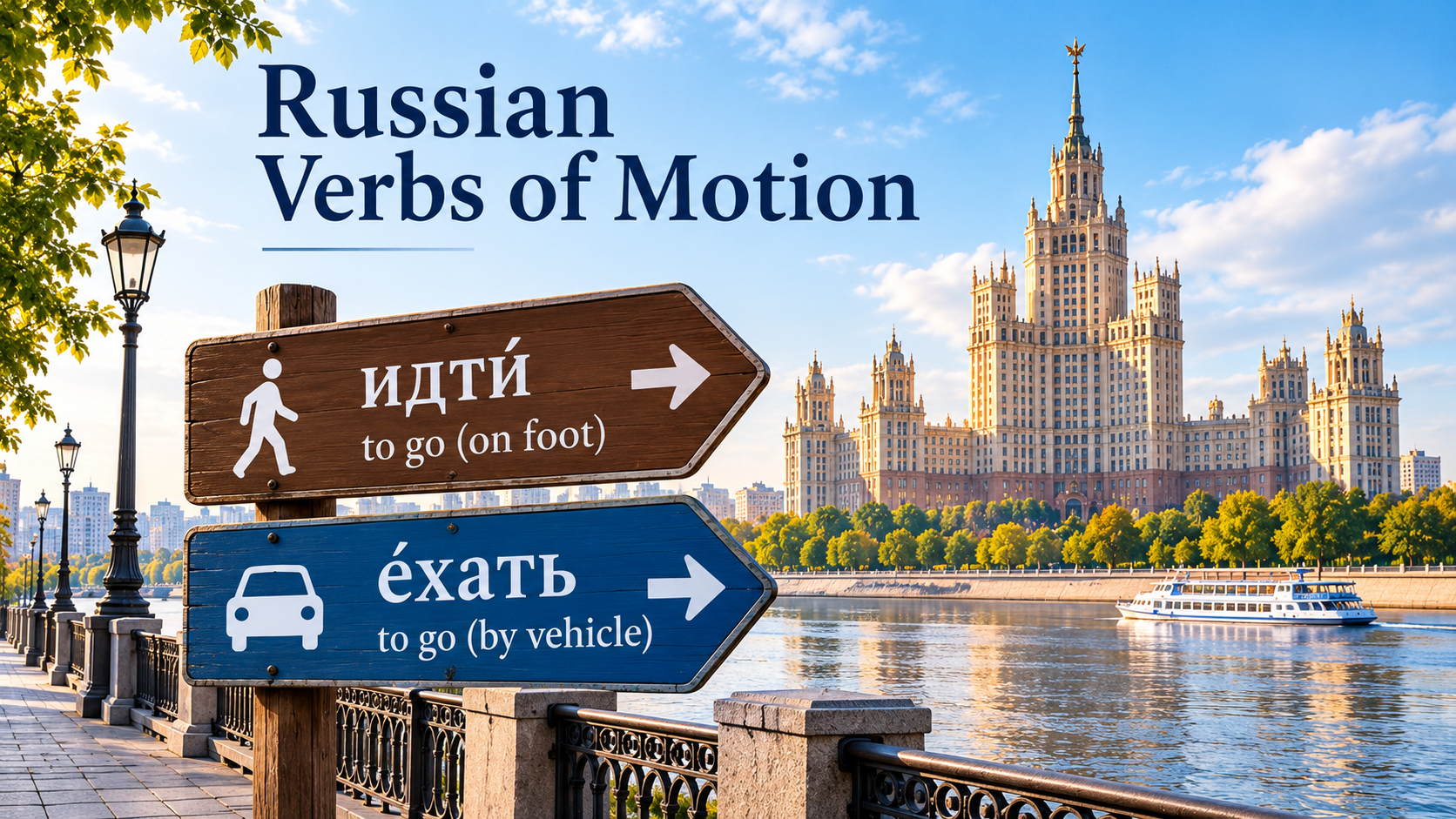
Russian has verbs such as идти́ (to go on foot in one direction), ходи́ть (to go or move around on foot), е́хать (to go by vehicle in one direction), and е́здить (to travel or move by vehicle).
Adding prefixes to these verbs makes it possible to express the direction or path of movement more precisely, including such meanings as “to enter,” “to exit,” “to arrive at a place,” “to leave a place,” and “to cross something.”
For example, adding different prefixes to идти́ produces the following verbs:
Each prefix has a basic image associated with direction or path.
For example, в- expresses movement “from outside to inside,” while вы- expresses the opposite movement, “from inside to outside.”
The prefix при- indicates arrival at a destination, while у- indicates movement away from a place.
The prefixes под- and от- also form a contrasting pair. Под- indicates movement toward or closer to something, while от- indicates movement away from it.
The prefix пере- carries the basic image of crossing or moving from one side to another.
By combining verbs that express a method of movement with prefixes that indicate direction or path, Russian can describe many types of movement in detail.
When learning verbs of motion, it is therefore useful not only to memorize words such as войти́, вы́йти, and прийти́ individually, but also to associate them with the basic meanings of their prefixes: в- as “inward,” вы- as “outward,” and при- as “arrival.” This understanding can then be applied to other verbs of motion.
Russian prefixes are used not only to express direction and location but also to describe how an action unfolds, including how it begins, how long it continues, and how far it progresses.
For example, за- can indicate the beginning of an action when added to certain verbs.
The prefix по- can also be added to verbs to indicate that an action is performed for a certain period of time.
The prefix до- has the basic image of reaching a particular point and can add the meaning of continuing an action to a certain stage or all the way to its completion.
The prefix пере-, meanwhile, develops from its spatial meaning of “crossing” or “moving from one place to another” and can indicate that an action is performed again.
In this way, many Russian prefixes have developed from spatial meanings and can also be used to express how an action progresses, including its beginning, limited duration, completion, and repetition.
Although Russian prefixes are frequently used with verbs, they also play an important role in the formation of nouns and adjectives.
For example, не- can add meanings of negation, absence, or opposition to the original word.
In this way, adding не- can create a word with a meaning that contrasts with that of the original noun or adjective.
The prefix без- is also used to form words expressing the idea of lacking or being without something.
For example, бездо́мный contains the root дом, meaning “house” or “home,” together with без-, which adds the meaning “without.” The word as a whole therefore means “without a home.”
Some prefixes can also express degree or extent.
The prefix сверх- conveys the idea of being “beyond” or “exceeding the normal range” and is comparable in some uses to English prefixes such as super- or ultra-.
Russian also uses экс- to refer to a person who formerly held a particular position or title.
These examples show that prefixes are used throughout Russian as a productive means of forming new vocabulary, not only with verbs but also with nouns and adjectives.
Russian prefixes are important elements added to the beginning of words to create new meanings.
They are particularly common with verbs, where they can express the direction, beginning, completion, or endpoint of an action and can also play a role in forming perfective verbs.
The main points discussed in this article can be summarized as follows:
When learning Russian prefixes, it is important to understand the basic idea associated with each one.
By studying prefixes in relation to roots, perfective and imperfective aspect, and verbs of motion, you can develop a deeper understanding of how Russian words are formed and how their meanings expand and change.