#32 Russian Augmentative Forms
Yuri Miyajima Russian Forest

Russian has a grammatical system called case, in which the forms of nouns, pronouns, adjectives, and other words change depending on their role in a sentence. Among the six Russian cases, the genitive is one of the most important because it is used in a wide range of situations.
The genitive case does not only express possession or association, similar to “of” or possessive ’s in English. It is also used with certain prepositions and numbers to express meanings such as “from” and relationships involving quantity or part of a whole.
At first, the genitive may seem complicated because it has many different uses. However, if you organize these uses and learn them one by one, you will gradually understand why the genitive appears in particular situations.
In this article, I will explain what the Russian genitive case is, its basic meanings and uses, and how noun endings change in the genitive.
The genitive is one of the six cases in Russian.
One of its most representative functions is to indicate who something belongs to or what something is associated with. In this respect, it is similar to English “of” and possessive “’s.”
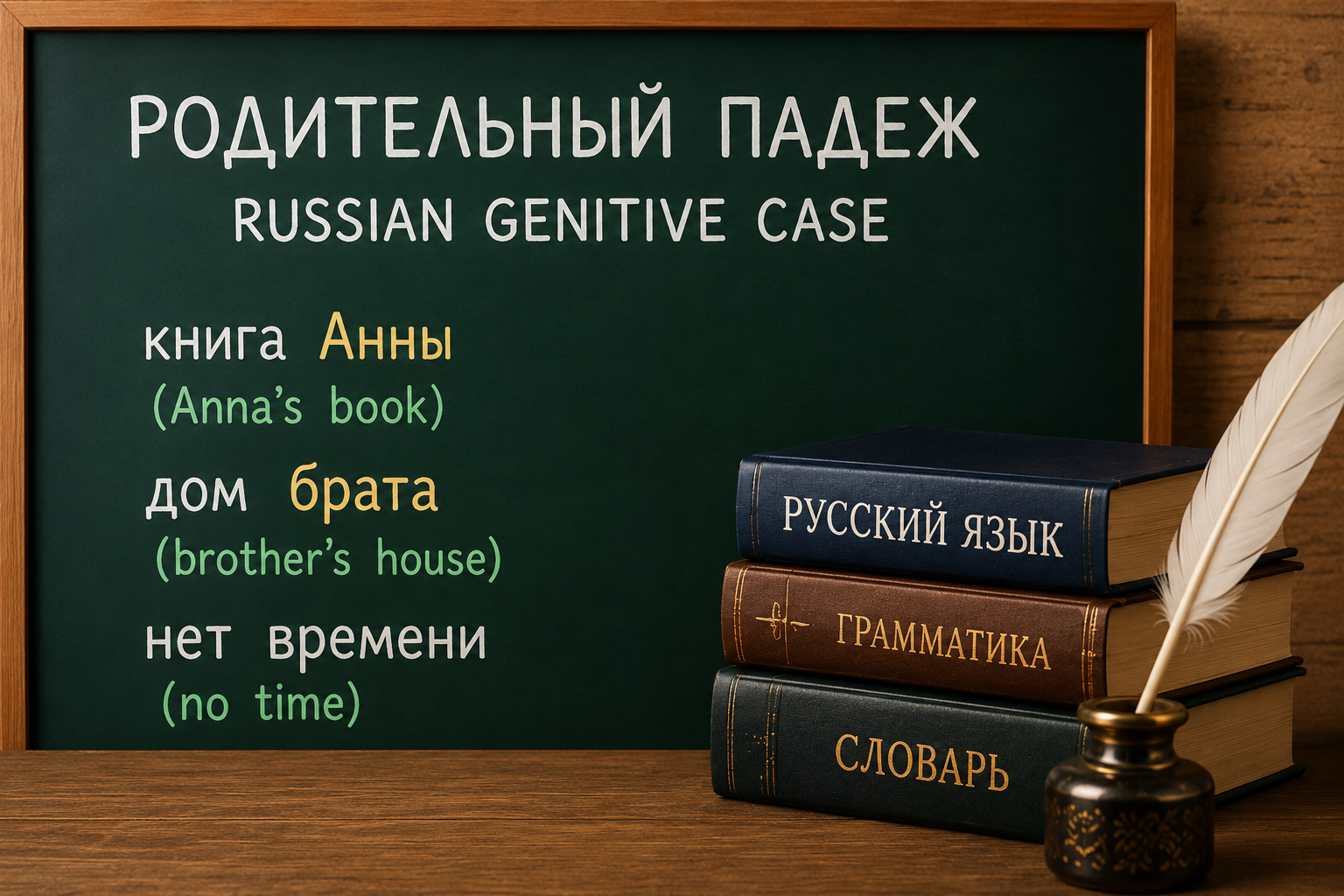
For example, “Anna’s book” can be expressed as follows:
А́нна is the nominative form, while in the genitive it changes to А́нны. In this example, А́нны indicates who the book belongs to.
Similarly, in the phrase “the roof of the house,” дом (house) changes to the genitive form до́ма.
In this way, Russian can express relationships corresponding to English “of” or “’s” by changing the noun itself into the genitive case.
The genitive is also used for more than possession and association. It can express absence, lack, origin, quantity, and part-whole relationships. In addition, certain prepositions, such as без, для, из, and от, require the noun that follows them to be in the genitive.
As you can see, the genitive is used in a wide variety of situations, including possession, negation, quantity, and origin.
In the genitive, noun endings change depending on gender and whether the noun is singular or plural. First, I will explain the basic patterns for the genitive singular.
Masculine nouns ending in a consonant generally take -а in the genitive singular.
Masculine nouns ending in -й or -ь generally change to -я.
Thus, masculine nouns generally take either -а or -я, depending on their nominative ending. However, some nouns may also undergo changes in the stem or spelling.
Feminine nouns ending in -а generally change to -ы in the genitive.
However, because of the Russian spelling rule that ы is not written after г, к, х, ж, ч, ш, щ, some nouns take -и instead.
Feminine nouns ending in -я or -ь generally change to -и.
Neuter nouns ending in -о generally change to -а.
Neuter nouns ending in -е generally change to -я.
As with masculine and feminine nouns, you can often predict the genitive form of a neuter noun by looking at its nominative ending.
The basic genitive singular patterns can be summarized as follows:
| Noun Type | Nominative Ending | Basic Genitive Ending |
|---|---|---|
| Masculine | consonant | -а |
| Masculine | -й, -ь | -я |
| Feminine | -а | -ы / -и |
| Feminine | -я, -ь | -и |
| Neuter | -о | -а |
| Neuter | -е | -я |
I recommend first learning basic changes such as дом → до́ма, окно́ → окна́, and кни́га → кни́ги, and then gradually moving on to special endings and irregular forms.
Among the forms of the genitive case, the genitive plural is particularly difficult for many learners.
In the genitive singular, there are relatively clear patterns, such as -а / -я for masculine nouns and -ы / -и for feminine nouns. In the genitive plural, however, endings vary considerably depending on gender and the original noun ending.
For example, masculine nouns may take endings such as -ов, -ев, or -ей.
By contrast, many feminine nouns ending in -а or –я lose their original ending in the genitive plural.
Neuter nouns may also lose their ending or change in other ways.
In addition, the genitive plural sometimes involves the appearance of a vowel inside the stem to make pronunciation easier. For example, in окно́ → о́кон, an о appears within the stem in the genitive plural. Such vowels are called fleeting vowels, because they appear or disappear depending on the grammatical form.
There are also irregular nouns whose forms change substantially, such as:
Because the genitive plural has several different patterns, I recommend learning the genitive plural forms gradually, beginning with frequently used words.
One of the most basic uses of the genitive case is to express possession, association, and relationships between things.
For example, in маши́на бра́та (brother’s car), брат changes to the genitive form бра́та. Here, бра́та identifies the owner of the car and expresses the relationship “the car owned by the brother.”
The genitive can similarly be used when a person owns something.
However, the genitive does not necessarily express literal ownership. It can also indicate that one thing belongs to, is associated with, or is related to another.
When two nouns are connected through the genitive, the basic word order is:
For example, in исто́рия Росси́и, the main noun исто́рия (history) is followed by Росси́и, the genitive form of Росси́я(Russia).
In English, relationships of this kind are expressed with “’s” or “of,” as in “Anna’s book” or “the history of Russia.” In Russian, the relationship can instead be expressed by changing the noun itself into the genitive case.
In Russian, the genitive case is used when expressing the absence or nonexistence of a person or thing. The genitive can also appear with the object of a negated verb, a phenomenon commonly called the genitive of negation.
One of the most important examples involves нет. The word нет means “there is no,” “there are no,” or “to not have,” and the noun referring to the absent person or thing is placed in the genitive.
Here, маши́на (car) changes to the genitive маши́ны.
Russian can therefore use the structure:
to express the idea that someone does not have something.
Other examples include:
The genitive can also appear when a sentence expressing existence is changed into the negative.
In the second sentence, стол changes to the genitive стола́.
As these examples show, the genitive is closely associated with negative sentences expressing the nonexistence of something.
However, not every noun in a negative sentence automatically takes the genitive. For example, with a negated transitive verb, either the genitive or accusative may be used for the direct object depending on meaning and context.
For this reason, when you first learn the genitive of negation, I recommend becoming familiar with basic patterns such as “нет + genitive” and “не́ было + genitive.”
Another important use of the genitive case is with numbers and expressions of quantity.
In Russian, the form of the noun following a number changes according to the number itself. One particularly important rule is that numbers 2, 3, and 4 are followed by the genitive singular, while numbers 5 and above generally require the genitive plural.
For example, студе́нт (student) changes as follows:
With 1, студе́нт appears in the nominative singular. With 2, 3, and 4, the genitive singular студе́нта is used, while 5 and above take the genitive plural студе́нтов.
As a basic rule, the noun form is determined by the final digit of the number, with an important exception for numbers ending in 11–14.
The main pattern is as follows:
The genitive is also used not only with specific numbers, but with quantity words such as мно́го (many / much), ма́ло(few / little), ско́лько (how many / how much), and не́сколько (several).
As you can see, the genitive appears very frequently when expressing numbers and quantities in Russian.
The rule “1 = nominative singular, 2–4 = genitive singular, 5 and above = genitive plural” is especially important because you will need it in many everyday situations involving shopping, time, age, and numbers of people.
In Russian, certain prepositions require the noun that follows them to be in the genitive.
Common prepositions that take the genitive include:
For example, the prepositions из, с, and от are frequently used with the genitive to express a point of origin. Although all three can often be translated as “from,” the correct choice depends on what kind of place or source is involved.
из is generally used when moving out of an enclosed space or when indicating a country or city as a point of origin.
By contrast, с can mean “from the surface of” and is also used when leaving certain places, activities, or events.
от is used when a person or object serves as the source, or when indicating movement away from something.
Other common genitive prepositions include без meaning “without,” для meaning “for,” до meaning “until,” and о́коло meaning “near.”
As you can see, prepositions that require the genitive can express a range of meanings, including origin, absence, purpose, endpoint, and location.
Because Russian often builds meaning through combinations of prepositions and cases, I recommend learning them together as fixed patterns, such as “из + genitive,” “без + genitive,” and “для + genitive,” rather than memorizing the preposition alone.
The genitive is one of the six Russian cases and is used to express a wide variety of meanings, including possession, association, negation, quantity, and origin.
Its main characteristics can be summarized as follows:
Because the genitive has many different uses, it may initially feel more difficult than some of the other Russian cases.
I recommend beginning with the basic meanings of “of,” “there is no,” “from,” and quantity. Once you are comfortable with these patterns, you can gradually expand your knowledge of genitive endings and prepositions, making it easier to use the case naturally.