#49 Animate and Inanimate Nouns in Russian
Yuri Miyajima Russian Forest

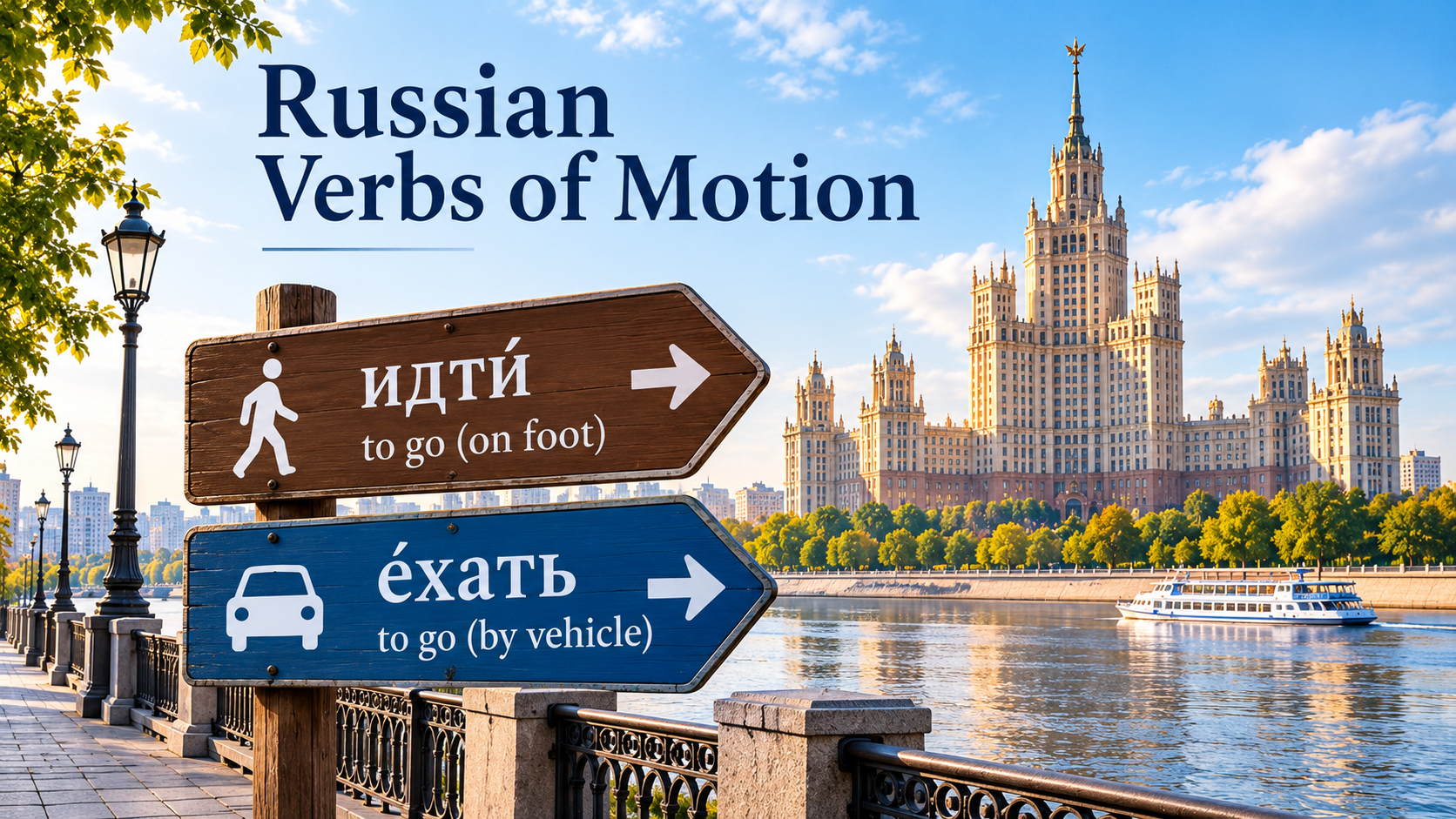
When expressing movement such as “going” or “coming” in Russian, an important group of verbs to understand is known as “verbs of motion.”
In Russian, the basic verb used for movement changes depending on whether a person is traveling on foot or by a means of transportation.
For example, идти́ is used for going somewhere on foot, while е́хать is used for traveling by vehicle or another means of transportation.
Russian verbs of motion can also be divided into determinate verbs, which describe movement in a particular direction, and indeterminate verbs, which can describe such actions as regularly traveling back and forth or moving in different directions.
As a result, even when expressing the general idea of “going,” Russian uses different verbs depending on the situation, including идти́, ходи́ть, е́хать, and е́здить.
In this article, I will explain the basic system of Russian verbs of motion and the difference between determinate and indeterminate verbs, using common verbs and example sentences.
One of the first distinctions to learn when studying Russian verbs of motion is how the movement takes place.
Russian uses different basic verbs depending on whether someone is moving on foot or traveling by a means of transportation.
Four of the most important verbs are as follows:
| Method of movement | Determinate verb | Indeterminate verb |
|---|---|---|
| On foot | идти́ | ходи́ть |
| By transportation | е́хать | е́здить |
идти́ and ходи́ть are used when someone moves from one place to another on foot.
Because идти́ is used in this sentence, it indicates that the speaker is currently heading to school on foot.
When traveling by car, bus, train, or another means of transportation, е́хать or е́здить is used instead.
Here, е́хать indicates movement by transportation rather than on foot. A phrase such as на авто́бусе (by bus) can be added to specify the particular means of transportation.
In addition to the distinction between traveling on foot and by transportation, the nature of the movement also affects the choice of verb.
For example, идти́, a determinate verb, is used when someone is currently walking toward school. If someone regularly walks to school, the indeterminate verb ходи́ть is used. Similarly, е́хать is used when someone is currently traveling toward a particular destination by transportation, while е́здить is used for habitual travel by transportation.
Comparing these four verbs shows that Russian verbs of motion involve two important distinctions: the method of movement—such as on foot or by transportation—and whether the verb is determinate or indeterminate.
Learning идти́ / ходи́ть and е́хать / е́здить as two basic pairs makes it easier to understand the system of other Russian verbs of motion introduced later.
Many Russian verbs of motion occur in determinate and indeterminate pairs.
For example, идти́ and ходи́ть both relate to the idea of going somewhere on foot, but they are used differently depending on the direction and nature of the movement.
Determinate verbs generally describe movement proceeding in a particular direction. For example, if someone is currently walking from home toward a shop, the determinate verb идти́ is used.
This sentence describes a specific one-way movement toward a particular destination: the speaker is currently walking toward the shop.
Determinate verbs are not limited to movement taking place at the present moment. They can also be used for past or future movement when the action proceeds in a particular direction.
Here as well, the past-tense form шёл of идти́ is used because the speaker was moving in a particular direction—toward home.
Indeterminate verbs, by contrast, can describe habitual or repeated movement, round trips involving going somewhere and returning, and movement in various directions.
In this example, ходи́ть is used because the sentence describes a repeated action—going to the shop every day—rather than a single movement toward the shop.
Indeterminate verbs can also be used when describing a past trip to a place when the person has already returned.
Here, the focus is on the complete activity of going to the cinema and returning, rather than only on the one-way movement toward the cinema.
Indeterminate verbs are also used to describe movement as a general ability or activity without reference to a particular destination.
In this sentence, the verb describes the general action or ability of walking rather than movement toward a particular place.
The basic distinction between determinate and indeterminate verbs can therefore be summarized as follows:
Understanding this basic distinction is essential when using Russian verbs of motion.
In addition to идти́ / ходи́ть for movement on foot and е́хать / е́здить for movement by transportation, Russian has many other pairs of verbs of motion.
Actions such as running, flying, and swimming each have their own determinate and indeterminate verbs. Different verbs are also used when moving another person or object, depending on whether something is carried, someone is led on foot, or someone or something is transported by vehicle.
Some common pairs include:
| Determinate verb | Indeterminate verb | Main meaning |
|---|---|---|
| бежа́ть | бе́гать | to run |
| лете́ть | лета́ть | to fly |
| плыть | пла́вать | to swim, move through water |
| нести́ | носи́ть | to carry something |
| вести́ | води́ть | to lead or take someone |
| везти́ | вози́ть | to transport someone or something by vehicle |
For example, бежа́ть is a determinate verb describing running in a particular direction. The indeterminate verb бе́гать, by contrast, can describe repeated running or running in different directions.
лете́ть and лета́ть have a similar relationship.
When someone is currently flying to Moscow, the determinate verb лете́ть is used. When someone repeatedly travels to Moscow by air, the indeterminate verb лета́ть is used.
Russian verbs of motion can also describe moving other people or objects rather than only the speaker’s or subject’s own movement.
For example, нести́ / носи́ть is used for carrying an object, вести́ / води́ть for leading or taking a person or animal on foot, and везти́ / вози́ть for transporting a person or object by vehicle.
In this way, Russian uses different verbs of motion according to factors such as the method of movement, who or what is moving, and whether another person or object is being taken or transported.
Russian verbs of motion describe in detail how and in what direction people or objects move.
The main points discussed in this article can be summarized as follows:
The verb used in Russian changes according to the method of movement: идти́ / ходи́ть is used for movement on foot, while е́хать / е́здить is used for movement by transportation. Verbs of motion also have the important distinction between determinate and indeterminate forms.
By keeping two basic questions in mind—“How is the movement taking place?” and “Is a determinate or indeterminate verb required?”—it becomes easier to choose the verb of motion that best fits the situation.