
#30 Russian in International Organizations
Yuri Miyajima Russian Forest

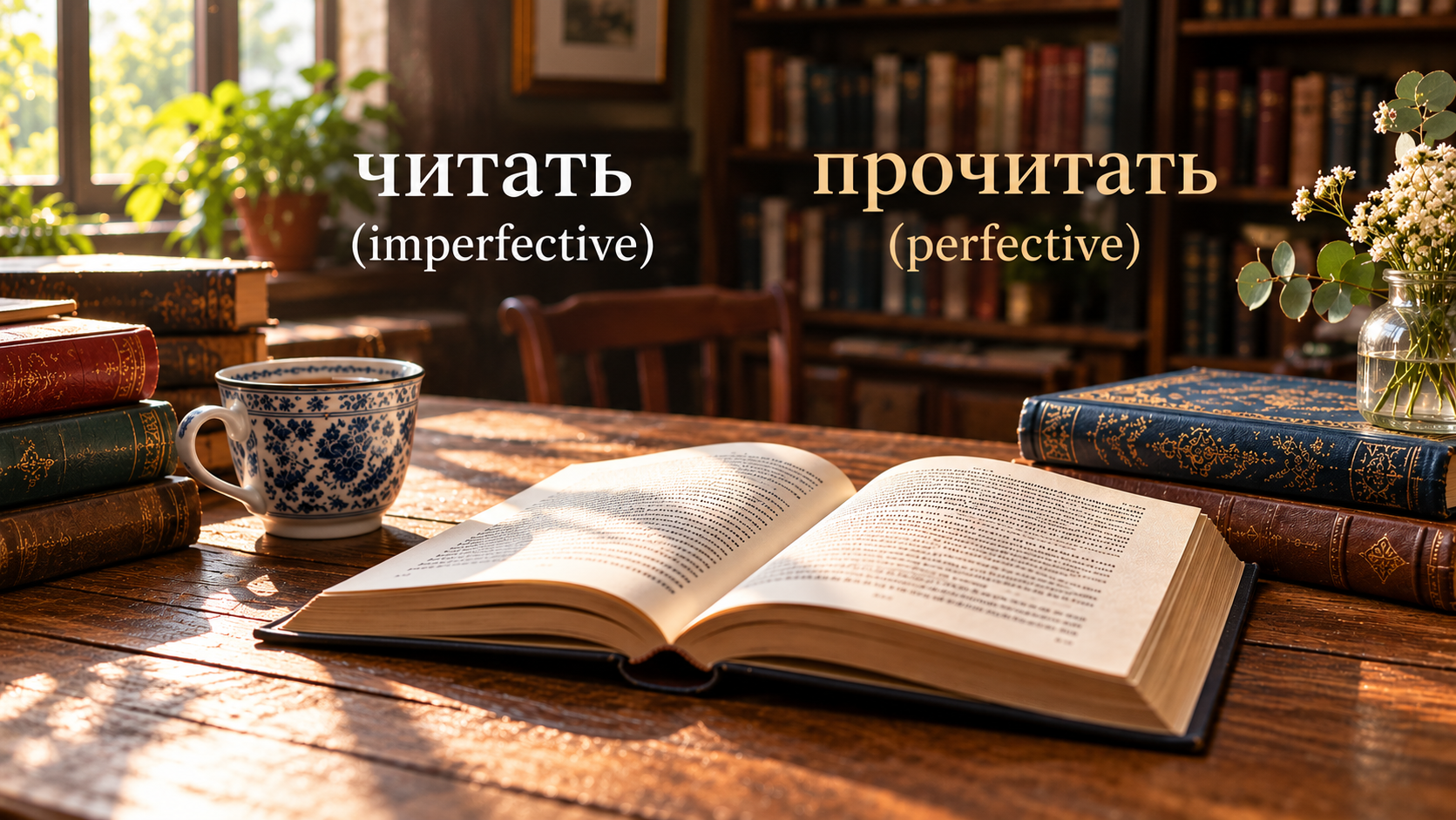
In Russian, the perfective and imperfective aspects are used differently depending on how an action is viewed — for example, whether it is in progress, repeated, or has reached a particular result.
For instance, Russian uses two verbs related to the meaning “to read”: чита́ть (to read: imperfective) and прочита́ть (to finish reading: perfective).
The imperfective чита́ть is used when the focus is on the act of reading itself or on its progress or duration. By contrast, the perfective прочита́ть is used when the focus is on the action being completed as a whole, such as reading a book or text through to the end.
In this way, the choice of a Russian verb is related to how the speaker views the action. This grammatical distinction is known as “aspect.”
The distinction between perfective and imperfective is relevant not only when describing past events, but also in a wide range of contexts, including present habits, future actions, commands, and requests. It is therefore one of the most important grammatical concepts for understanding Russian verbs.
In this article, I will explain the differences between the perfective and imperfective aspects in Russian using specific verbs and example sentences.
Russian verbs can broadly be divided into perfective and imperfective verbs according to how the action expressed by the verb is viewed.
In Russian, the perfective aspect is called соверше́нный вид, while the imperfective aspect is called несоверше́нный вид. The word вид can mean “type,” “appearance,” or “form,” and when used as a grammatical term, it refers to “aspect.”
Aspect differs from tense, which indicates when an action takes place. Instead, aspect is a grammatical system that indicates how an action is viewed.
For example, the following two verbs are related to the meaning “to write”:
писа́ть is used when the focus is on the process, duration, or repetition of the act of writing, as in “to be writing” or “to write repeatedly.”
By contrast, написа́ть is used when the focus is on completing a letter, text, or other piece of writing and bringing the action to a result.
Consider the following sentences:
In the first sentence, which uses the imperfective aspect, the focus is on the act of writing the letter itself. Rather than emphasizing whether the letter was completed, the sentence focuses on the fact that the person was engaged in the activity of writing it.
In the second sentence, which uses the perfective aspect, the act of writing the letter is viewed as a single complete event, with the focus on the result that the letter was finished.
The distinction between the imperfective and perfective aspects is easier to understand if it is viewed not simply as a difference between “an action currently in progress” and “an action that has already ended,” but rather as a difference in how the speaker views the action.
For example, an imperfective verb can also be used in the past tense, so the actual action may already have ended. Even so, the imperfective is used when the speaker focuses on the process or activity itself.
The perfective aspect, on the other hand, views the action as a whole and expresses its completion, result, or attainment of a particular endpoint.
Therefore, when understanding Russian verbs, it is important to consider not only tense—“When did the action take place?”—but also aspect—“From what perspective is the action being presented?”
One of the main functions of the imperfective aspect is to express an action in progress or an action continuing over a period of time.
For example, the sentence Я чита́ю кни́гу. (I am reading a book.) uses чита́ю, the present-tense form of чита́ть.
The important point here is the act of reading the book itself: “I am currently engaged in the activity of reading.” Rather than viewing the action from beginning to end as a single whole, the imperfective focuses on the process taking place within it.
The same principle applies to past events.
This sentence focuses on the activity of reading continuing for a period of two hours. Rather than emphasizing how much of the book was read or whether it was finished, the sentence presents the two hours spent reading as an activity.
The imperfective is also commonly used with expressions indicating the duration of an action, such as весь день (all day) and до́лго (for a long time).
These sentences likewise indicate that the work or conversation continued over a certain period.
The imperfective can also describe a “background action” that was already in progress when another event occurred.
In this sentence, чита́л is the past-tense form of the imperfective чита́ть (to read) and describes the action of reading that was already in progress.
By contrast, позвони́л is the past-tense form of the perfective позвони́ть (to call). The imperfective звони́ть (to call) and the perfective позвони́ть form an aspectual pair.
Here, чита́л describes an action that continued for a period of time, while позвони́л describes a single event that occurred during that action. In other words, the event of “calling” occurred against the continuing background of “reading.”
When describing past events, it is therefore common to use the imperfective for an ongoing background action and the perfective for a single complete event that occurs within that background.
The imperfective aspect is also frequently used to describe actions that are repeated over a period of time or form part of a regular habit.
In these sentences, the focus is on the repeated nature of the actions.
For this reason, the imperfective is often used with words expressing frequency or repetition, such as ка́ждый день (every day), ча́сто (often), обы́чно (usually), and иногда́ (sometimes).
The same applies to habitual actions in the past.
Here, the sentence indicates that going to the theater was an action repeatedly performed during the period when the speaker lived in Moscow.
The imperfective can also be used to state the experience or fact of having performed an action in the past.
In this exchange, the focus is on whether the experience of reading the book has occurred.
By contrast, using the perfective прочита́ть shifts the focus to reading an entire book through to the end and completing the action.
Thus, the imperfective aspect is used not only for actions in progress, but also in a variety of other contexts, including habitual actions, repeated actions, past experiences, and statements about the fact that an action took place.
The perfective aspect is used when the focus is on an action being completed as a whole or on the result produced by that action.
For example, the following sentence uses the perfective прочита́ть:
Here, the focus is on the fact that the book was read through to the end and the action was completed.
By contrast, using the imperfective чита́ть in Я чита́л кни́гу. (I was reading a book / I read a book.) places the focus on the activity of reading itself. Depending on the context, the reading may already have ended, but whether the book was read through to the end is not particularly emphasized.
The perfective aspect is also used in examples such as the following:
The first sentence focuses on the completion of the letter, the second on the successful purchase of the tickets, and the third on reaching a solution to the problem.
A characteristic of the perfective aspect is therefore that it views an action as a single whole and focuses on its completion, endpoint, or result.
The perfective can also be used when a specific action is viewed as a single event from beginning to end.
In these sentences, “opening” and “closing” are presented as single complete events. They also carry the implication of a resulting state: the window becomes open, and the door becomes closed.
The same principle applies to future events.
In these sentences, the actions of “buying” and “reading” are viewed as complete events, with the endpoints of purchasing the ticket and finishing the book respectively.
Thus, the perfective aspect involves more than simply indicating that an action “ends.” It views the action as a whole and often emphasizes a particular endpoint, completion, or result.
In the past tense, the imperfective aspect focuses on the process, duration, or repetition of an action, while the perfective aspect focuses on the completion of the action as a whole or on its result.
For example, compare the following sentences about preparing dinner:
гото́вить is imperfective, while пригото́вить is perfective.
The first sentence indicates that the speaker was engaged in the activity of preparing dinner at a particular time in the past. The focus is on what the speaker was doing rather than on whether dinner was completed.
The second sentence, by contrast, focuses on the completion of the entire process and the resulting fact that dinner was ready.
The same distinction can be seen with the verb “to read.”
Because чита́ть is imperfective, the first sentence presents the activity of reading itself. By contrast, прочита́ть is perfective, so the second sentence strongly indicates that the book was read through to the end.
Thus, even when describing similar events in the past, the choice of aspect changes according to what the speaker wishes to emphasize.
Thinking in terms of whether the speaker is focusing on the activity or process itself, or viewing the action as a complete event, makes the basic distinction between the imperfective and perfective aspects easier to understand.
The perfective and imperfective aspects also differ significantly in how they express tense.
Imperfective verbs can be used to express past, present, and future events. For example, with the imperfective чита́ть (to read):
To describe a present action, the present-tense form of an imperfective verb, such as чита́ю, is used.
To express a future action, the future form of быть (to be) is combined with the infinitive of an imperfective verb. This construction is known as the “compound future.”
The future forms of чита́ть are as follows:
The imperfective future can therefore express an action that will be taking place at a particular time in the future, will continue for a certain period, or will be performed repeatedly.
Perfective verbs, on the other hand, conjugate with the same type of personal endings used for the present tense of imperfective verbs, but these forms refer to future events. This is known as the “simple future.”
For example, прочита́ть (to finish reading) is conjugated as follows:
The simple future forms of perfective verbs are conjugated with personal endings in the same way as the present-tense forms of imperfective verbs.
However, because they describe complete events that will occur in the future, forms of perfective verbs such as прочита́ю are treated as simple future forms rather than present-tense forms.
Comparing the imperfective and perfective future makes the distinction clearer.
Imperfective:
Perfective:
The first sentence, which uses the imperfective, focuses on the activity or continuation of reading. The second sentence, which uses the perfective, focuses on the complete event of finishing the book.
Thus, the imperfective future is formed by combining the future tense of быть with an infinitive, while the perfective future is expressed through the conjugated verb itself in the simple future.
The distinction between the imperfective and perfective aspects also appears in imperative sentences used to ask or tell someone to do something.
For example, there are two possible imperative forms related to the meaning “Read!”:
Чита́йте! is the imperative form of the imperfective чита́ть and focuses on the act of reading itself. It can be used to encourage someone to continue reading or to make reading a regular habit.
For example, when recommending a repeated action, the imperfective is used:
The imperfective is also used in situations where the speaker encourages someone to begin an action that they have not yet started, as in:
The perfective imperative, by contrast, is commonly used when asking someone to perform a specific action once and carry it through to completion or achieve a particular result.
For example:
Here, the perfective прочита́ть is used, with the focus on reading the specified text as a complete action.
Negative commands, meanwhile, primarily use the imperfective aspect.
These sentences prohibit the actions of opening the window, talking about the subject, and smoking. The imperfective is therefore used because the focus is on preventing the activity itself.
Perfective negative imperatives, on the other hand, can be used to warn someone against an undesirable single event or result.
Rather than prohibiting an ongoing activity, these expressions warn the listener to avoid a specific result, such as falling or forgetting something.
Thus, aspect in imperative sentences depends on how the speaker views the action.
As a general guideline, the imperfective is used when the focus is on the activity itself, its continuation, or repetition, while the perfective is commonly used for a specific single action or its completion.
In Russian, many verbs have corresponding perfective and imperfective forms. These verbs share a basic meaning but differ in how they present the action.
For example, Russian has two verbs associated with the act of reading:
чита́ть is used when the focus is on the process, continuation, or repetition of reading.
прочита́ть, by contrast, focuses on reading a particular text or book through to the end and completing the action as a whole.
Other common pairs include:
| Imperfective | Perfective | Main Meaning |
|---|---|---|
| чита́ть | прочита́ть | to read |
| писа́ть | написа́ть | to write |
| де́лать | сде́лать | to do, to make |
| покупа́ть | купи́ть | to buy |
| открыва́ть | откры́ть | to open |
| закрыва́ть | закры́ть | to close |
| реша́ть | реши́ть | to solve |
| получа́ть | получи́ть | to receive |
As these examples show, many Russian verbs form aspectual pairs that share the same basic meaning while differing in aspect.
Russian dictionaries and textbooks may identify verbs with abbreviations such as нсв. (несоверше́нный вид, imperfective) and св. (соверше́нный вид, perfective). Checking these labels when learning a new verb makes it easier to identify its aspect.
It is also useful to learn imperfective and perfective verbs together as pairs, such as чита́ть / прочита́ть and писа́ть / написа́ть.
The perfective and imperfective aspects in Russian are important grammatical categories that indicate how the speaker views the event expressed by a verb.
The main points discussed in this article can be summarized as follows:
When learning the perfective and imperfective aspects, it is important to consider whether the speaker is focusing on the action itself—its process, duration, or repetition—or viewing the entire action or its result as a single whole.
Once you become familiar with the distinction between the perfective and imperfective aspects, you will be able to express finer differences in meaning more accurately in Russian.