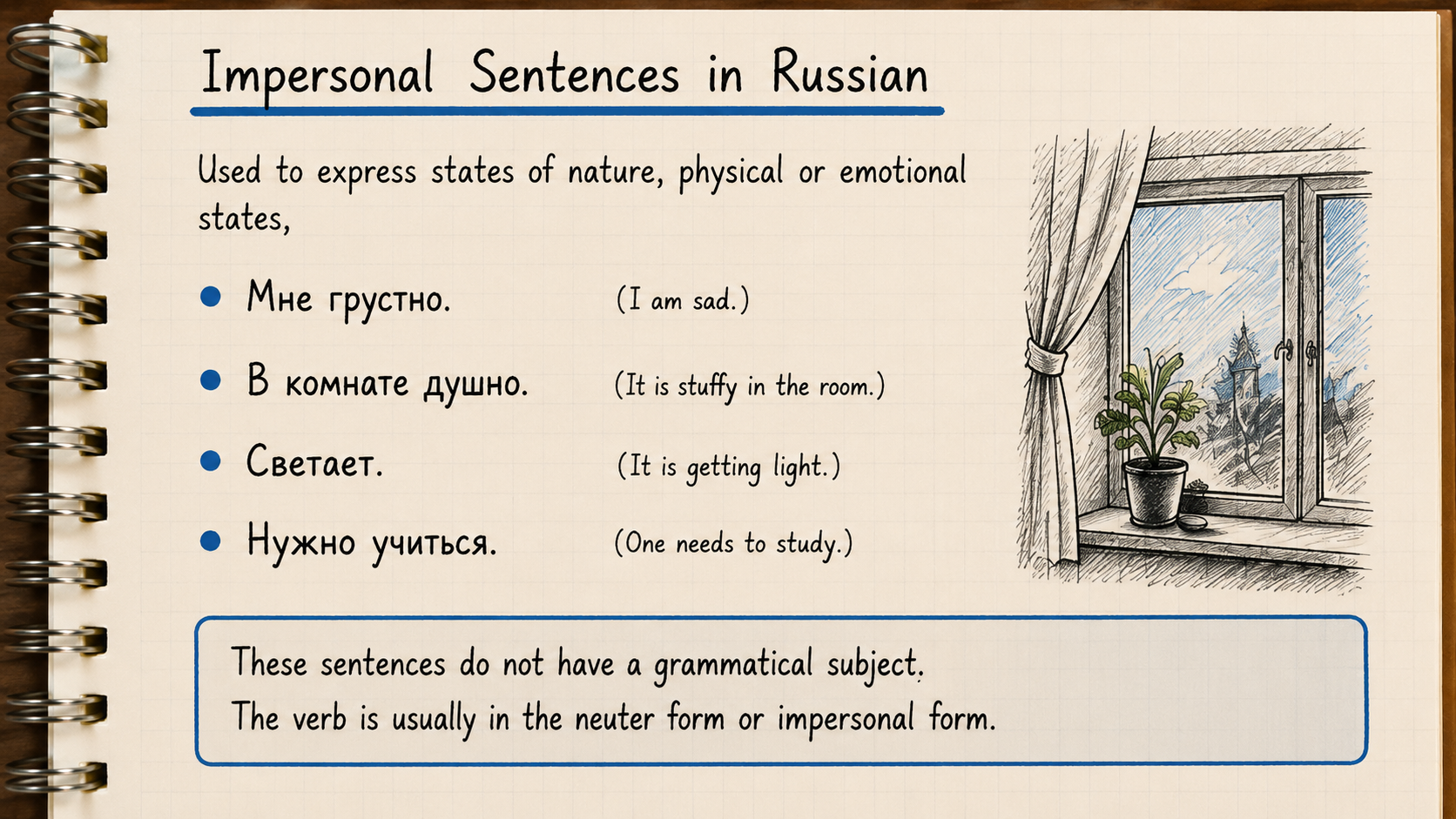
#52 Impersonal Sentences in Russian
Yuri Miyajima Russian Forest


In Russian, the way you address another person can affect the sense of distance or closeness in a conversation. One of the clearest examples of this is the distinction between the second-person pronouns Ты and Вы.
Although both can be translated as “you,” they are used in different situations. One form is typically used with family members and close friends, while the other is used with people you have just met, professional contacts, and those to whom you wish to show respect. As a result, even if your grammar is correct, choosing the wrong pronoun can make you sound either overly familiar or unnecessarily distant.
The difference between Ты and Вы is therefore more than a grammatical distinction. It is an important part of Russian communication that reflects your relationship with the other person, your relative social positions, and the situation in which the conversation takes place.
In this article, I will explain the differences between Ты and Вы, when each form is used, and the main points you should keep in mind when choosing between them.
Both Ты and Вы are personal pronouns meaning “you.” Which one you use depends on your relationship with the other person and the context of the conversation.
The basic distinction is as follows.
Ты is used when speaking with family members, close friends, romantic partners, and other people with whom you have a familiar relationship. Вы, on the other hand, is used with people you are meeting for the first time, teachers, superiors, professional contacts, and others whom you wish to address politely.
However, age alone does not determine which pronoun you should use. You may use Ты with an older person if you have a close relationship, while Вы may be appropriate with someone your own age if you have just met or if the relationship is professional.
In this way, your choice between Ты and Вы reflects the psychological distance and relationship between you and the other person. For this reason, choosing a second-person pronoun is itself an important part of communication in Russian.
Ты is mainly used when speaking with someone with whom you have a close or familiar relationship. Typical examples include:
Ты may also be used among students of a similar age or between colleagues who have become close. The choice does not depend on age alone; it can also reflect the degree of familiarity between the speakers and the customs of a particular group.
However, because Ты generally implies a familiar relationship, using it immediately with an adult you have just met can sound overly familiar or even impolite.
In particular, I recommend avoiding Ты at the beginning of interactions between adults who do not know each other, in professional communication, and in formal situations.
As a general rule, if your relationship with someone is not yet clear, it is safer to begin with Вы. You can then switch to Ты later once you become closer and both parties are comfortable doing so.
Вы is used to show politeness and respect toward another person. You will commonly use it with:
In Russian-speaking regions, Вы is generally used when speaking to strangers in shops, hotels, restaurants, hospitals, railway stations, and other public places.
It is also common to begin with Вы when speaking to a new colleague or business contact. In professional and formal contexts, the nature of the relationship and the situation are usually more important than age.
If you are unsure whether to use Ты or Вы, I recommend choosing Вы. Speaking politely will generally not cause offense, whereas using Ты too soon can give an impression of excessive familiarity.
You can switch to Ты once the other person suggests it or once the relationship has become sufficiently close.
One important point to remember is that Вы does not only function as a polite form of singular “you.” It is also the second-person plural pronoun meaning “you” when addressing more than one person.
For example, in the following sentence, Вы refers to several people.
In the next sentence, however, Вы is used politely when speaking to one person.
In other words, Вы has two main functions:
If you see the sentence by itself, it may sometimes be difficult to determine whether Вы refers to one person or several. In actual conversation, however, the number of people being addressed and the surrounding context usually make the meaning clear.
Even when Вы is used politely for one person, the verb still takes the second-person plural form. This means that you cannot distinguish polite singular Вы from plural Вы from the verb form alone.
In letters and emails, you may also see Вы written with a capital letter when politely addressing one individual. When referring to several people, вы is normally written with a lowercase letter.
When you use Ты and Вы, the form of the verb changes as well.
For example, the verb говори́ть, meaning “to speak,” is conjugated as follows in the present tense.
The verb жить, meaning “to live,” changes in the same way.
As you can see, Russian changes not only the pronoun but also the ending of the verb. This means that you cannot simply replace Ты with Вы without changing the verb as well.
Grammatically, Вы is treated as a second-person plural form. Whether it refers politely to one person or literally to several people, the verb takes the second-person plural form.
To become comfortable using Ты and Вы, I recommend learning each pronoun together with the corresponding verb forms.
In Russian-speaking cultures, people who become closer may switch from Вы to Ты.
This may happen, for example, between colleagues who originally met at work, acquaintances who become close at university, or people who gradually develop a more familiar relationship after meeting repeatedly.
However, this change is usually not made unilaterally. In general, both people should agree to the switch. If there is a significant difference in age or status, the older or more senior person may be the one to suggest it.
The following expressions can be used when proposing a switch from Вы to Ты.
If the other person agrees, both speakers can then begin addressing each other with Ты.
At the same time, becoming closer does not necessarily mean that speakers will always switch to Ты. If there is a large age difference or if the relationship exists within a formal professional environment, people may continue using Вы even after knowing each other for many years.
Both Ты and Вы are Russian personal pronouns meaning “you,” but they are used differently depending on your relationship with the other person.
The main points can be summarized as follows:
The distinction between Ты and Вы is not only a matter of grammar. It is also a cultural way of expressing social distance, familiarity, and respect.
At first, the distinction may feel slightly difficult. However, if you pay attention to your relationship with the other person and the context of the conversation, you will gradually become able to choose between the two forms more naturally.