#47 How to Use the Instrumental Case in Russian
Yuri Miyajima Russian Forest

In Russian, the endings of nouns change depending on the role they play in a sentence. This system is known as case, and Russian has six cases: the nominative, genitive, dative, accusative, instrumental, and prepositional.
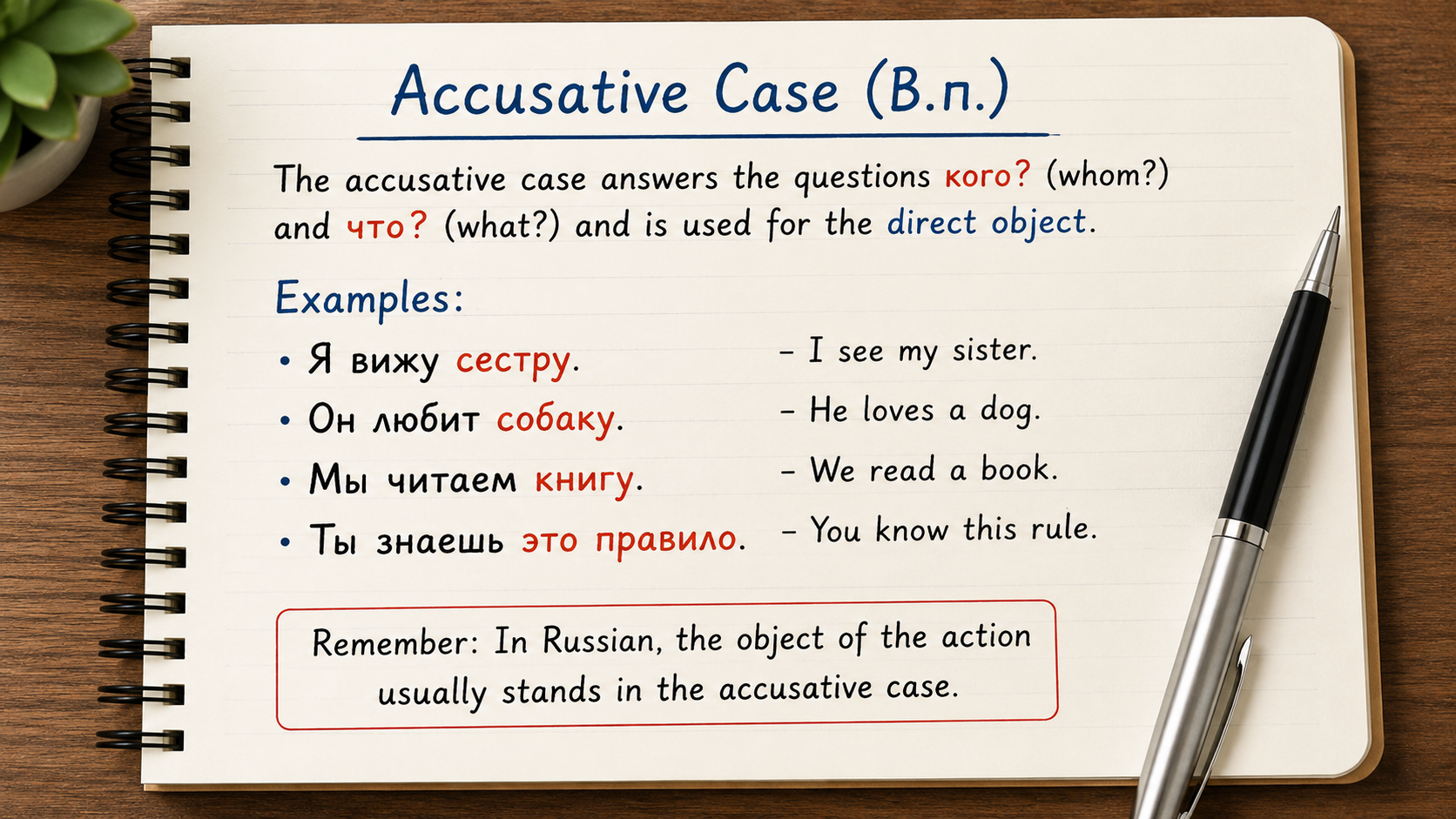
The accusative case is mainly used to indicate the object of an action, corresponding closely to the direct object in English. For example, in phrases such as “read a book” or “watch a film,” the nouns “a book” and “a film” function as direct objects.
The accusative can also be used with certain prepositions to express meanings such as direction of movement and time.
In addition, with masculine singular nouns and plural nouns, the accusative form varies depending on whether the noun is animate or inanimate. This distinction is an important point to understand when learning Russian case declension.
In this article, I will explain what the Russian accusative case is, how it is used, how noun endings change, and how animate and inanimate nouns differ.
The accusative is one of the six cases in Russian.
Its main function is to indicate the object affected by the action expressed by a verb. In this respect, it is similar to the direct object in English.
For example, “I am watching a film” is expressed as follows:
In this sentence, фи́льм (film) is the object of the action “to watch,” so it is in the accusative case. Since фи́льм is a masculine inanimate noun, its singular accusative form is identical to its nominative form: фи́льм.
The accusative case is also used with certain prepositions to express direction of movement and time.
Here, the accusative form шко́лу of шко́ла (school) follows the preposition в and expresses the direction of movement: “to school.”
When learning the accusative, I recommend first paying attention to the basic structure of a sentence—who is doing what, and what the action is directed toward. If you understand that the noun corresponding to “what?” is often placed in the accusative, the later declension patterns will be easier to learn.
The accusative is frequently used with transitive verbs that take direct objects, such as “read,” “see,” and “buy.”
For example, the accusative is used with the direct objects of the following verbs:
As these examples show, when you ask кого́? (whom?) or что? (what?) in relation to a verb, the noun that answers the question is often placed in the accusative case.
However, a noun translated as an English direct object is not always expressed in the accusative in Russian. Some Russian verbs require the noun that follows them to be in another case, such as the genitive, dative, or instrumental.
For this reason, when you learn a new verb, it is important to check not only its meaning but also which case it requires.
The accusative is used not only for direct objects but also with prepositions to indicate direction of movement or a destination.
The prepositions в and на are especially common. The structures “в + accusative” and “на + accusative” answer the question “where to?”
For example:
Here, шко́ла → шко́лу, Москва́ → Москву́, and рабо́та → рабо́ту, with each noun changing into the accusative.
Whether you use в or на depends on the destination.
The preposition в is commonly used when moving into or toward countries, cities, buildings, and similar places.
By contrast, на is often used with activities and events such as work, classes, and concerts, as well as with certain places.
However, the choice between в and на is often determined by convention. For this reason, when learning vocabulary for places, I recommend learning which preposition is normally used with each noun.
You should also note that the same prepositions в and на take the prepositional case rather than the accusative when they indicate location rather than movement.
This distinction becomes easier to understand if you consider the question words involved.
When answering Куда́? (Where to?), you generally use “в / на + accusative.”
When answering Где? (Where?), you generally use “в / на + prepositional.”
When learning the accusative, it is therefore important to remember not only its function as a direct object but also its use with в and на to express where someone or something is moving.
When changing masculine nouns into the accusative, the distinction between animate and inanimate nouns is important.
Animate nouns refer mainly to people and animals. Examples include брат (brother), студе́нт (student), and кот (cat).
Inanimate nouns refer to objects, places, abstract concepts, and similar things. Examples include стол (table), телефо́н(telephone), and фи́льм (film).
This distinction matters because masculine singular nouns take different accusative forms depending on whether they are animate or inanimate.
For inanimate nouns, the accusative is the same as the nominative.
In this sentence, стол is in the accusative because it is the object of покупа́ю (I am buying). However, because стол is inanimate, its form remains identical to the nominative: стол.
With animate nouns, however, the accusative is the same as the genitive.
In these examples, бра́та and студе́нта have the same forms as the genitive.
The rule for masculine singular nouns can therefore be summarized as follows:
However, the distinction between animate and inanimate is a grammatical classification and does not always correspond perfectly to whether something is literally alive. Some nouns, such as ро́бот (robot), can therefore require particular attention.
As a starting point, I recommend remembering the basic principle that nouns referring to people and animals are generally animate, while nouns referring to objects and concepts are generally inanimate.
For feminine and neuter nouns, the singular accusative follows relatively regular patterns.
First, feminine nouns ending in -а or -я generally change their endings as follows:
For example:
Feminine nouns ending in -ь, however, have the same form in the accusative and nominative.
For neuter nouns, the singular accusative is generally identical to the nominative.
The singular accusative patterns for feminine and neuter nouns can therefore be summarized as follows:
The distinction between animate and inanimate nouns is also important in the plural accusative.
In the singular, the animate–inanimate distinction affects the accusative form mainly with masculine nouns. In the plural, however, the accusative form depends on animacy regardless of grammatical gender.
For inanimate nouns: plural accusative = plural nominative
For example, the feminine inanimate noun кни́га (book) appears as follows in the plural:
Here, кни́ги is in the plural accusative, but it has the same form as the plural nominative кни́ги.
For animate nouns referring to people or animals: plural accusative = plural genitive
For example, the plural nominative of студе́нт (student) is студе́нты, while the plural accusative is студе́нтов, the same as the plural genitive.
This rule also applies to feminine and neuter nouns in the plural.
For example, сестра́ (sister) is feminine, but because it refers to a person and is therefore animate, its plural accusative is сестёр, identical to the plural genitive, rather than the plural nominative сёстры.
The plural rules can therefore be summarized as follows:
In the singular, you need to pay particular attention to whether the noun is masculine. In the plural, however, the animate–inanimate distinction applies regardless of whether the noun is masculine, feminine, or neuter.
The accusative is one of the six cases in Russian and is mainly used to indicate the object of an action.
Its main characteristics can be summarized as follows:
The accusative is one of the most frequently used and important cases in Russian. It is essential for forming basic expressions such as “what you do something to” and “where you are going.”
At first, the distinction between animate and inanimate nouns and the different ending changes may seem complicated. However, if you organize the rules together with example sentences, they become much easier to understand.