#3 The Origins of the Russian Language
Yuri Miyajima Russian Forest


When you read about the history of the Soviet Union, you will frequently encounter abbreviations written in Cyrillic, such as СССР, КПСС, НКВД, and КГБ.
The widespread use of such abbreviations is one of the distinctive features of Russian during the Soviet era. After the Russian Revolution of 1917, numerous organizations and institutions were created under the new political system, and many abbreviations emerged as a convenient way to refer to them.
In the Soviet Union, abbreviations were not formed only by combining the initial letters of words. It was also common to create new words by combining parts of several words. Some of these shortened forms remain firmly established in modern Russian.
In this article, I will explain why abbreviations became so widespread in Russian during the Soviet era, introduce several representative examples, and show you how they were formed.
Russian had already used various methods of shortening words and names before the Soviet period.
However, abbreviations and shortened forms began to increase rapidly after the Russian Revolution of 1917 and during the subsequent Soviet era.
When the political system of the Russian Empire collapsed following the 1917 Revolution, a wide variety of new organizations and institutions were established to administer the new state and society. These included political parties, government agencies, security organizations, military institutions, enterprises, and educational institutions. As a result, many new names and terms that had not previously existed also appeared.
These organizations were often given long official names consisting of several words. Writing or pronouncing the full name every time was therefore inconvenient. For this reason, shortened forms came to be used extensively in newspapers, official documents, and other contexts where information needed to be communicated efficiently.
One representative example is СССР, the abbreviation for the Soviet Union itself.
Its full name is Сою́з Сове́тских Социалисти́ческих Респу́блик. The abbreviation is formed from the first letter of each word: С + С + С + Р → СССР
Abbreviations during the Soviet era were not limited to politics and government administration. They also became common in fields closely connected with everyday life, including agriculture, industry, and education. As a result, some abbreviations and shortened forms came to be used like ordinary nouns rather than merely as names of organizations.
In this way, the establishment of a new political system in the Soviet era led to the creation of numerous new institutions and concepts. The need for new vocabulary to express them contributed greatly to the rapid development of abbreviations and shortened forms.
Some of the best-known Soviet abbreviations were formed by combining the initial letters of several words.
Because this method made it possible to shorten long names of organizations and state institutions, it was widely used in politics, administration, the military, and other fields.
In addition to СССР, representative examples include КПСС, КГБ, and НКВД.
СССР is the abbreviation for Сою́з Сове́тских Социалисти́ческих Респу́блик, the official name of the Soviet Union, which was established in 1922.
In Russian, it is pronounced by reading the name of each letter individually: эс-эс-эс-э́р
You will still encounter this abbreviation frequently in history books, news reports, literary works, and other materials dealing with the Soviet Union, so it is useful to recognize when studying Russian.
КПСС is the abbreviation for Коммунисти́ческая па́ртия Сове́тского Сою́за, meaning the Communist Party of the Soviet Union.
It is formed from the initial letters of the words: К + П + С + С → КПСС
The Communist Party of the Soviet Union was the central political party of the Soviet political system. You will often encounter this abbreviation in texts dealing with Soviet politics and society.
КГБ is the abbreviation for Комите́т госуда́рственной безопа́сности, meaning the Committee for State Security.
It is formed as follows: К + Г + Б → КГБ
In Russian, the letters are pronounced individually as: ка-гэ-бэ́
The KGB was established in 1954 and was responsible for matters including state security, intelligence, and counterintelligence. Because the English form KGB became widely known internationally, you may already have encountered the term in films, novels, or other media even if you do not know Russian.
НКВД is the abbreviation for Наро́дный комиссариа́т вну́тренних дел, meaning the People’s Commissariat for Internal Affairs.
It is formed from the initial letters: Н + К + В + Д → НКВД
The responsibilities of the NKVD changed over time, but it was a state institution with authority over a broad range of areas, including policing, internal administration, and state security.
You will encounter the abbreviation particularly often in texts dealing with the Stalin era of the 1930s and the Great Purge.
Soviet abbreviations were not always formed by combining initial letters, as in СССР or КГБ. Another widely used method was to combine parts of several words to create a new word.
These shortened forms were useful not only because they reduced long expressions, but also because they could function as independent words.
Representative examples include the following.
колхо́з is a shortened form of коллекти́вное хозя́йство, meaning “collective farm.”
The element кол- comes from коллекти́вное, while -хоз comes from хозя́йство.
During the Soviet period, agriculture was collectivized, and many farmers became part of collective farms of this kind. As a result, колхо́з became one of the characteristic words associated with Soviet society.
совхо́з is a shortened form of сове́тское хозя́йство, meaning “state farm.”
The element сов- comes from сове́тское, while -хоз comes from хозя́йство.
Although колхо́з and совхо́з are both related to Soviet agriculture, their systems were different. A колхо́з was a collective farm organized on a cooperative basis, where farmers worked together, whereas a совхо́з was a state-owned farm.
Understanding this distinction can make it easier for you to read texts about agriculture and social institutions during the Soviet period.
The modern Russian word зарпла́та, meaning “salary” or “wages,” was also formed through abbreviation.
The original expression is зара́ботная пла́та, which means “wages” or “salary.”
Parts of these two words were combined to create зарпла́та, which remains a common word in everyday Russian today.
When the Soviet Union was dissolved in 1991, many of the state institutions and political structures of the Soviet era disappeared.
As a result, abbreviations such as СССР, КПСС, and НКВД are now used mainly in historical contexts.
However, not all abbreviations and shortened forms that became widespread during the Soviet era disappeared. For example, зарпла́та remains an ordinary word in modern Russian. колхо́з and совхо́з also continue to appear when discussing Soviet agriculture and history.
Moreover, the method of creating new names and words by combining shortened parts of several words continues to be used in modern Russian.
The Soviet Union itself no longer exists, but some of the abbreviations and shortened forms that became common during that period have been inherited by the Russian language of today.
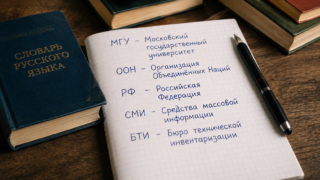
During the Soviet era, numerous abbreviations emerged as new political and social institutions were created.
The main characteristics can be summarized as follows:
Behind the development of Soviet abbreviations lay the enormous historical transformation that followed the Revolution, during which new state institutions and social systems were created one after another.
Learning these abbreviations not only expands your Russian vocabulary but also helps you understand the society and culture of the Soviet era more deeply.