#44 How to Use the Genitive Case in Russian
Yuri Miyajima Russian Forest

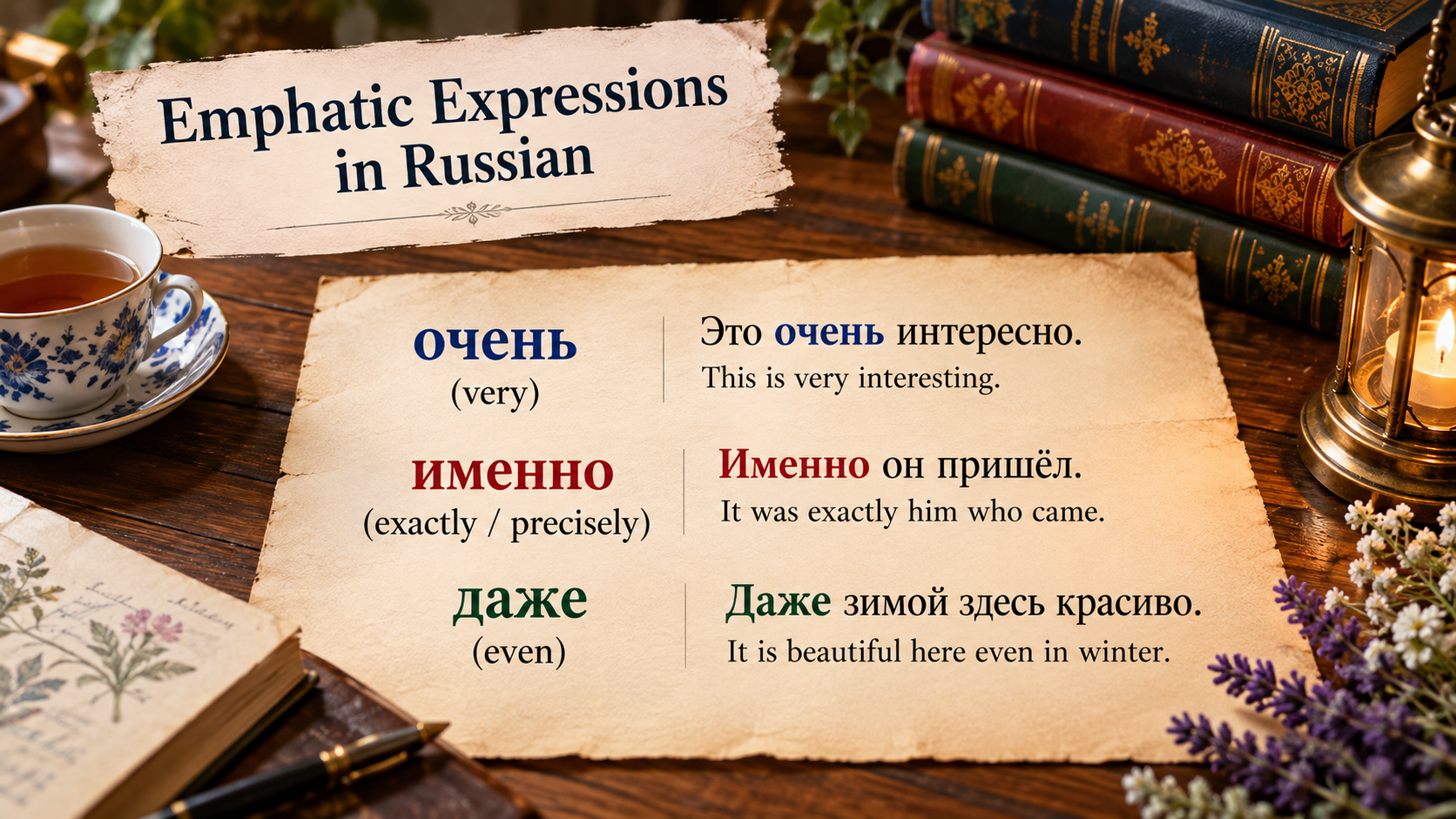
Russian frequently uses words such as о́чень (very), и́менно (precisely, exactly), and да́же (even) to emphasize particular meanings or information.
For example, adding о́чень to Э́то ва́жно. (This is important.) gives Э́то о́чень ва́жно. (This is very important.), strengthening the degree of importance.
By contrast, И́менно э́то ва́жно. means “This is exactly what is important,” placing particular emphasis on э́то (this). In this way, Russian emphatic expressions can not only intensify the degree of a quality but also draw attention to a particular person, object, or piece of information.
Russian can also create emphasis by adding particles such as же and ведь, changing word order, or placing stronger spoken stress on a particular word.
Understanding these features makes it easier to grasp not only the meanings of individual words and grammatical structures but also what the speaker particularly wants to emphasize.
In this article, I will explain some of the most common emphatic expressions in Russian, using specific words and example sentences.
One of the most commonly used words for intensifying degree in Russian is о́чень.
О́чень is an adverb meaning “very” or “extremely.” It can be used with adjectives and adverbs, as well as with verbs and expressions describing emotions or states, to indicate a high degree or intensity.
О́чень can also be combined with verbs and other expressions to emphasize the intensity of an emotion or state.
In this way, о́чень can be combined with a wide variety of expressions related to emotions, states, and actions.
In addition to о́чень (very), Russian has various other adverbs that can intensify the degree expressed by an adjective, adverb, or other expression.
Common examples include кра́йне, чрезвыча́йно, необыкнове́нно, and ужа́сно.
Кра́йне expresses a particularly strong degree and can be translated as “extremely” or “highly.” It is often used when emphasizing matters such as importance or seriousness.
Чрезвыча́йно also expresses a strong degree and can be translated as “extremely” or “exceptionally.”
Необыкнове́нно means “extraordinarily” or “exceptionally” and emphasizes that something goes well beyond the ordinary degree.
In everyday conversation, ужа́сно is also frequently used as an intensifier.
Ужа́сно is related to ужа́с (horror, something terrible), but when used as an intensifying adverb, it can also emphasize positive statements.
When comparing several people or things and indicating that one has a particular quality to the highest degree, Russian can use са́мый.
The construction “са́мый + adjective” can form a superlative meaning “the most.”
Са́мый declines like an adjective. Together with the adjective that follows it, its form changes according to the gender, number, and case of the noun being modified.
In the nominative case, са́мый is used for masculine singular nouns, са́мая for feminine singular nouns, са́мое for neuter singular nouns, and са́мые for plural nouns. In other cases, these forms change according to the relevant case endings.
In addition to forming superlatives, са́мый can also be used for emphasis in the sense of “the very” or “that exact.”
Тот са́мый focuses attention on a particular person, object, time, or other referent that has already been mentioned or is otherwise identifiable from the context.
Thus, са́мый can be used both to emphasize degree in the sense of “the most” and to identify a particular referent in the sense of “the very” or “that exact.” Which meaning is intended can be determined from the surrounding words, such as an adjective or тот, and from the context.
И́менно means “precisely,” “exactly,” or “the very” and is used to focus attention on a particular piece of information.
It emphasizes one specific possibility among several, conveying the sense of “this particular one” or “this and no other.”
Consider the following sentence:
Here, the focus is on он (he). The sentence emphasizes that he, rather than someone else, was the person who helped the speaker.
И́менно is generally placed before the word or phrase being emphasized.
In the first sentence, туда́ (there) is emphasized; in the second, сего́дня (today); and in the third, э́ту кни́гу (this book).
И́менно can therefore focus attention on many kinds of information, including people, places, times, and objects.
It can also be used by itself to express strong agreement with what another person has said.
When used independently in this way, и́менно strongly confirms the other speaker’s statement and corresponds to expressions such as “Exactly” or “Precisely.”
И́менно therefore has a different function from о́чень, which expresses a high degree. Rather than intensifying degree, и́менно selects and focuses attention on a specific piece of information within a sentence.
In Russian, да́же is frequently used to emphasize a person, object, or situation that is unexpected in some way.
Да́же is a particle meaning “even” and is often placed before the word or phrase being emphasized.
It draws attention to information that the speaker considers surprising, unexpected, or noteworthy within a particular context.
In Да́же он э́того не зна́ет., there is an underlying expectation that even if other people do not know, he probably would. Да́же emphasizes the surprising fact that he does not know either.
Similarly, Да́же де́ти э́то понима́ют. conveys the idea that not only adults but even children understand it, placing emphasis on де́ти (children).
Да́же is also frequently used with negative expressions.
The construction да́же не can convey the sense that something did not reach even a minimum expected level.
In this way, да́же is an emphatic expression used to highlight information that is unexpected to the speaker or particularly noteworthy within a certain range of possibilities.
The particle же is also frequently used in spoken Russian.
Же can emphasize a particular word or idea in a sentence and can also convey the speaker’s attitude or emotion. Depending on the context, it may correspond to a variety of expressions in English, such as “after all,” “you know,” “but,” or other forms of emphasis.
It is particularly common when the speaker refers again to information that the listener is expected to know or reinforces something that has already been said.
Consider the following example:
Я говори́л. simply states the fact “I said it.” Adding же, as in Я же говори́л!, introduces a nuance such as “I told you before” or “I told you so.”
In other words, же emphasizes the fact that the speaker had already said this previously.
In these examples as well, же draws the listener’s attention back to information that the speaker believes the listener already knows or that has previously been established.
The nuance of a sentence containing же can also change according to intonation.
When pronounced strongly, it can convey insistence, dissatisfaction, surprise, or other emotions more prominently. With gentler intonation, it may sound more like a reminder of information shared by the speaker and listener.
When interpreting же, it is therefore useful to consider which information the speaker is trying to bring more strongly to the listener’s attention. This makes it easier to understand both the sentence and the speaker’s intention.
Ведь is another particle frequently used for emphasis.
It is used when the speaker restates information that they believe the listener already knows or introduces an established fact as a reason or basis for what is being said.
Ты зна́ешь э́то. neutrally communicates the meaning “You know this.” By changing it to Ты ведь зна́ешь э́то., the speaker adds a nuance such as “You know this, don’t you?” or “You do know this,” confirming or reminding the listener of something they are expected to know already.
Ведь is therefore commonly used when referring again to information shared between the speaker and listener or to a fact that the speaker expects the listener to understand or accept.
Ведь can also be used to present a reason or justification.
Here, ведь presents the fact that it is raining outside as the reason for taking an umbrella.
Ведь can also serve as a gentle reminder or reinforce something important.
In this example, ведь brings renewed attention to the fact that the exam is tomorrow, reinforcing the reason why the listener should not forget.
Russian has a variety of emphatic expressions that allow speakers to communicate meanings and emotions more strongly.
The main points discussed in this article can be summarized as follows:
О́чень is one of the most basic emphatic expressions in Russian and combines with adjectives, adverbs, and other expressions to convey a high degree, such as “very” or “extremely.” Words such as кра́йне and чрезвыча́йно can express an even stronger degree or, depending on the context, a more formal nuance.
И́менно, meanwhile, focuses on specific information in the sense of “precisely” or “exactly,” while да́же highlights unexpected information in the sense of “even.”
Particles such as же and ведь can further add nuances related to the speaker’s attitude and information shared between the speaker and listener.
To understand emphatic expressions in Russian, it is useful to pay attention to both what the speaker is emphasizing and the attitude or intention with which the information is being expressed.