#30 Russian in International Organizations
Yuri Miyajima Russian Forest

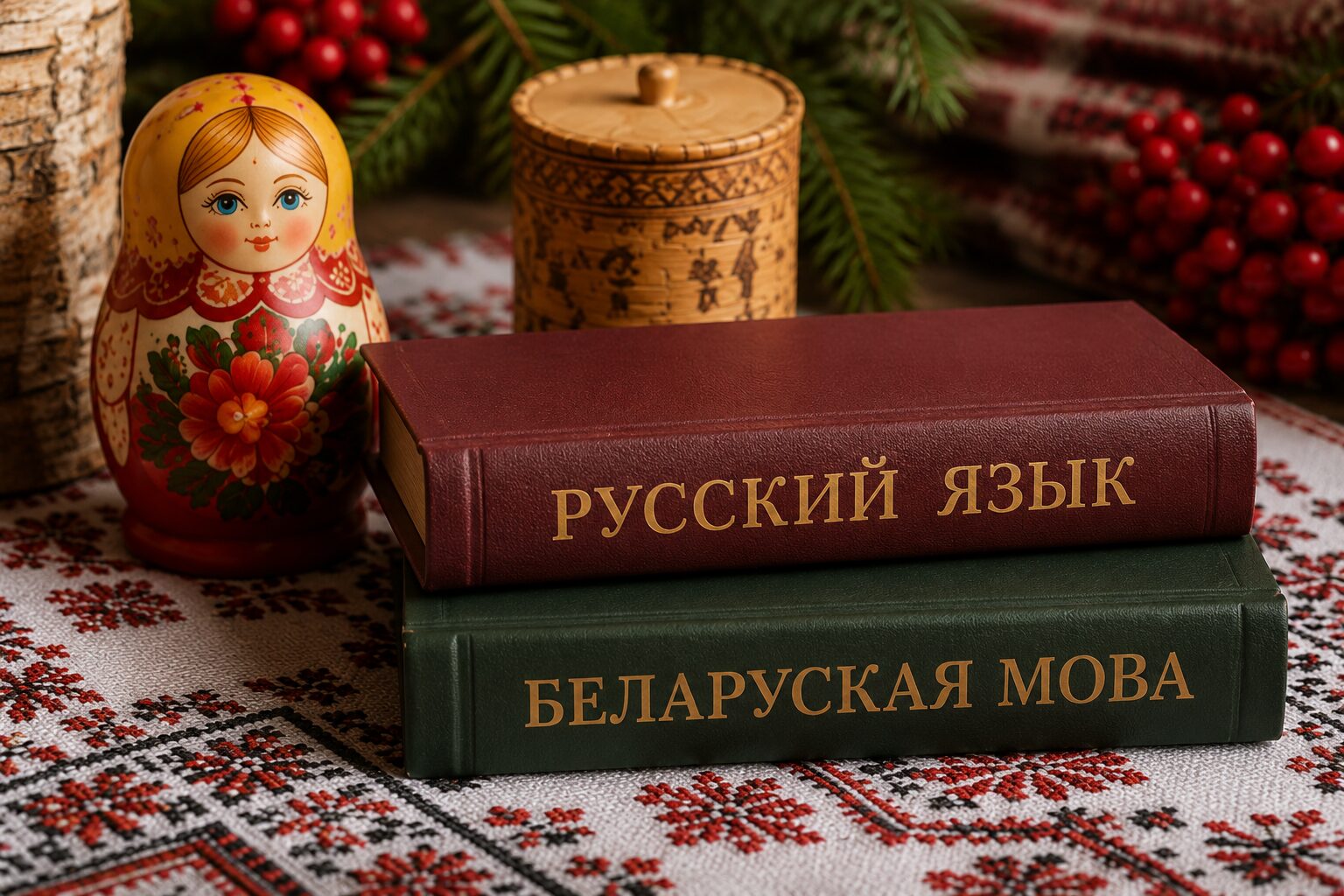
Russian and Belarusian both belong to the East Slavic branch of the Slavic language family and share many similarities in vocabulary and grammar.
At the same time, they are separate languages with distinct historical developments. As Belarusian developed in the regions centred on present-day Belarus, it came into contact with neighbouring languages, particularly Polish.
As a result, its pronunciation, spelling, and vocabulary have developed features that differ from those of Russian.
In this article, I will introduce the main differences between Russian and Belarusian, including pronunciation, alphabet, vocabulary, and grammar.
Russian and Belarusian both belong to the East Slavic branch of the Slavic language family within the Indo-European language family.
The three main East Slavic languages are:
These languages share a common linguistic foundation connected to Old East Slavic, which was used during the medieval period in the territories centred on Kievan Rus’.
Over time, the different regions came under distinct political and cultural influences, and the language gradually developed into modern Russian, Ukrainian, and Belarusian.
Because they share a common origin, the three languages have many similarities in their basic grammar and vocabulary. For example, all three have grammatical cases for nouns, verbs that conjugate according to person, and a distinction between perfective and imperfective verb aspects.
At the same time, each language followed its own historical path, leading to gradual differences in pronunciation, vocabulary, and spelling conventions. Belarusian in particular was influenced over the centuries by neighbouring languages such as Polish and Lithuanian, which contributed to characteristics that distinguish it from Russian.
Belarusian is one of the official languages of the Republic of Belarus.
Following a national referendum held in 1995, both Belarusian and Russian were given official-language status. The current Constitution also recognizes both languages as official languages.
Legally, therefore, Belarusian and Russian have equal official status.
In practice, however, the linguistic situation is more complex.
In present-day Belarus, Russian is widely used in everyday life, government administration, education, and the media. In urban areas, particularly in the capital Minsk, many people use Russian as their main language of daily communication.
Belarusian, meanwhile, plays an important role in literature, music, theatre, publishing, and cultural activities. It is also valued as a language that represents Belarusian history and national culture.
However, the proportion of education provided in Belarusian is lower than that provided in Russian. Therefore, although the two languages have equal legal status, their actual spheres of use cannot be considered completely equal.
Belarus is thus officially a bilingual country, but Russian remains dominant in many areas of society.

Russian and Belarusian differ in several aspects of pronunciation. One of the most representative features is a phenomenon known as akannye (а́канне).
Akannye refers to the pronunciation of an unstressed о as a sound close to а.
This phenomenon also occurs in Russian. In Russian, an unstressed о is often pronounced closer to а, but it is normally still written as о.
In standard Belarusian, by contrast, this pronunciation change is also reflected in the spelling.
For example, the word “milk” is written as follows:
In Russian, the first two instances of о are pronounced closer to а, but the word remains spelled молоко́. In Belarusian, however, it is written малако́ to reflect the actual pronunciation.
Belarusian spelling therefore tends to represent pronunciation more directly than Russian spelling does.
Belarusian г is also generally pronounced as a voiced velar or glottal fricative. There is no exact equivalent in English, but unlike the Russian г, which is usually pronounced as a stop consonant, the Belarusian sound is produced with friction in the back of the throat.
Belarusian also has a feature in which softened д and т are pronounced as sounds close to дз and ц, respectively. These phenomena are known in Belarusian as dzekannye (дзе́канне) and tsekannye (це́канне).
For example, the Belarusian equivalent of the Russian word де́нь is дзе́нь.
These differences in vowels and consonants give Belarusian its own distinctive sound, even though it remains closely related to Russian.
Russian and Belarusian both use the Cyrillic alphabet. However, there are several differences in the letters used and in their spelling conventions.
For example, Belarusian uses the letter ў. Unlike the Russian vowel у, this letter represents a non-syllabic sound similar to the English w. It does not exist in the Russian alphabet and is often regarded as one of the most distinctive symbols of Belarusian.
Belarusian also uses the letter і, which represents a sound similar to the Russian и.
For example, the word “name” is written as follows:
The following letters used in Russian are not included in the Belarusian alphabet:
The function performed by the Russian hard sign ъ is generally represented in Belarusian by an apostrophe. For example, the Belarusian equivalent of the Russian объяви́ть is written аб’яві́ць.
The sound represented by the Russian letter щ is written in Belarusian using the two-letter combination шч.
Since the two languages share many Cyrillic letters, you may become familiar with written Belarusian relatively quickly if you already study Russian. However, because Belarusian has its own letters and spelling rules, you cannot simply apply Russian pronunciation rules to Belarusian words.
Russian and Belarusian share many identical or similar words.
For example, the word “house” is the same in both languages:
Many basic words used in everyday life are shared by both languages.
However, there are also numerous words that differ significantly. For example, “thank you” is expressed as follows:
The expression for “hello” also differs:
Some words therefore have similar forms in both languages, while others are difficult to understand from knowledge of Russian alone.
These differences are connected to the historical development of Belarus. For a long period, the Belarusian lands had close political and cultural ties with regions that are now part of Poland and Lithuania. As a result, Belarusian vocabulary contains influences from neighbouring languages such as Polish and Lithuanian.
Belarusian therefore shares a common ancestor with Russian but has developed independently, resulting in many words and expressions that differ from their Russian equivalents.
The basic grammatical structures of Russian and Belarusian are very similar.
Both languages mainly have the following features:
For this reason, many aspects of Belarusian grammar may be comparatively easy to understand if you have already studied Russian.
However, differences can be found in the declension of nouns and adjectives, verb endings, pronouns, and the use of prepositions.
For example, “I speak” is expressed as follows:
The subject pronoun я is shared by both languages, but the form of the verb differs.
Belarusian grammar and spelling also contain other rules that are not found in Russian.
Although the two languages have similar basic structures, Belarusian cannot be created simply by mechanically replacing Russian words or endings. It is important to study each as an independent language.
Russian and Belarusian speakers may be able to understand each other to some extent.
This is because the two languages share a common ancestor and have similar vocabulary and grammar. In simple sentences and everyday expressions, speakers can often infer the general meaning.
However, this does not necessarily mean that they can communicate freely without difficulty. If a conversation continues entirely in Belarusian or contains a large amount of region-specific vocabulary and expressions, a Russian speaker may not fully understand it.
Similarly, a Belarusian speaker who has not learned Russian may not necessarily understand everything in Russian without difficulty.
In Belarus itself, many people can also speak Russian, and Russian is widely used in everyday life, employment, and education. As a result, Russian speakers visiting Belarus may experience relatively few major communication difficulties.
However, this is not because Russian and Belarusian are the same language. It is largely due to the social reality that many people in Belarus understand and use Russian.
The two languages therefore share many similarities and may be mutually understandable to a certain degree, but they must still be recognized as separate languages.
Russian and Belarusian are closely related East Slavic languages, but each has its own history and distinctive characteristics.
The main points can be summarized as follows:
By comparing the two languages, you can notice features of Russian pronunciation and grammar that may be difficult to recognize when studying Russian alone.
For this reason, I believe that if you are learning Russian, it is also worthwhile to have a basic understanding of Belarusian.