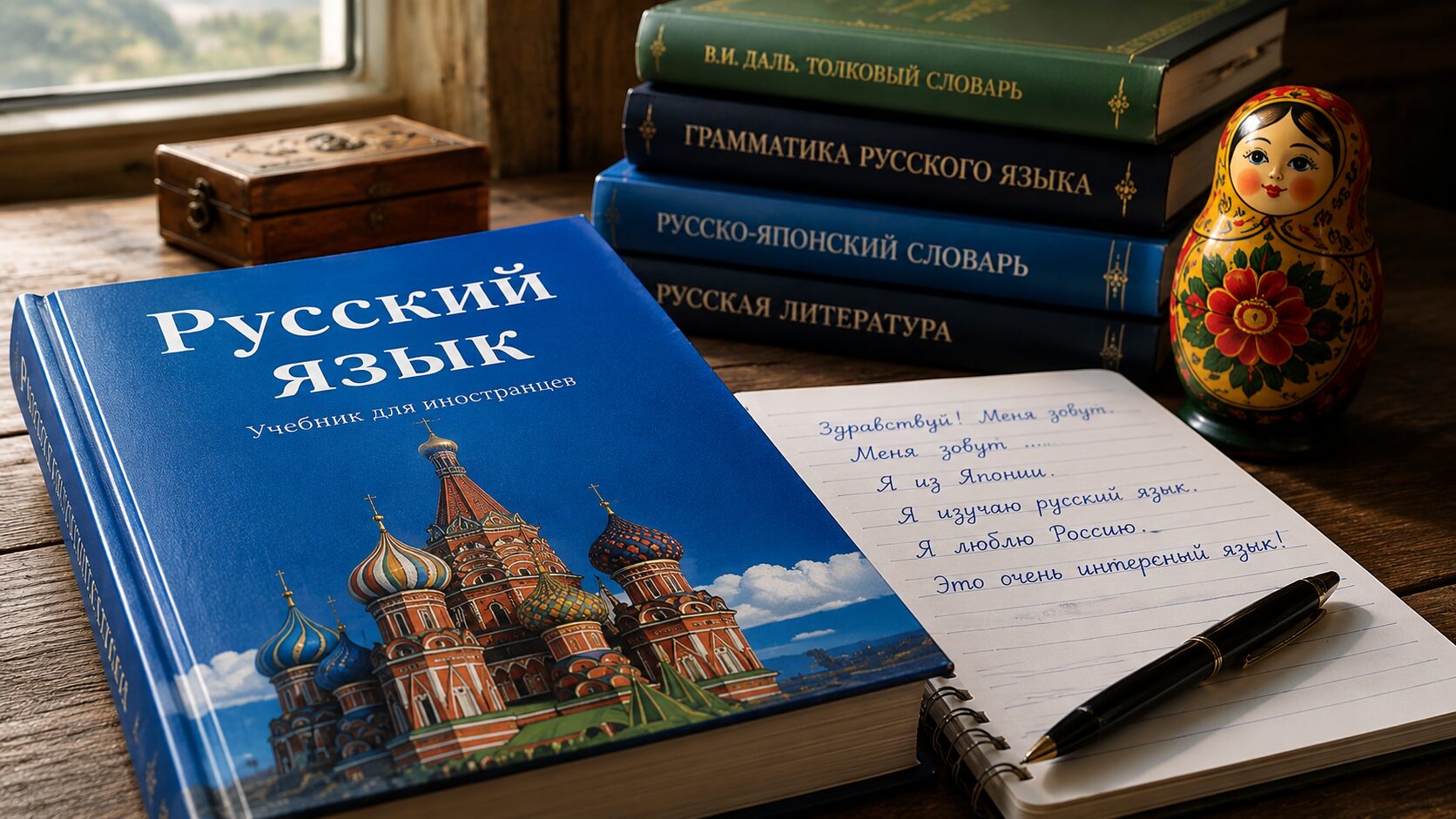
#1 Characteristics of the Russian Language
Izumi RUSSIAN FOREST

You may have heard that Russian is one of the most difficult languages in the world. If you are thinking about studying Russian, you may be wondering whether you will really be able to master it.
Before I began learning Russian, I also thought it was an extremely difficult language. However, as I continued studying, I came to realize that although Russian certainly has challenging features, it is by no means impossible to learn if you understand the reasons for those difficulties and approach them one step at a time.
Russian is often considered difficult because it has several features that differ greatly from English, including the Cyrillic alphabet, grammatical cases, and distinctive verb patterns.
In this article, I will introduce the main reasons why Russian is considered a difficult language.
The first difficulty many learners encounter when studying Russian is the Cyrillic alphabet. Russian does not use the Latin alphabet found in English. Instead, it uses the Cyrillic alphabet, which consists of 33 letters.
For people who are accustomed to English, Russian may initially appear to be written with entirely unfamiliar symbols. Letters such as Я, Ж, and Ы may look strange, and many beginners feel that they cannot read even a single word at first.
Another source of confusion is that some Cyrillic letters resemble Latin letters but represent different sounds. For example, the Cyrillic letter В represents the English v sound, Н represents n, and Р represents r. Until you become familiar with these differences, reading Russian can be frustrating.
In practice, however, the relationship between Cyrillic letters and their sounds is relatively clear. Compared with English, Russian has fewer words in which the spelling and pronunciation differ significantly. Once you learn the basic rules, you can often make a reasonable guess at how an unfamiliar word is pronounced.
One important point to remember is that unstressed vowels can change their pronunciation in Russian. The position of the stress is often impossible to determine from the spelling alone. For this reason, when learning a new word, it is important to check not only its meaning and spelling but also its stress pattern.
At the beginning of your studies, you may feel that simply reading the letters requires all your attention. Once you have learned the Cyrillic alphabet, however, you will gradually become able to read words and sentences. It may seem like a major obstacle at first, but after you overcome it, the rest of your studies will become much easier.
One reason Russian is considered difficult is its system of grammatical cases.
A grammatical case is a change in the form of a noun, adjective, pronoun, or other word according to its function within a sentence.
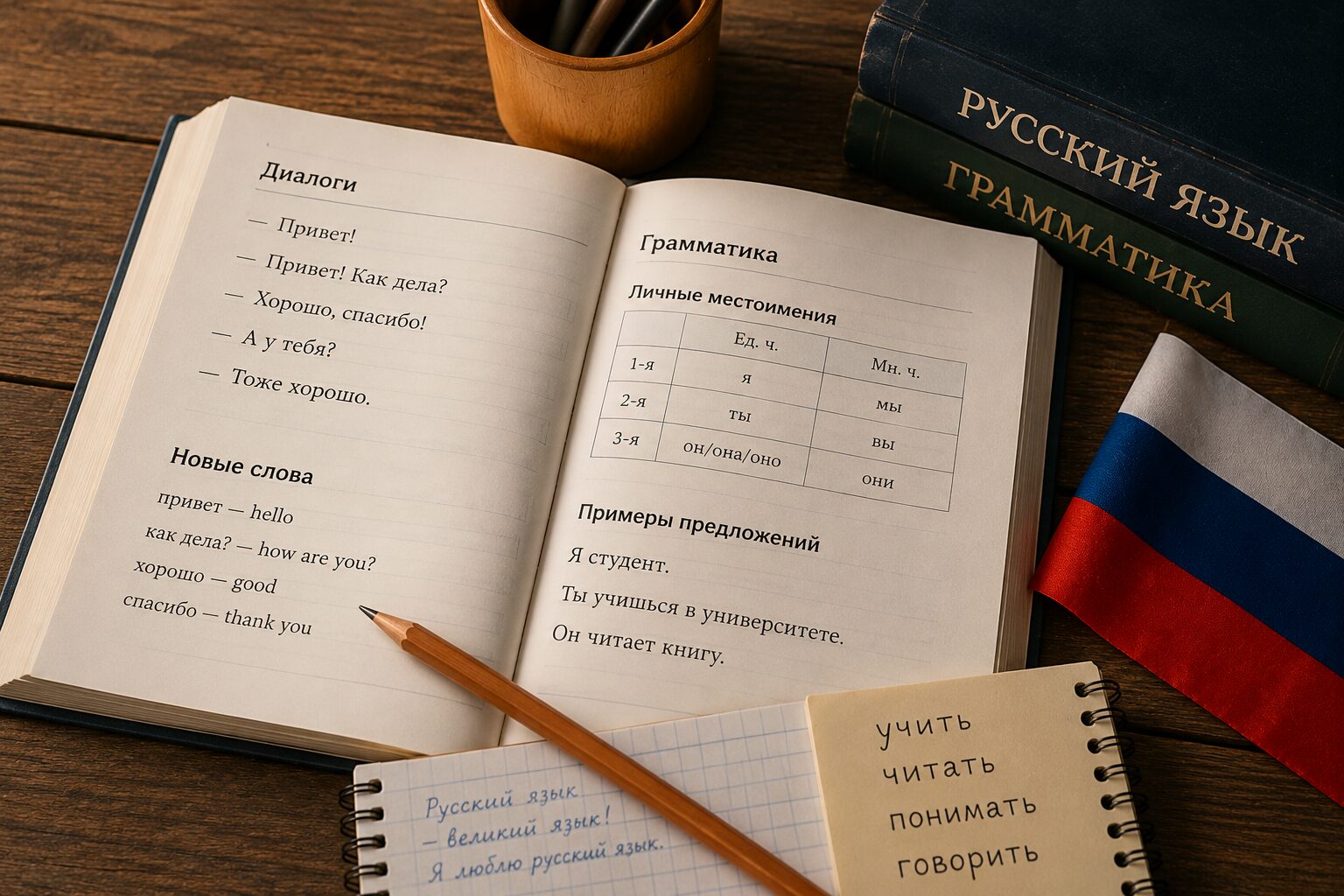
Russian has 6 cases: the nominative, genitive, dative, accusative, instrumental, and prepositional cases. Each case expresses a different grammatical function, such as the subject of a sentence, possession, a recipient, an object, a means, or a location.
Some relationships that are expressed through word order in English are expressed through case endings in Russian.
For example, the Russian word дом, meaning “house,” changes its form depending on its role in the sentence.
In this way, Russian combines prepositions with case changes to express meanings such as “where to,” “where,” and “where from.” For example, the same preposition в is followed by the accusative case when it indicates movement into a place, but by the prepositional case when it indicates a location inside that place.
The patterns of case changes also differ according to whether a noun is singular or plural, whether it is masculine, feminine, or neuter, and what type of ending it has. Adjectives and pronouns must also change to agree with the gender, number, and case of the nouns they are connected to.
For this reason, I do not recommend trying to memorize every possible ending from the beginning. It is more effective to study the basic function of each case and repeatedly observe how it is used in example sentences. Over time, you will gradually develop an intuitive understanding of the case system.
Russian has a grammatical concept known as verbal aspect. Many Russian verbs have 2 forms: the imperfective aspect and the perfective aspect.
The imperfective aspect is used when focusing on an action in progress, an ongoing or repeated action, a habit, or the action itself.
The perfective aspect, by contrast, is used when focusing on the completion of an action, its result, or the achievement of a particular goal.
For example, there are 2 verbs associated with the meaning “to read.”
The imperfective verb читать focuses on the process of reading, such as being in the middle of reading a book. The perfective verb прочитать, on the other hand, emphasizes the result of having finished the book.
In Russian, you therefore need to consider not only what action took place, but also whether the speaker views that action as an ongoing process or as a completed result.
English also has progressive and perfect constructions, but Russian aspect does not correspond exactly to English tense. This makes verbal aspect one of the features that learners often find difficult at the beginning.
Russian does not have the same strict word order as English. This is because the case endings of nouns and pronouns indicate the role that each word plays within a sentence.
In English, for example, changing the word order in a sentence such as “The student reads the book” can change who is performing the action and what is being read.
In Russian, however, subjects and objects are distinguished primarily through grammatical cases rather than word order. As a result, the order of words can often be changed without making the basic meaning unclear.
Word order in Russian can also affect which information is presented as new or which part of the sentence the speaker wishes to emphasize. Therefore, even when the same words are used, changing their order can create a different nuance.
For this reason, beginners may feel confused when they encounter sentences in which the subject or verb appears in a different position from the basic word order taught in textbooks.
When studying Russian, I recommend first learning to construct sentences using the basic word order. After that, you can gradually develop a sense of how changes in word order affect nuance by reading and listening to a wide range of Russian.
Russian belongs to the Slavic branch of the Indo-European language family, while English belongs to the Germanic branch. As a result, many common Russian words have different origins from their English equivalents.
For example, the English words house, water, and friend are дом, вода, and друг in Russian. These words look completely different, making it difficult to guess their meanings by applying your knowledge of English. You therefore need to learn much of the basic vocabulary from the beginning.
At the same time, Russian and English both belong to the Indo-European language family, so they are not entirely unrelated. Many international and academic terms resemble their English equivalents. For example, words such as телефон (telephone), музей (museum), and университет (university) are relatively easy to understand from English.
Nevertheless, much of the basic vocabulary used in everyday conversation is of Slavic origin and is unfamiliar to English speakers. This feeling that you must learn a large amount of vocabulary from the beginning is another reason Russian is often perceived as difficult.
Russian is certainly not an easy language. However, its difficulty can make the sense of achievement even greater when you notice your progress.
You can steadily deepen your understanding of Russian by taking the learning process one step at a time:
As you continue studying, you will gradually experience small signs of progress. You may realize that you can now read Russian words that once seemed impossible to decipher, or that you can recognize familiar words in films and songs. These experiences can become a major source of motivation.
When I first began studying Russian, I also wondered whether I would be able to remember so many different forms. However, by continuing little by little, I became able to read sentences and began to understand the structure and appeal of the language.
Because Russian is challenging, the satisfaction of understanding a new grammatical pattern or expression can be particularly strong. I believe this is one of the great attractions of learning Russian.
Russian is often considered difficult because its writing system and grammar differ significantly from those of English.
The main reasons can be summarized as follows:
When you first begin studying Russian, the amount of new information may make the language seem difficult.
However, as you continue learning one step at a time, its underlying structure will gradually become clearer. Rather than trying to understand everything at once, it is important to learn the alphabet, basic vocabulary, and grammar in a logical order.