#6 The Orthodox Church and Church Slavonic
Izumi RUSSIAN FOREST

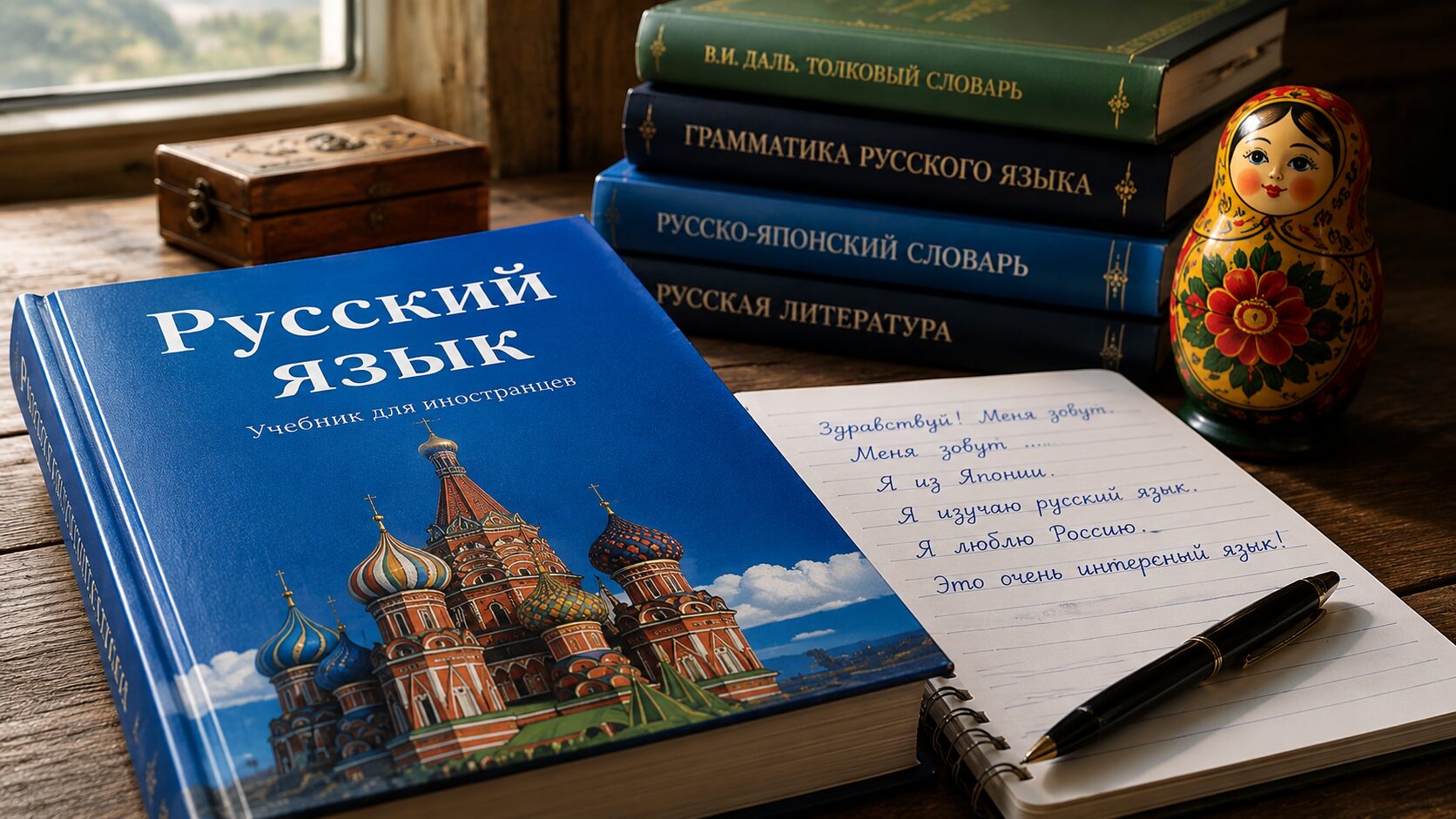
Russian is often regarded as a difficult language. Its Cyrillic alphabet, complex grammar, and system of noun cases can initially seem confusing to learners.
However, even grammatical features that appear complicated at first are governed by clear rules and have specific purposes. As you begin to understand how these systems work, you will gradually discover what makes Russian such an interesting language.
In this article, I will introduce the main characteristics of Russian, focusing on its writing system and grammar.
Russian is a member of the Slavic branch of the Indo-European language family.
The Indo-European language family includes many branches, such as the Germanic languages, which include English and German; the Romance languages, which include French and Spanish; and the Slavic languages, which include Russian.
The Slavic languages are further divided into three groups: East Slavic, West Slavic, and South Slavic.
Russian belongs to the East Slavic group and shares many features with Ukrainian and Belarusian in particular. These languages have similarities in their basic vocabulary and grammar, and recognizing these common elements can be helpful when you study one of the other languages.
Polish, Czech, Serbian, and several other languages also belong to the Slavic branch. However, each has developed independently, and there are considerable differences in pronunciation, vocabulary, and grammar.
By learning about the relationships among the Slavic languages, you can understand Russian not merely as an isolated language but as part of the broader Slavic world.
Becoming aware of these linguistic connections can make your study of Russian even more interesting.
One of the most distinctive features of Russian is its use of the Cyrillic alphabet.
Instead of the Latin alphabet used in English and French, Russian uses a writing system known as Cyrillic. The modern Russian alphabet consists of 33 letters and distinguishes between uppercase and lowercase forms. Cyrillic is also used by several other languages, including Bulgarian and Mongolian.
Although it may look difficult when you first encounter it, many of its letters follow recognizable patterns.
For example, the following letters resemble their Latin counterparts in both appearance and pronunciation:
On the other hand, letters such as the following represent sounds that do not exist in Japanese or English:
You also need to be careful with letters that resemble Latin letters but represent different sounds. For example, В is pronounced like “V,” Н like “N,” and Р like “R.”
Nevertheless, I do not believe that Cyrillic is as difficult as many people imagine. The Russian alphabet contains 33 letters, only slightly more than the 26 letters of the English alphabet, and the relationship between spelling and pronunciation is relatively regular. Once you have learned the alphabet, you will be able to pronounce many unfamiliar words simply by looking at their spelling.
However, vowel pronunciation can change depending on the position of the stress. For this reason, you generally need to learn the stress pattern of each word.
One of the grammatical systems that most clearly characterizes Russian is noun declension.
Russian nouns change their endings according to the role they perform within a sentence. This change in form is known as case declension.
Modern Russian generally uses the following six cases:
Each case has its own function. The nominative case, for example, is generally used for the subject of a sentence. The genitive can express possession or the meaning of “of.” The dative often corresponds to “to” or “for,” while the accusative commonly marks the direct object. The instrumental may express meanings such as “with” or “by means of,” and the prepositional is commonly used with prepositions referring to location or the subject of discussion.
For example, the Russian word книга, meaning “book,” may change to forms such as книги or книгу, depending on its role in the sentence.
In English, grammatical relationships are generally expressed through word order and prepositions. In Russian, however, word endings themselves indicate the grammatical role of each noun. As a result, Russian word order can be changed more freely than English word order.
For beginners, noun declension may be one of the most difficult areas of Russian grammar. Nevertheless, each case has a clear purpose, and the system becomes manageable when you study the cases individually.
Although case declension is often seen as a symbol of Russian grammatical complexity, it is also a highly logical system that allows speakers to communicate the relationships between words precisely.
Another essential feature of Russian grammar is verbal aspect.
In Russian, many verbs occur in pairs consisting of an imperfective verb and a perfective verb. This system distinguishes between viewing an action as ongoing, repeated, or habitual and viewing it as a completed event or a result.
For example, the verb meaning “to read” has the following aspectual pair:
The imperfective aspect is used when you describe an action in progress, a habitual activity, or a repeated action. You might use it to say that someone is reading a book, reads every day, or enjoys reading.
The perfective aspect, by contrast, focuses on the completion or result of an action. It can be used when someone has finished reading a book or will read an entire book to completion.
English has grammatical forms such as the progressive and the perfect, but Russian aspect is a different concept. You need to choose between the imperfective and perfective aspects when discussing both past and future actions.
I consider verbal aspect to be one of the features that most clearly distinguishes Russian from many other European languages. It may seem difficult at first, but once you begin thinking in terms of how the speaker views an action, you will gradually gain a better understanding of characteristically Russian ways of expressing events.
Another major characteristic of Russian is its relatively flexible word order.
In English, word order generally determines the grammatical meaning of a sentence. For example:
In this sentence, “the dog” is the subject and “the cat” is the object. However, if you reverse the order:
the meaning changes because the cat has become the subject.
In Russian, nouns change according to case, so their endings indicate the role that each word performs in the sentence. Consequently, the basic meaning of a sentence can often remain the same even when its word order changes.
For example:
The same basic meaning can also be expressed with different word orders:
All three sentences convey the basic idea that I am reading a book.
However, this does not mean that every word order creates exactly the same impression. By changing the order, you can emphasize the book, the speaker, or another element of the sentence. Word order can therefore indicate which information the speaker considers most important.
In Russian, word order is not used only to express grammatical structure. It also helps communicate emphasis, intention, and nuance.
This flexibility is one of the features that gives Russian its rich expressive power. It may initially seem confusing because there are several possible arrangements, but once you understand the case system, you will gradually begin to see why a particular word order is used.
Russian nouns have grammatical gender. In modern Russian, every noun belongs to one of the following three categories:
Examples include:
Apart from certain pronouns, English nouns do not have grammatical gender. As a result, this may be one of the first unfamiliar grammatical systems that English-speaking learners encounter when studying Russian.
In Russian, however, the gender of a noun does not exist in isolation. Adjectives, pronouns, past-tense verbs, and certain numerals must also change their forms to agree with the gender of the relevant noun.
For example, the adjective meaning “new” takes different endings in the phrases “new book” and “new table”:
In the past tense, verbs also change according to the gender of the subject:
As these examples show, grammatical gender affects the form of the entire sentence.
Fortunately, you can often identify a noun’s gender from its ending. Nouns ending in a consonant are generally masculine, those ending in -а or -я are generally feminine, and those ending in -о or -е are generally neuter.
There are exceptions, but once you have learned the basic patterns, you will often be able to predict the gender of an unfamiliar noun.
Russian verbs change according to person, number, and tense. For example, the verb читать, meaning “to read,” has the following forms in the present tense:
As you can see, the ending of the verb changes according to the subject.
Russian verbs also change in the past and future tenses. A distinctive feature of the past tense is that its form changes according to the gender of the subject.
For example, even when saying “I read” in the past tense, the verb differs depending on whether the speaker is male or female:
Because the verb ending often makes the subject clear, Russian can sometimes omit the subject pronoun when it is already understood from the context.
Verb conjugation may initially appear to involve a great deal of memorization. However, it follows a number of regular patterns. Once you have learned the main conjugation models, you will be able to apply them to many other verbs.
Russian has three basic tenses: present, past, and future.
English also distinguishes between present, past, and future time, but the Russian tense system is relatively simple. Russian does not require you to distinguish among as many tense forms as English, such as the present perfect and past perfect.
The three basic tenses are:
Using the verb читать, meaning “to read,” the three tenses can be illustrated as follows:
Russian also has the system of verbal aspect, consisting of perfective and imperfective verbs. As a result, the future can be expressed differently depending on the meaning you wish to convey.
For example:
Russian has many features that distinguish it from other European languages.
Its main characteristics can be summarized as follows:
Although Russian may appear complex, it is a highly systematic language.
You may find it difficult when you first begin studying it. However, as you learn the reasons behind its grammatical and phonological systems, you will gradually discover what makes Russian so fascinating.
I believe that this process of discovery is one of the greatest attractions of learning the language.