
#7 What Is the Glagolitic Alphabet?
Izumi RUSSIAN FOREST

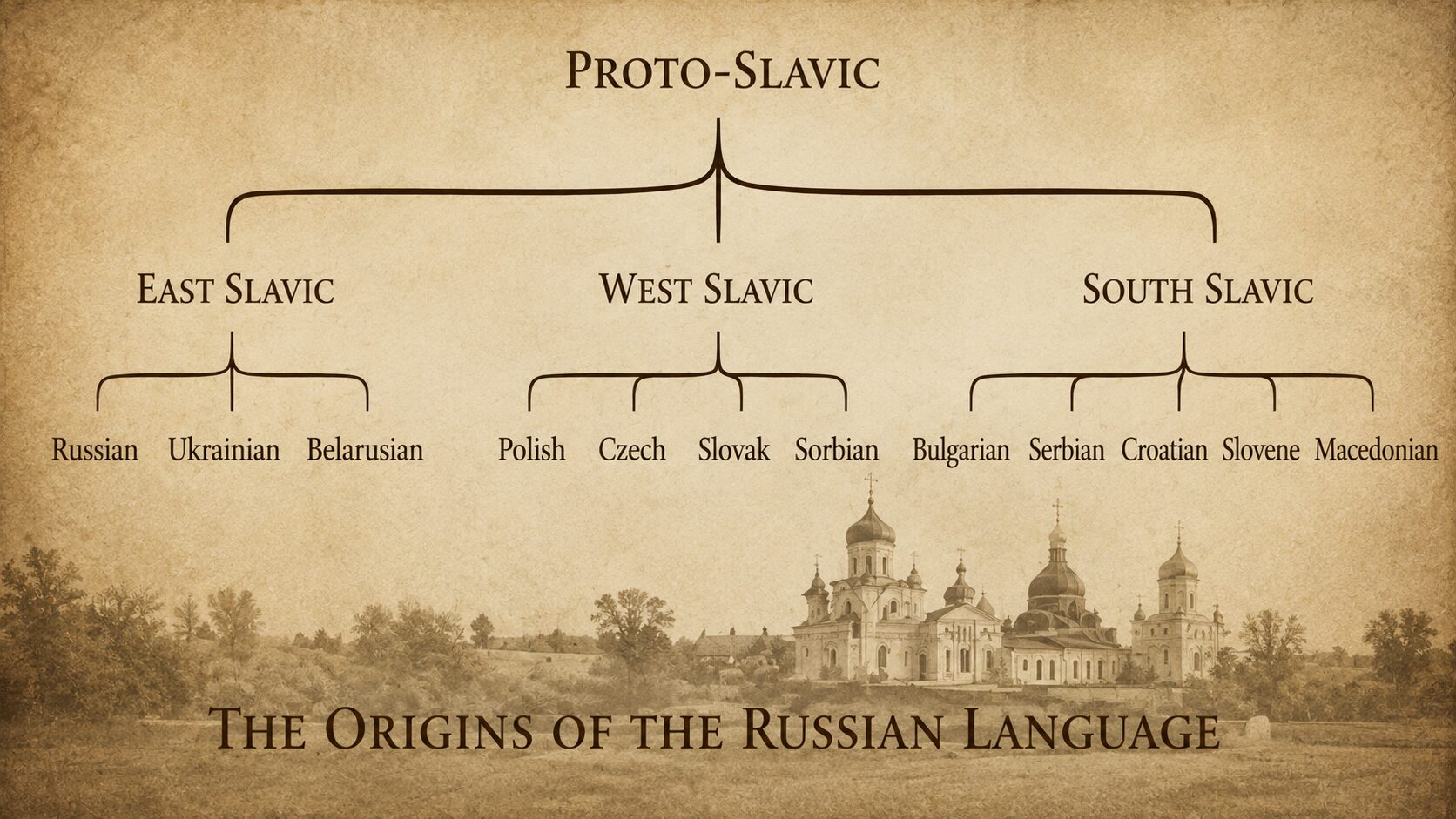
Russian is one of the most widely spoken Slavic languages in the world, but where did its history begin?
Modern Russian developed over a long period of time under the influence of various peoples and cultures. When you trace its origins, you are led back to the communities that spoke Proto-Indo-European, the societies of the early Slavs, and eventually the formation of Kievan Rus’.
When learning Russian, it is important to study not only grammar and vocabulary but also how the language originated and how it developed throughout history. By understanding its history, you can gain a clearer understanding of the characteristics of modern Russian and its relationship with other Slavic languages.
In this article, I will introduce the historical development of Russian, from Proto-Indo-European to the modern language.
The history of Russian can be traced back to Proto-Indo-European, an ancient language that is no longer spoken.
Linguists believe that it was spoken roughly between 4500 BCE and 2500 BCE in the region stretching from present-day Eastern Europe to the areas surrounding the Black Sea and the Caspian Sea. Although no written records of the language survive, scholars have reconstructed much of its vocabulary and grammar by comparing the many languages that descended from it.
Over thousands of years, Proto-Indo-European gradually split into numerous branches. Many of the languages spoken today across Europe and parts of South Asia belong to the Indo-European language family, all sharing this common ancestor.
Some of the major branches of the Indo-European family include:
This means that Russian, English, and even French ultimately share the same distant linguistic ancestor. For this reason, although these languages may appear completely different, certain similarities remain in their basic vocabulary and grammatical structures.
For example, the word meaning “mother” is мать in Russian, mother in English, Mutter in German, and mère in French. Similarly, the Russian word брат, meaning “brother,” shares a common origin with the English word brother and the German word Bruder.
By learning about this common origin, you can see that European languages that initially appear unrelated are in fact deeply connected. You can also understand that Russian did not suddenly emerge as an independent language, but instead developed through thousands of years of linguistic change.
The next major stage in the history of Russian was Proto-Slavic, which developed from Proto-Indo-European over a long period of time.
Proto-Slavic is believed to have been spoken from around 1500 BCE until the 6th century CE. It is regarded as the common ancestor of all modern Slavic languages, including Russian, Polish, and Serbian.
During this period, there was not yet a distinction between languages such as Russian and Polish. Instead, the Slavic peoples are thought to have spoken relatively similar varieties of the same language, allowing communication across different regions.
Beginning around the 6th century, however, Slavic peoples gradually migrated throughout Eastern Europe, Central Europe, and the Balkan Peninsula. As communities became geographically separated, their pronunciation, vocabulary, and grammar slowly changed. Contact with neighboring peoples and languages also contributed to these differences.
Over many centuries, these gradual changes eventually led Proto-Slavic to split into multiple languages, giving rise to the modern Slavic language family.
Understanding this history also explains why Russian shares so many similarities with languages such as Polish, Ukrainian, and Belarusian. Although they are now distinct languages, they still preserve many common features inherited from their shared ancestor.
As Proto-Slavic speakers spread across different regions from around the 6th century onward, geographical separation and contact with neighboring peoples gradually produced distinct linguistic varieties.
Today, the Slavic languages are generally divided into three major groups:
Russian belongs to the East Slavic group. Consequently, it shares many similarities in vocabulary, grammar, and pronunciation with Ukrainian and Belarusian.
Although Russian also has features in common with the West and South Slavic languages, each branch followed its own historical path, resulting in considerable differences over time.
These three groups also correspond closely to geography. East Slavic languages developed primarily in present-day Russia, Ukraine, and Belarus, while West Slavic languages evolved in Central Europe, and South Slavic languages developed throughout the Balkan Peninsula.
The unique history and culture of each region have played an important role in shaping the characteristics of their languages.
No discussion of Russian language history would be complete without Kievan Rus’.
Founded in the late 9th century and centered in what is now Ukraine, Kievan Rus’ was a state largely inhabited by East Slavic peoples. During this period, the language commonly spoken was Old East Slavic, which later developed into Russian, Ukrainian, and Belarusian.
The formation of Kievan Rus’ united East Slavic communities across a vast territory into a shared political and cultural entity. This helped preserve a considerable degree of linguistic unity. As government administration and trade expanded, Old East Slavic came to be used not only in everyday life but also in official contexts.
A major turning point came in 988, when Kievan Rus’ adopted Eastern Orthodox Christianity. Closer ties with the Byzantine Empire encouraged the development of literacy and written culture, and Old Church Slavonic became the principal written language for religious and administrative texts.
The interaction between the spoken language of the East Slavic population and the literary tradition of Old Church Slavonic formed the foundation upon which Russian would later develop.
Old Church Slavonic occupies a central place in the history of Russian.
In the 9th century, the Byzantine missionaries Saints Cyril and Methodius created Slavic religious texts in order to spread Christianity among the Slavic peoples. The language they used is known as Old Church Slavonic.
Rather than representing everyday speech, Old Church Slavonic was a literary language designed specifically for religious worship and sacred writings. As translations of the Bible and liturgical texts spread, it became widely used throughout the Slavic world in religion, scholarship, and administration.
After Kievan Rus’ accepted Christianity in 988, religious manuscripts written in Old Church Slavonic reached the East Slavic lands. Consequently, the spoken language of the East Slavic peoples absorbed a significant amount of vocabulary, stylistic features, and literary expressions from Old Church Slavonic.
Even today, modern Russian retains many words and expressions of Old Church Slavonic origin, particularly in religious, literary, and formal styles.
In this sense, Russian developed on the basis of spoken East Slavic while drawing substantial influence from Old Church Slavonic as its written language.
During the 13th century, the Mongol Empire invaded the East Slavic lands, beginning a long period commonly known as the Mongol Yoke.
Although the Mongols themselves spoke Mongolian, Turkic-speaking peoples also played an important role in administration and trade. As a result, Russian adopted vocabulary not only from Mongolian but also from various Turkic languages. Many words related to administration, military affairs, trade, and everyday life can still be traced back to this period.
Later, as the Grand Duchy of Moscow expanded, Russia established closer contacts with both Europe and Asia, leading to the adoption of many additional foreign words.
Between the 16th and 18th centuries, Russian borrowed numerous military, technical, and maritime terms from German and Dutch. During the 18th and 19th centuries, French culture became highly influential among the Russian aristocracy, introducing a large number of French loanwords. In more recent times, advances in science, technology, and information technology have brought an increasing number of borrowings from English.
The Russian studied today is based on the standard language that took shape during the 18th and 19th centuries.
In the early 18th century, Peter the Great introduced sweeping reforms that promoted Western European culture and technology. As new ideas entered Russia, many words from Dutch, German, and French were adopted, particularly in government, the military, science, and engineering.
During the same century, the scholar Mikhail Lomonosov helped systematize Russian grammar and literary style. His work laid the foundation for Russian as a language suitable for scholarship and literature.
In the 19th century, the poet Alexander Pushkin transformed Russian literature by naturally combining everyday spoken language with refined literary expression. Earlier literature had been heavily influenced by Old Church Slavonic, but Pushkin embraced contemporary spoken Russian, establishing the foundation of modern Russian literature. For this reason, he is often referred to as the father of modern Russian literature.
Through these developments, modern Standard Russian gradually took shape. The Russian used today in schools, newspapers, television, and books is based on the linguistic standards established during this period.
The origins of Russian can be summarized as follows:
The history of Russian is closely connected to the broader history of Europe and Eurasia.
By understanding this historical background, you can gain a deeper appreciation of the distinctive features of modern Russian and its relationship with the other Slavic languages.