#8 The Road to the Standardization of Russian
Izumi RUSSIAN FOREST


Russian, Ukrainian, and Belarusian are distinct languages, but they share a common ancestor. That ancestral language is known as Old East Slavic.
When you study modern Russian, you may sometimes wonder why the language has certain grammatical features or why it resembles Ukrainian and Belarusian. Many of the answers become clearer when you trace the history of Old East Slavic.
In this article, I will introduce what kind of language Old East Slavic was, how it developed, what characteristics it had, and how it is related to modern Russian.
Old East Slavic was the language spoken by the East Slavic peoples in Eastern Europe from approximately the 10th to the 14th century.
It is generally considered the common ancestor of modern Russian, Ukrainian, and Belarusian. Although these three are now independent languages, tracing their origins leads back to Old East Slavic.
The term Old East Slavic is used in modern linguistics as a collective name for the language and dialects spoken by the East Slavs during the period of Kievan Rus’. The people of that time did not all speak an entirely uniform language, and various regional dialects existed. However, these dialects shared many important features, so modern linguists group them together under the name Old East Slavic.
It is also important to note that “Old East Slavic” is a modern academic term. The people of the period did not refer to their own language by this name. Later scholars introduced the term to distinguish this stage of linguistic development from the modern Russian, Ukrainian, and Belarusian languages that followed it.
Learning about Old East Slavic is an important first step toward understanding not only the history of Russian but also the history of the East Slavic languages as a whole. Many grammatical structures and words found in Russian today were inherited from this earlier language. Understanding their origins can therefore deepen your knowledge of modern Russian.
Old East Slavic was widely spoken in the medieval state known as Kievan Rus’.
Kievan Rus’ was an East Slavic state established in the late ninth century. Its territory extended across a broad region that included much of present-day Ukraine, western Russia, and Belarus. Its capital was Kyiv, also known as Kiev, which is now the capital of Ukraine. At the time, the city flourished as a major centre of politics, trade, and culture.
The East Slavic peoples living throughout Kievan Rus’ shared a common cultural and political framework. In daily life, they spoke East Slavic dialects with many common features. Modern linguists collectively refer to these dialects as Old East Slavic.
Naturally, regional differences existed across such a large territory. However, these differences are generally thought to have been smaller than those separating modern Russian, Ukrainian, and Belarusian, and speakers were probably able to understand one another.
After Kievan Rus’ adopted Christianity in 988, Old Church Slavonic came to be widely used for religious texts and official documents. Old East Slavic, however, continued to be used in everyday speech. This created a situation in which a spoken vernacular and a formal written language coexisted.
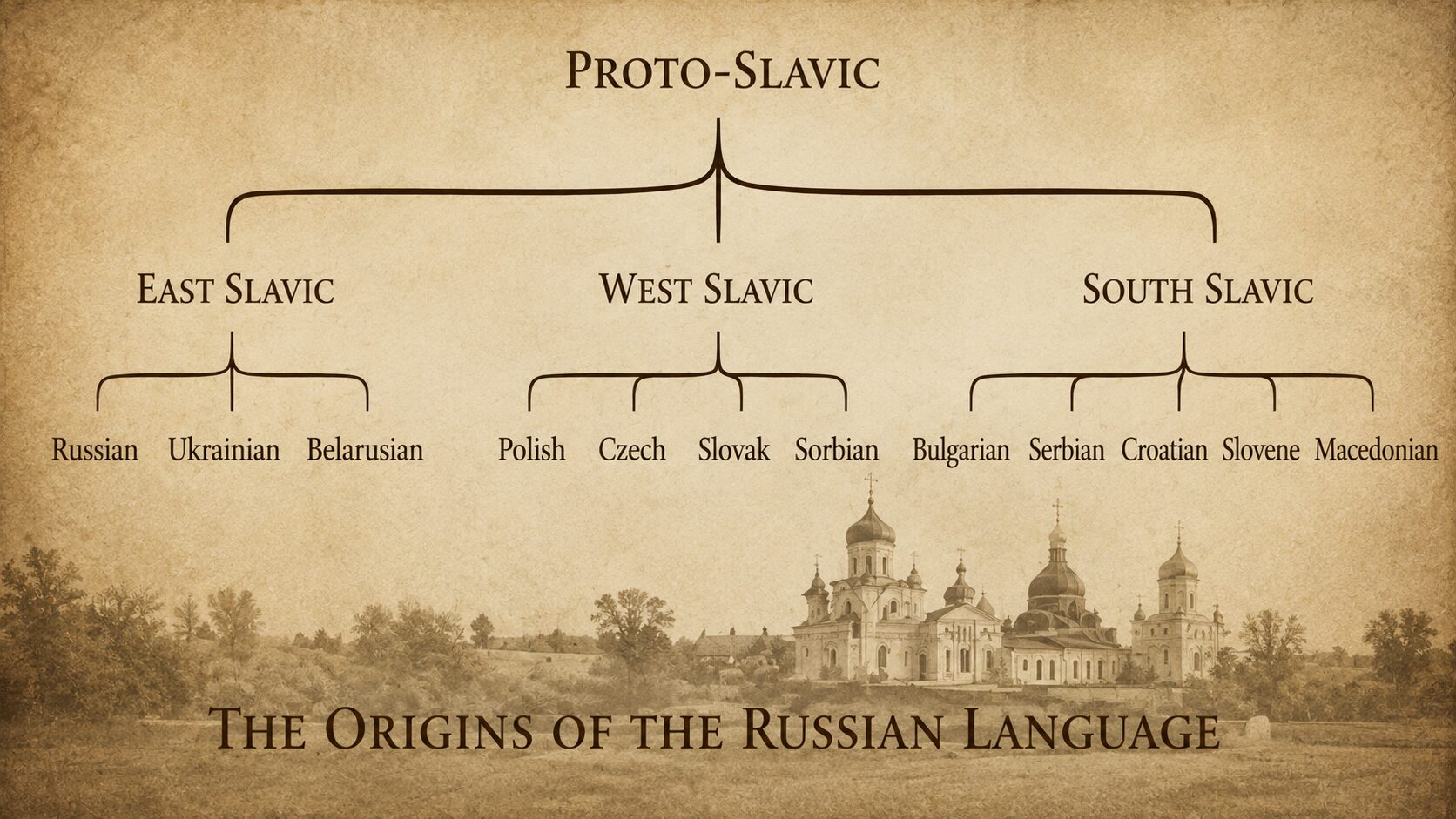
Old East Slavic developed from an even earlier language known as Proto-Slavic.
Proto-Slavic was the common ancestor of all Slavic languages and is generally believed to have been spoken from around 1500 BCE until approximately the sixth century CE. Its speakers lived in parts of what is now Eastern Europe.
Between roughly the fifth and seventh centuries, Slavic peoples spread across various regions of Europe. As they settled in different areas, their speech gradually developed distinct regional characteristics.
Proto-Slavic therefore began to divide, eventually giving rise to three major groups:
The East Slavic varieties spoken in and around the regions of present-day Russia, Ukraine, and Belarus later developed into what is now called Old East Slavic.
However, Old East Slavic did not suddenly appear at one particular moment. It emerged gradually through linguistic changes that took place over several centuries.
In other words, Old East Slavic represents an important stage connecting Proto-Slavic with modern Russian, Ukrainian, and Belarusian.
When you study Old East Slavic, you will often encounter another language called Old Church Slavonic. Although the two are sometimes confused, they were separate languages with different roles.
Old East Slavic was the language spoken in everyday life by the East Slavic peoples of Kievan Rus’. It was used naturally in household conversations, trade, and communication within local communities.
Old Church Slavonic, by contrast, was a literary language developed in the ninth century by the Byzantine missionaries Cyril and Methodius for the Christianisation of the Slavic peoples. It was used to translate the Bible, liturgical books, and other religious texts into a Slavic language. Rather than being an everyday spoken language, it was primarily used in churches, religious ceremonies, and scholarly contexts.
After Kievan Rus’ adopted Christianity in 988, many religious and official texts were written in Old Church Slavonic. As a result, Old East Slavic absorbed a considerable amount of vocabulary, phrasing, and stylistic influence from Old Church Slavonic. The two languages continued to influence one another as they developed.
Their relationship was somewhat similar to the relationship between Latin and the vernacular languages of medieval Western Europe. People in Western Europe spoke the ancestors of French, Italian, Spanish, and other languages in daily life, while Latin was used in religion, scholarship, and law.
In the same way, the people of Kievan Rus’ spoke Old East Slavic in everyday life while using Old Church Slavonic in churches and religious texts.
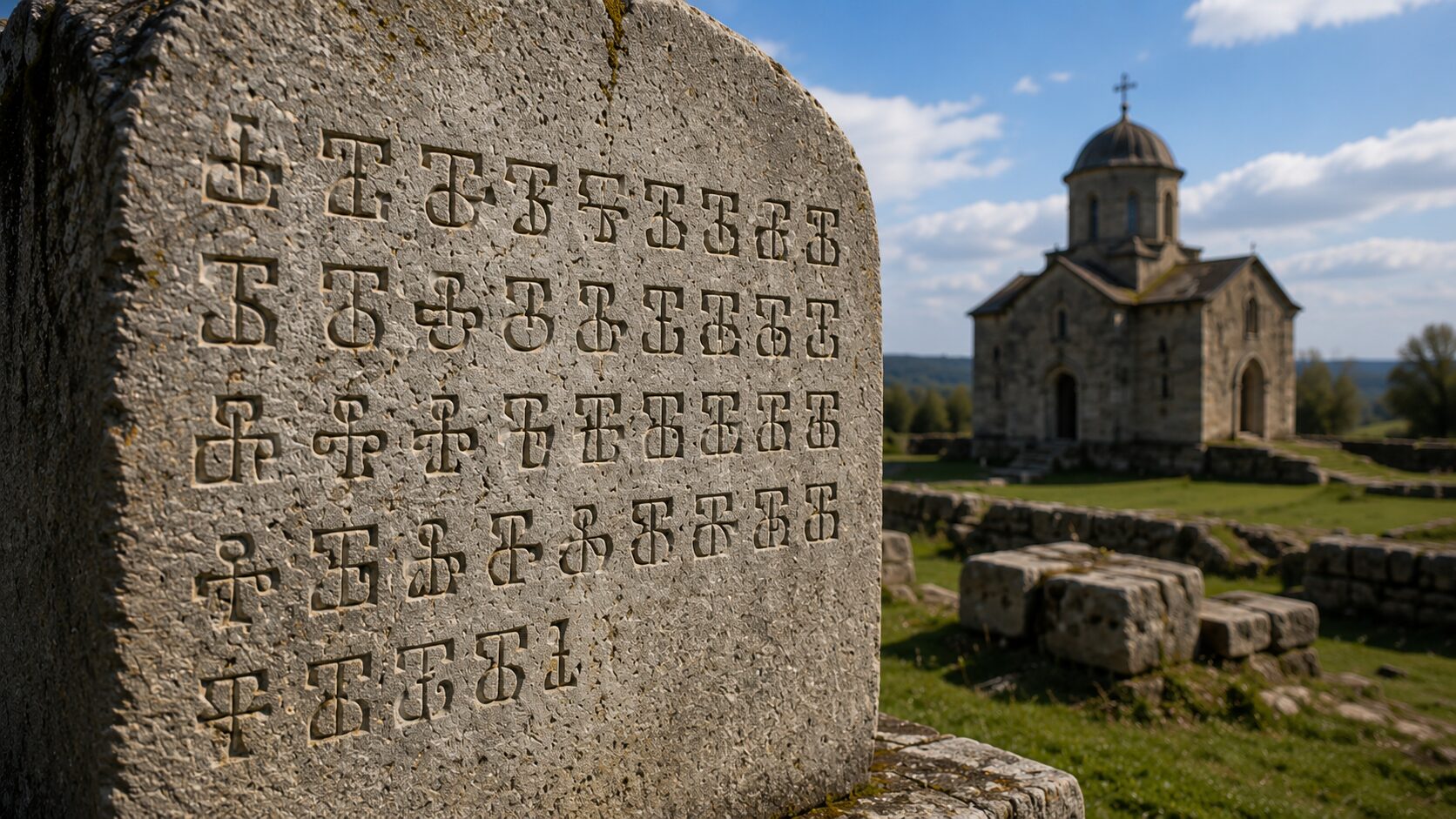
Old East Slavic was written primarily in the Cyrillic script.
The Cyrillic script was developed in the First Bulgarian Empire between the late ninth and early tenth centuries. After Kievan Rus’ adopted Christianity at the end of the tenth century, religious texts and clergy arrived from the South Slavic regions, bringing Cyrillic writing culture into the East Slavic world.
However, the Cyrillic alphabet used at that time was not identical to the modern Russian alphabet. Modern Russian uses 33 letters, whereas the medieval writing system contained many additional letters that have since been abolished.
Some representative examples include:
The letters ѧ and ѫ originally represented nasal vowels. However, nasal vowels gradually disappeared in the East Slavic regions, and the sounds represented by these letters consequently changed over time.
Some letters, including ѯ, ѱ, ѳ, and ѵ, were mainly used for personal names and religious terms of Greek origin. This reflects the strong influence of the Byzantine Empire and the Eastern Orthodox Church on the written culture of the period.
Early manuscripts were often written in a formal, angular script known as ustav. Each letter was carefully written, and this style was commonly used in religious documents such as Bibles and liturgical books. As writing practices developed, faster styles such as semi-ustav and cursive script also came into use.
Old East Slavic was not written only in manuscripts on parchment. In places such as Novgorod, archaeologists have discovered many birch-bark documents. These contain letters, debt records, commercial transactions, writing exercises, and other materials relating to everyday life.
Religious documents often show strong Old Church Slavonic influence, whereas birch-bark texts tend to reflect more closely the East Slavic language that ordinary people actually used. For this reason, birch-bark documents are extremely valuable sources for understanding spoken Old East Slavic and everyday life during the period.
Words in medieval texts were not always separated as clearly as they are in modern writing. Frequently used religious terms and sacred names could also be abbreviated by placing a mark known as a titlo above the letters.
Over time, changes in pronunciation, the standardisation of spelling, and writing reforms during the Russian Empire led to the gradual removal of letters that were no longer needed. Following the orthographic reforms of the early twentieth century, the modern Russian alphabet of 33 letters was established.
Old East Slavic had many grammatical features that were later inherited by modern Russian.
The following elements were already present during the Old East Slavic period:
Noun declension and verb conjugation, in particular, remain central foundations of modern Russian grammar. Although individual endings and conjugation patterns have changed over time, the underlying systems have survived into the present day.
Russian also allows relatively flexible word order. This feature was inherited partly from Old East Slavic, in which grammatical cases clearly indicated the role of each word within a sentence.
At the same time, Old East Slavic differed from modern Russian in many respects.
It contained word forms and conjugations that are no longer used today. Some vowels and consonants inherited from Proto-Slavic also changed in pronunciation and spelling through later sound changes. In addition, the language used letters that no longer exist in modern Russian.
For this reason, even a native speaker of modern Russian would not find it easy to read and understand an Old East Slavic text without specialised study. Nevertheless, many of its grammatical and lexical foundations remain recognisable in modern Russian.
Over the course of history, Old East Slavic gradually changed and developed into modern Russian, Ukrainian, and Belarusian.
One major turning point was the Mongol invasion in the 13th century. Kievan Rus’ lost its political unity, and different regions came under the control of different political powers.
In the northeast, for example, the Grand Duchy of Moscow expanded its influence and eventually developed into the Russian state. In the southwest and west, many territories became part of the Grand Duchy of Lithuania and later the Polish–Lithuanian Commonwealth, leading them along different historical paths.
As the political and cultural environment changed from one region to another, differences gradually emerged in the languages spoken by local populations. These changes did not occur over a short period. Developments in pronunciation, vocabulary, and grammar accumulated over many centuries, eventually resulting in modern Russian, Ukrainian, and Belarusian.
Old East Slavic is an important language because it is the common ancestor of modern Russian, Ukrainian, and Belarusian.
The main points can be summarised as follows:
Old East Slavic is no longer spoken, but it remains essential for understanding the history of Russian.
Behind modern Russian lies a long process of linguistic change that developed over many centuries. Learning about that history is an important first step toward gaining a deeper understanding of the Russian language.