#43 How to Use the Nominative Case in Russian
Yuri Miyajima Russian Forest

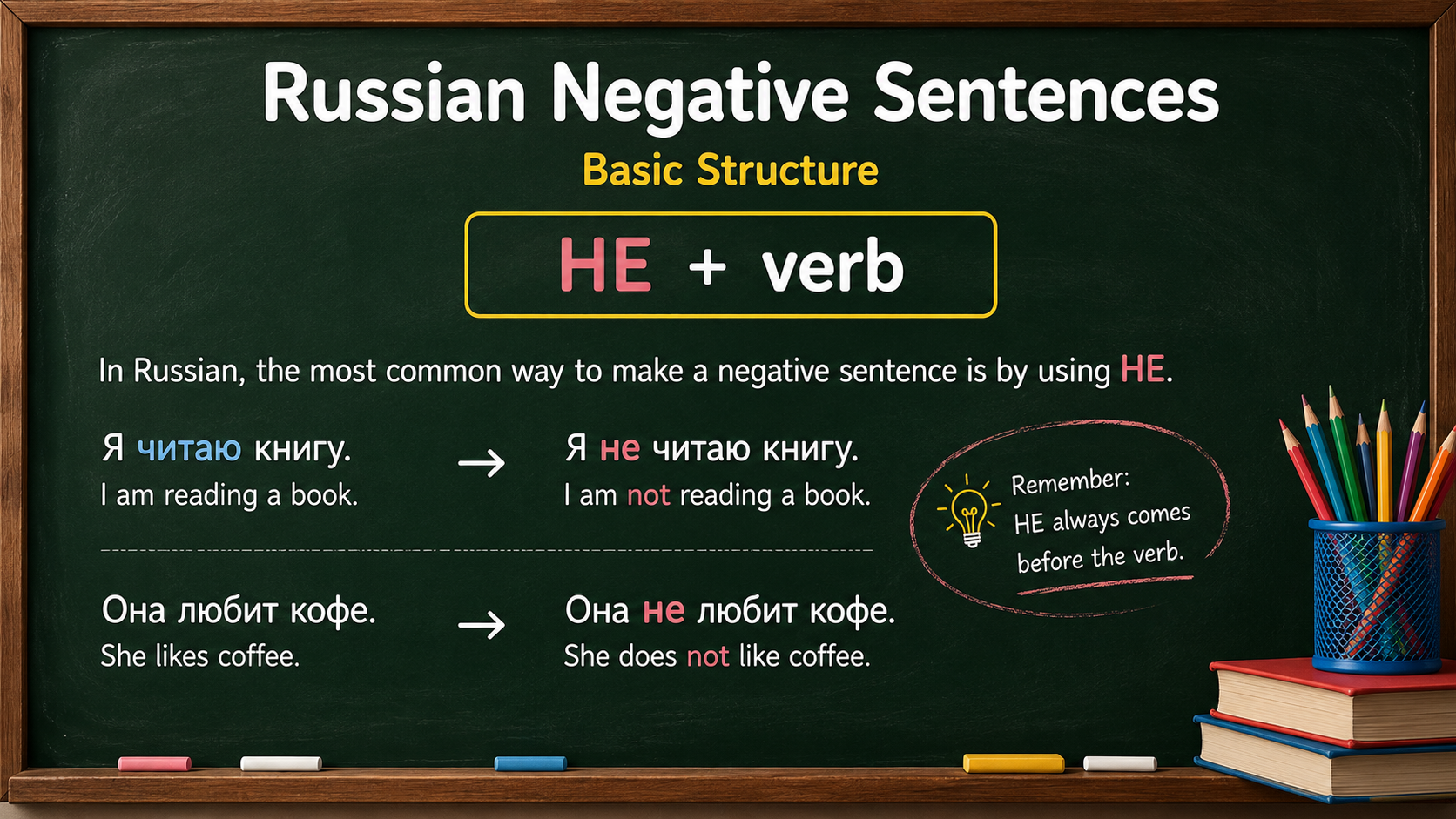
Forming negative sentences in Russian is relatively simple. In many cases, you can express meanings such as “do not” or “is not” simply by placing не before the verb or other word you want to negate.
However, Russian negation involves more than just не. It also includes нет, which expresses the absence of something, as well as double-negative constructions using words such as никто́ (nobody) and ничего́ (nothing).
In this article, I will explain the basics of negative sentences in Russian, including the difference between не and нет, as well as double negation, with example sentences.
The most basic way to form a negative sentence in Russian is to use не.
не is a negative particle meaning “not” or “do not,” and it functions similarly to not in English. When you want to negate a verb, you generally place не immediately before the verb.
For example, if you add не to the affirmative sentence Я зна́ю. (I know), it becomes Я не зна́ю. (I do not know).
In this way, you do not need to change the verb itself. You can form a negative sentence simply by placing не before it.
In English, when you negate an ordinary verb, you generally use do not or does not, so I know becomes I do not know. In Russian, however, the basic structure is simply “не + verb,” which makes the system of negation relatively straightforward.
As a general rule, не is placed before the word you want to negate. Therefore, when you are negating a verb, it is important to place не directly before that verb.
не is used not only with verbs but also to negate nouns, adjectives, and other parts of speech.
For example, if you negate the sentence Э́то кни́га. (This is a book), it becomes Э́то не кни́га. (This is not a book).
In Russian, the verb быть, which corresponds to the English verb be, is normally omitted in the present tense. Therefore, instead of using a structure such as “be + not,” as in the English sentence This is not a book, you can simply place не before the noun you want to negate.
In this way, basic present-tense sentences meaning “A is not B” use the structure “не + noun.”
You can also use не to negate adjectives and adverbs.
For example, if you negate Э́тот дом большо́й. (This house is big), you get Э́тот дом не большо́й. (This house is not big).
You can also say:
However, there can be a difference in meaning or nuance between writing не together with an adjective as one word, as in небольшо́й, and writing it separately, as in не большо́й.
For example, небольшо́й is an adjective meaning “small” or “not very large.” By contrast, не большо́й directly negates the quality expressed by большо́й (big), giving the sense of “not big.”
Therefore, when you negate nouns, adjectives, and other words, the basic rule is still to place не before the word you want to negate. However, you should also be aware that some adjectives, such as небольшо́й, are written with не as part of a single word and may differ in meaning from ordinary negative constructions.
When you study Russian negation, another word you will frequently encounter alongside не is нет. Both are basic negative words, but they have different functions and are used in different situations.
не is placed before verbs, nouns, adjectives, and other words to negate them or the meaning they express.
By contrast, нет can be used by itself to mean “no,” and it is also used to express that something does not exist or is not present.
Here, нет functions like the English word No, giving a negative answer to the question “Do you have a car?”
You can also use нет to express that something does not exist.
In Russian, negative possession can be expressed with the structure “у + genitive + нет + genitive,” meaning that someone “does not have” something. In this construction, the noun following нет is generally put in the genitive case.
The difference between не and нет can therefore be summarized as follows:
In Russian, the structure “нет + genitive” is commonly used to express that something does not exist or is not present.
In affirmative sentences expressing that something exists, есть may be used.
In this affirmative sentence, магази́н (store) is in the nominative case.
To negate the sentence and say “There is no store here,” you can say:
In the negative sentence, not only is есть replaced by нет, but магази́н changes from the nominative to the genitive form магаз́ина.
The same pattern can be seen in the following example, where the affirmative маши́на changes to the genitive маши́ныin the negative sentence.
In this way, when you negate existence or possession in Russian, “нет + genitive” is the basic structure to remember.
In Russian, when you form negative expressions meaning “nobody,” “nothing,” or “never,” you normally combine a negative word with не in the same sentence.
Some common negative words include:
For example, in the sentence Я ничего́ не зна́ю. (I know nothing / I do not know anything), two negative elements are used: ничего́ (nothing) and не зна́ю (do not know).
Here are some other examples of double negation:
The important point is that even when a negative word such as никто́ or ничего́ is present, the predicate generally still needs to be negated with не.
For example, to say “Nobody came,” you say Никто́ не пришёл. You do not say Никто́ пришёл.
In English, sentences such as Nobody came or I don’t know anything are generally formed around a single negative element. In Russian, by contrast, several negative elements can appear in the same sentence without cancelling each other out. Instead, they work together to form a single negative meaning.
Therefore, the presence of a negative word does not mean that не is unnecessary. One characteristic of Russian is that negative words and не are typically used together in these constructions.
In Russian, negative sentences are basically formed with не. However, Russian also has characteristic negative constructions involving нет, the “нет + genitive” structure, and double negation.
The main points can be summarized as follows:
You can form many basic negative sentences in Russian simply by learning the structure “не + verb.”
After that, by gradually learning constructions such as “нет + genitive” and double negation, you will be able to express a much wider range of negative meanings in Russian.