#53 How the Russian Present Tense Works
Yuri Miyajima Russian Forest

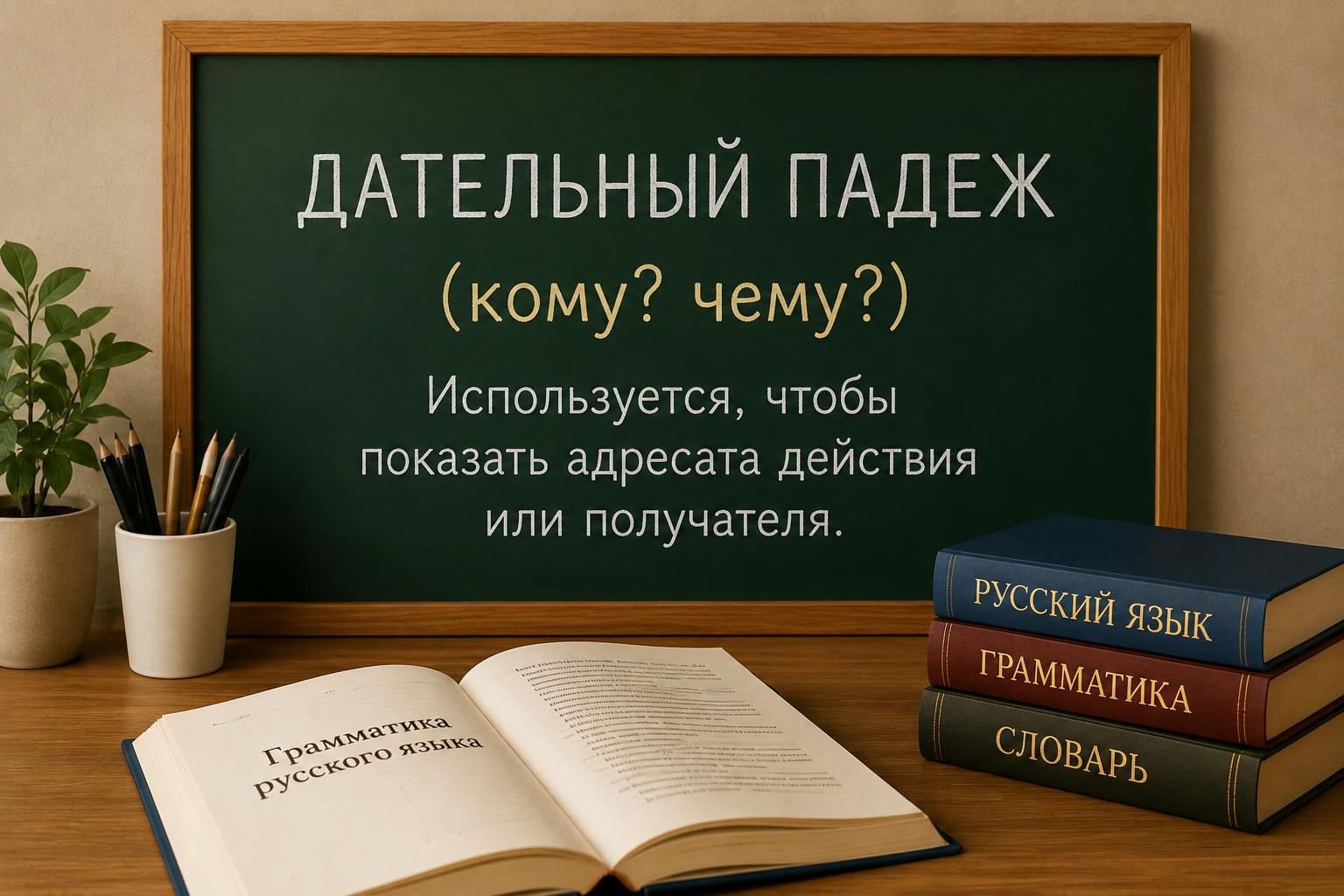
The dative case is one of the six grammatical cases in Russian. It is commonly used to indicate the person or thing toward whom or which an action is directed, corresponding to meanings such as “to whom” or “to what.”
For example, in the sentence “I gave a book to my friend,” the phrase “to my friend” would be expressed using the dative case. In Russian, however, the dative is used not only when giving something to someone, but also in expressions such as “I am cold” and when stating a person’s age.
For this reason, understanding the basic meaning of the dative case will help you understand a wide range of Russian expressions more easily.
In this article, I will explain what the Russian dative case is, its basic meanings and uses, and how noun endings change in the dative.
The main function of the Russian dative case is to indicate the person or thing toward whom an action is directed, or the recipient of something resulting from that action.
For example, “I give Anna a book” can be expressed as follows:
In this sentence, А́нна changes to the dative form А́нне.
Я is the person giving the book, кни́гу is the thing being given, and А́нне is the person receiving it. In other words, the answer to the question “To whom am I giving the book?” is expressed in the dative case.
In Russian, the interrogative pronouns кому́? (to whom?) and чему́? (to what?) are used when asking about the dative case.
In this way, the dative case indicates the person or thing toward whom an action or state is directed.
It is also used to express age, emotions, preferences, necessity, and other meanings. In addition, certain prepositions, such as к and по, require the dative case.
In the dative case, noun endings change according to gender and whether the noun is singular or plural.
Let us look at the basic patterns.
| Noun Type | Nominative Singular | Dative Singular |
|---|---|---|
| Masculine noun ending in a consonant | брат | бра́ту |
| Masculine noun ending in -й | музе́й | музе́ю |
| Masculine noun ending in -ь | слова́рь | словарю́ |
| Feminine noun ending in -а | ма́ма | ма́ме |
| Feminine noun ending in -я | неде́ля | неде́ле |
| Feminine noun ending in -ь | дверь | две́ри |
| Neuter noun ending in -о | окно́ | окну́ |
| Neuter noun ending in -е | мо́ре | мо́рю |
For masculine nouns, nouns ending in a consonant generally take -у, while nouns ending in -й or -ь generally take -ю.
Feminine nouns ending in -а or -я generally change their ending to -е.
However, feminine nouns ending in -ь change -ь to -и.
Feminine nouns ending in -ия follow a different pattern from ordinary -я nouns and take -ии in the dative.
For neuter nouns, the basic changes are -о → -у and -е → -ю.
In the plural, nouns generally take -ам or -ям, regardless of gender.
When learning dative endings, I recommend first remembering the basic patterns: -у / -ю for masculine nouns, -е for feminine nouns ending in -а / -я, -у / -ю for neuter nouns, and -ам / -ям for plural nouns.
The most basic use of the dative case is to indicate the recipient or target of an action, corresponding to “to whom” or “to what.”
When you give something to someone, write a letter to someone, or show something to someone, the action is directed toward a particular person. In Russian, this recipient is expressed in the dative case.
In this sentence, бра́ту is in the dative case. Its basic form is брат (brother), but because it indicates the person to whom the book is given, it changes to бра́ту.
The same pattern appears in the following examples, where друг → дру́гу and роди́тели → роди́телям indicate the recipients of the actions.
In Russian, what corresponds to the direct object, or “what,” is generally expressed in the accusative case, while the indirect object, or “to whom,” is expressed in the dative case.
For example, in “Я даю́ кни́гу бра́ту.” (I give my brother a book), кни́гу (a book) answers the question “what?” and is in the accusative case, whereas бра́ту (to my brother) answers “to whom?” and is in the dative case.
When reading Russian sentences, it is important to distinguish clearly between the accusative and dative cases.
In Russian, the dative case is also used in impersonal sentences that express physical sensations, moods, psychological states, and similar conditions.
An impersonal sentence expresses a state or feeling without placing a clear grammatical subject in the sense of “someone does something.” In such sentences, the person experiencing the state is expressed in the dative case.
In Russian impersonal sentences, the person experiencing the state is expressed using the dative мне, rather than the nominative я.
For this reason, “Мне хо́лодно.” can be understood literally as something like “It is cold to me” or “It feels cold to me.”
The dative is also used in impersonal expressions of possibility, necessity, permission, and prohibition.
In these sentences as well, the person to whom the situation applies is expressed using a dative form such as мне or ему́, rather than the nominative я or он.
In Russian, the dative case is also used when stating a person’s age.
For example, “I am 20 years old” is expressed as:
Here, Russian uses the dative мне rather than the nominative я.
In English, the person whose age is being stated is the grammatical subject, as in “I am twenty years old.” In Russian, by contrast, the person is placed in the dative, and age is expressed through a structure that can be understood roughly as indicating how many years apply to that person.
The same structure is used for other people.
ему́ is the dative form of он, ей is the dative form of она́, and А́нне is the dative form of А́нна.
When expressing age, the form of год (year) changes depending on the number.
As a basic rule, numbers ending in 1 generally use год, numbers ending in 2–4 use го́да, and other numbers use лет. However, numbers from 11 to 14 use лет regardless of their final digit.
For example:
By contrast:
Some Russian verbs require their object to be in the dative case.
Common examples include:
For example, “I help my friend” is expressed as:
Because помога́ть requires the dative case, друг changes to дру́гу.
In English, the equivalent sentence is “I help my friend,” where “my friend” is a direct object. For that reason, you might expect Russian to use the accusative in the same way. However, with помога́ть, the person being helped is expressed in the dative.
In this way, an object that is expressed as a direct object in English may be expressed in the dative in Russian, depending on the verb.
In Russian, the case required by an object is sometimes determined by the verb itself. When you learn a new verb, I recommend learning not only its meaning but also which grammatical case it requires.
In Russian, the dative case is also used after certain prepositions. Two representative examples are к and по.
The preposition к is used in the structure “к + dative” to indicate movement or direction toward a person or thing, with meanings such as “to,” “toward,” or “up to.”
In the first sentence, врач changes to the dative врачу́. In the second, окно́ changes to окну́.
The preposition по is also commonly used with the dative.
по has a wide range of meanings and can form expressions such as “along,” “through,” or “on/about,” depending on the context.
Both к and по are therefore important prepositions that commonly take the dative case. However, по has a particularly broad range of uses, and in some fixed expressions it can also be associated with cases other than the dative.
The dative is one of the six cases in Russian and is mainly used to express the recipient or target of an action, corresponding to meanings such as “to whom” or “to what.”
Its main characteristics can be summarized as follows:
Because the dative case has many different uses, you may initially feel tempted to memorize each one as a separate grammar rule.
However, many of these uses share a common underlying idea: an action, state, or situation is directed toward or applies to someone or something.
I recommend first remembering the basic image of the dative as “the person or thing toward whom an action or state is directed.” You can then gradually learn its use with age expressions, impersonal sentences, specific verbs, and prepositions.