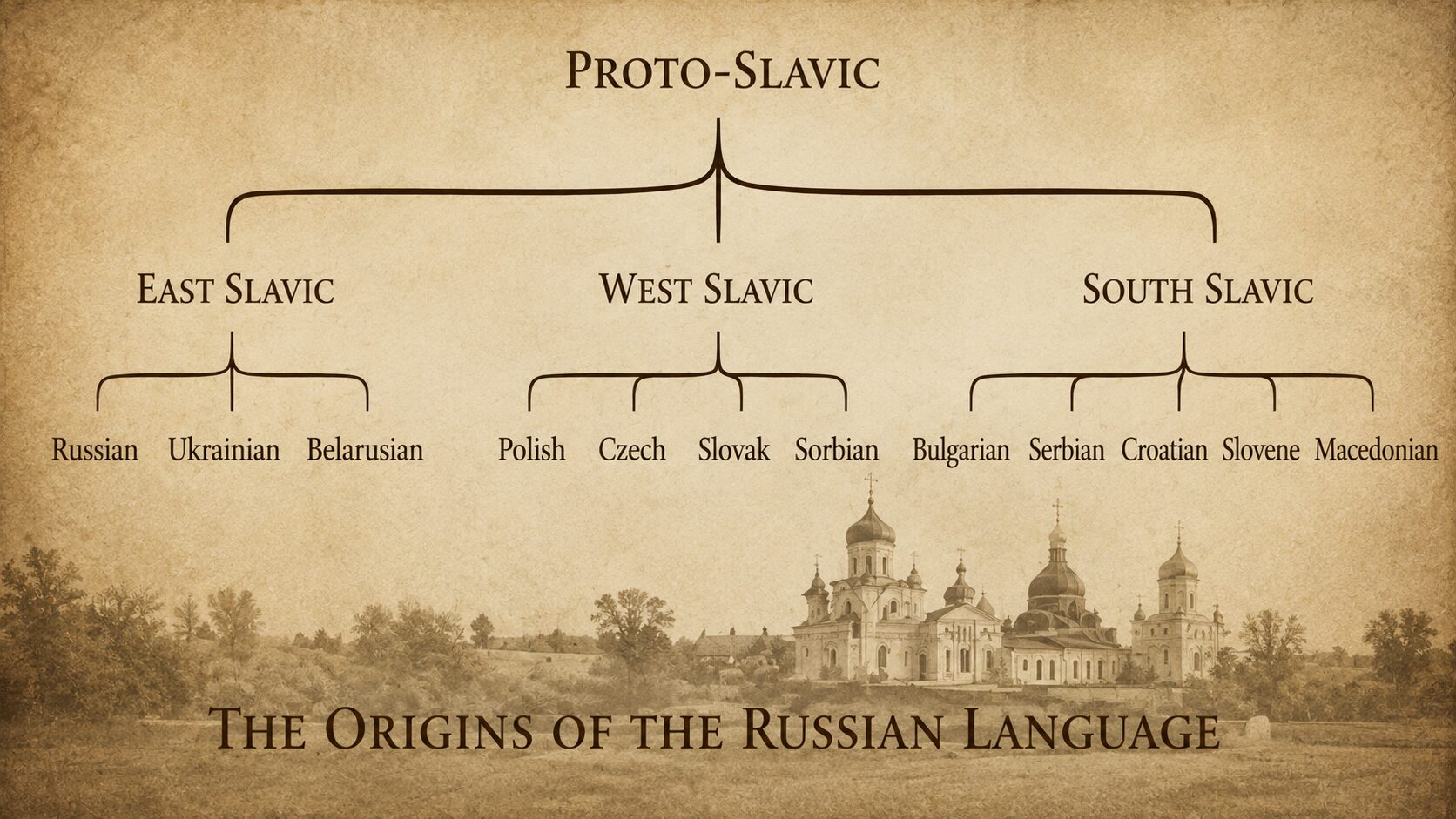
#3 The Origins of the Russian Language
Izumi RUSSIAN FOREST


The Russian language used in Russia today has a standardized form based on dictionaries and grammar books. As a result, broadly consistent Russian is used throughout the country in schools, television, newspapers, and official documents.
However, this standard language did not exist from the beginning. Russia is a vast country with many regional dialects, and during the medieval period, pronunciation, vocabulary, and writing practices differed from one region to another.
In this article, I will explain the background to the standardization of Russian, the individuals who played important roles in the process, and its influence on the modern Russian language.
The standardization of Russian refers to the process of establishing common rules for grammar, vocabulary, spelling, pronunciation, and expression so that the language could be understood and used by a wide range of people.
Today, Standard Russian is used in education, government administration, publishing, television, and newspapers. This makes it possible for people to communicate smoothly across the vast territory of Russia.
In medieval Russia, however, no common linguistic standard comparable to the modern one existed. Different regional dialects were spoken, while Church Slavonic was used in religious contexts and differed considerably from the Russian spoken in everyday life.
Spelling and expression also varied widely depending on the writer, and no unified system of written Russian had yet been established.
Under these circumstances, a common linguistic standard became necessary for the development of education, administration, literature, and scholarship. From the 18th century onward, scholars, writers, and political leaders gradually organized Russian grammar and orthography, helping to shape the Standard Russian used today.
The standardization of Russian was therefore not simply a process of making language uniform. It also provided an important foundation for the modernization of the Russian state and the development of its culture. The Russian you study today is built upon this long history of standardization.
Before standardization, there was a considerable difference between spoken and written language in Russia.
In everyday life, people used East Slavic forms of speech that had developed from the language of Kievan Rus’. In churches and monasteries, by contrast, Church Slavonic was used primarily for liturgy and religious texts.
Because Russia covered such a vast territory, pronunciation, vocabulary, and grammar also differed from region to region. The language spoken by ordinary people was therefore far less uniform than it is today. The dialects found around Moscow, in northern regions, and in southern regions had distinct features, and usage varied even within what is now regarded as Russian.
There was also no unified standard for written language. Spelling and expression could vary depending on the writer or region. As a result, authors of literary works, official documents, and scholarly texts did not have access to the common grammatical and orthographic rules that exist today.
This situation made it difficult to establish a nationwide system of education and administration. As Russia developed into a modern state, it therefore became necessary to bring the language under a more consistent set of standards.
The standardization of Russian began to advance more substantially as a result of the reforms introduced by Peter the Great in the early 18th century.
Peter the Great actively adopted institutions and cultural practices from Western Europe in an effort to transform Russia into a modern state. His reforms extended beyond government and the military to include education, scholarship, and publishing.
Before this period, Church Slavonic was widely used in religious texts, and written language retained many archaic expressions and complex letter forms. However, building a modern state required a system in which administrative documents, textbooks, and scientific works could be read and written by a broader section of society.
In 1708, Peter the Great introduced the Civil Script (гражданский шрифт), which simplified the forms and presentation of Cyrillic letters for use in government administration and publishing. It was distinguished from the traditional script used in religious books and came to be widely used in secular publications and official documents.
Translations and publications introducing Western European science and technology also became increasingly common. As a result, new vocabulary and expressions entered Russian.
These developments helped Russian expand beyond its traditional role as a language associated primarily with religion. It increasingly became a modern language used in scholarship, science, and government administration.
Peter’s reforms marked a major turning point in the history of Russian. By reorganizing the writing system and publishing culture, they created the foundation for Mikhail Lomonosov’s later systematization of Russian grammar and Alexander Pushkin’s contribution to the development of modern Russian literature.
One of the most important figures in the standardization of Russian was the 18th-century scholar Mikhail Lomonosov.
Lomonosov systematically organized Russian grammar, which had previously lacked a sufficiently unified standard. In 1755, he completed his Russian Grammar (Российская грамматика).
This work is widely recognized as one of the first major attempts to systematize Russian grammar comprehensively. It was published in 1757 and had a considerable influence on later education and linguistic study.
Lomonosov also organized literary styles and proposed what became known as the theory of three styles: the high, middle, and low styles.
For example, he recommended a high style containing a substantial amount of Church Slavonic vocabulary for heroic poetry and solemn odes. For letters, satire, and comedy, he considered a style closer to everyday language more appropriate.
This theory established guidelines for determining what kind of Russian should be used in different situations and literary genres. It also made a major contribution to the later development of Russian literature.
When discussing modern Standard Russian, one of the most important figures is the 19th-century poet and writer Alexander Pushkin.
Before Pushkin, literary language often contained formal expressions strongly influenced by Church Slavonic, as well as a considerable amount of French vocabulary used in aristocratic society. As a result, literary Russian was somewhat removed from the language spoken by ordinary people in daily life.
Pushkin, by contrast, actively incorporated natural Russian that was closer to everyday speech into his works. At the same time, he skilfully used elevated expressions of Church Slavonic origin when appropriate.
By combining accessible language with literary elegance, he created a style that was both natural and artistically refined.
His works were widely read and exerted a major influence on later writers. As a result, Pushkin’s vocabulary and style became models for subsequent Russian literature and were inherited as part of the foundation of modern Standard Russian.
In this way, Pushkin greatly expanded the expressive possibilities of Russian and had an immeasurable influence on the later development of Russian literature and culture.
From the 19th century through the 20th century, the development of school education and publishing culture helped Standard Russian spread throughout the country.
Schools began teaching standardized grammar and spelling, enabling children to study the same form of Russian regardless of their region. Numerous dictionaries and grammar books were also published, gradually establishing common standards for vocabulary and expression.
As newspapers and magazines became more widely available, increasing numbers of people were exposed to a shared written language.
In the 20th century, the expansion of mass media, including radio and television, further supported the establishment of standard pronunciation and expression throughout the country.
During the Soviet period, the education system was expanded nationwide, and literacy campaigns were actively promoted. As a result, Standard Russian became established not only in schools and government administration but also as a common language used throughout society.
Regional dialects still exist today. However, Standard Russian is generally used in official contexts, education, television, newspapers, and online media.
This common linguistic standard makes smooth communication possible across Russia’s enormous territory.
The standardization of Russian developed gradually over several centuries and eventually produced the Standard Russian used today.
The main points can be summarized as follows:
The Russian language did not reach its present form naturally or all at once. It developed through the efforts of many people and the accumulation of changes over a long historical period.