
#57 The Hard Sign and Soft Sign in Russian
Yuri Miyajima Russian Forest

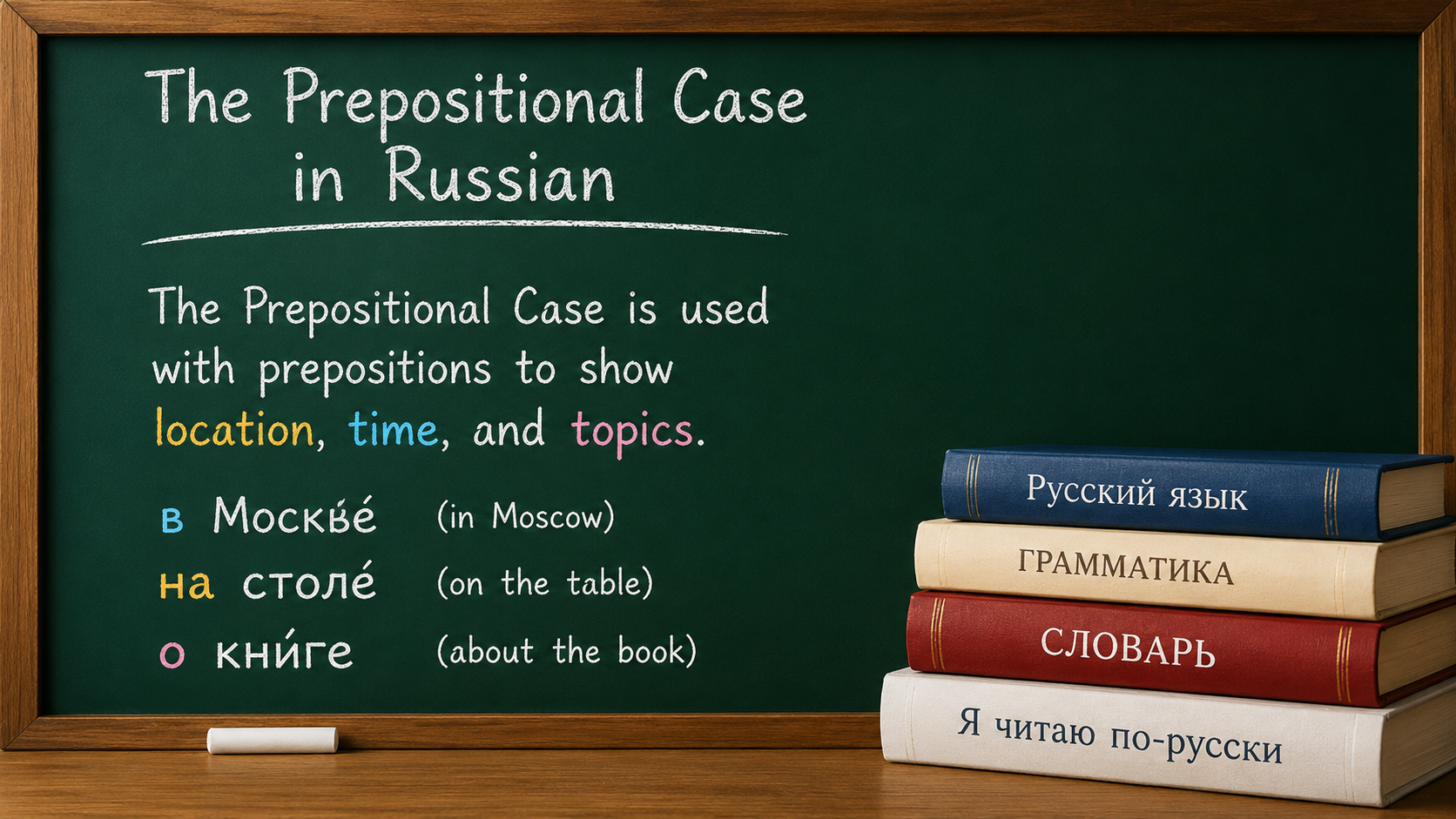
When you want to say things such as “I live in Moscow,” “I study at school,” or “I am talking about music” in Russian, the form of the noun indicating the place or topic changes.
For example, “in Moscow” is в Москве́, “at school” is в шко́ле, and “about music” is о му́зыке.
The case used in these expressions is the prepositional case, one of the six cases in Russian.
As its name suggests, the prepositional case is generally used together with a preposition. It appears especially often in expressions meaning “in,” “at,” or “about,” making it an essential case in everyday conversation.
In this article, I will explain what the Russian prepositional case is, from its basic endings to its main uses, with examples.
The Russian prepositional case is not used on its own. It is always used together with prepositions such as в, на, and о. This is also the origin of the name “prepositional case.”
Its main uses include expressing location and indicating the topic or object of discussion or thought.
In these examples, Москва́ (Moscow) changes to the prepositional form Москве́, while рабо́та (work) changes to рабо́те.
In English, expressions such as “in Moscow” and “about work” are generally formed simply by adding a preposition, while the noun itself remains unchanged. In Russian, however, you must not only use a preposition but also change the following noun into the prepositional case.
However, a preposition does not always require the prepositional case. For example, в and на take the prepositional case when expressing location, but they take the accusative case when expressing a destination.
In the first sentence, университе́т changes to университе́те because the sentence expresses location. In the second sentence, университе́т is used in the accusative because it indicates a destination.
For this reason, when choosing a case in Russian, it is important not to look only at the preposition itself. You also need to consider what the sentence is expressing.
In the prepositional case, noun endings change according to gender and whether the noun is singular or plural.
In the singular, many nouns take -е, although some types take -и instead. In the plural, the basic endings are -ах / -ях.
Here, I will explain the main patterns for masculine, feminine, neuter, and plural nouns.
Masculine nouns ending in a consonant generally take -е.
Masculine nouns ending in -й generally drop -й and take -е.
However, masculine nouns ending in -ий take -ии.
For feminine nouns ending in -а / -я, the ending generally changes to -е.
Feminine nouns ending in -ь take -и in the prepositional case.
Feminine nouns ending in -ия are a special pattern and take -ии.
You will use Росси́я → в Росси́и very frequently when studying Russian, so I recommend learning this form early.
Neuter nouns ending in -о generally replace -о with -е.
Many neuter nouns ending in -е do not change in form in the prepositional case.
However, neuter nouns ending in -ие take -ии.
In the plural, gender is no longer relevant. The prepositional case generally takes -ах / -ях.
Although singular nouns change differently depending on gender and ending, the plural pattern is comparatively easy to remember because -ах / -ях is the basic form.
Some masculine nouns in Russian have a special form used for location in addition to the regular prepositional case. This form is commonly called the second prepositional case or locative case.
Normally, masculine nouns ending in a consonant take -е in the prepositional case.
However, some masculine nouns take -у́ / -ю́ instead of the regular -е when used with в or на to express a concrete location.
For example, лес (forest) changes as follows:
The noun бе́рег (shore, bank) also has this form:
Other common examples include:
With these -у́ / -ю́ forms, the stress is often placed on the ending, so the stress pattern may differ from that of the regular prepositional form.
The most important point about the second prepositional case is that it is mainly used for location.
For example, when лес refers to a location, you use:
However, when you mean “about the forest,” you use the regular prepositional form:
In other words, the same noun can take different forms depending on the preposition and meaning: в лесу́ / о ле́се
The same applies to сад:
Not all masculine nouns have this second prepositional form. It is limited to certain nouns.
For this reason, I recommend learning it through common combinations such as в лесу́, в саду́, на берегу́, and в шкафу́.
One of the main uses of the prepositional case is to express location with в and на.
When you want to say where a person or thing is located, you generally use: “в / на + prepositional case”
The preposition в basically means “in” or “inside” and is commonly used with places such as buildings, cities, and countries.
The basic meaning of на is “on.” However, in actual Russian usage, it is not limited to physical surfaces. Many workplaces, events, and certain facilities conventionally take на.
In many cases, whether you use в or на depends on the noun.
For this reason, I recommend learning the preposition and noun together as a fixed combination, such as в шко́ле, в университе́те, and на рабо́те.
The prepositions в and на can be used not only with the prepositional case but also with the accusative case.
The basic distinction is:
Let us look at some examples.
In the first sentence, the speaker is already at school, so шко́ла changes to the prepositional form шко́ле.
In the second sentence, the speaker is moving toward school, so шко́ла takes the accusative form шко́лу.
The same distinction applies with на.
The first sentence expresses location, so the prepositional case is used. The second expresses a destination, so the accusative case is used.
It is also important to remember that a verb involving movement does not automatically require the accusative case.
For example:
The verb гуля́ть involves movement, but парк is not the destination. It is the location where the activity takes place. Therefore, парк takes the prepositional form па́рке.
By contrast:
Here, the park is the destination, so the accusative case is used.
In English, location and direction are often distinguished mainly by changing the preposition, as in “in the office” and “to the office.” In Russian, however, the same prepositions в and на can be used while the case of the following noun changes.
For this reason, when you see в or на, do not determine the case from the preposition alone. You should first ask whether the sentence expresses a location or a destination.
Another important use of the prepositional case is with о to express a topic or the object of thought, meaning “about” or “concerning.”
The preposition о works similarly to English about and is commonly used in expressions such as “talk about” and “think about.”
A noun or pronoun following о takes the prepositional case. For example:
The preposition о can also appear as об or обо, depending on the following word.
In general, об is used before words beginning with a vowel to make pronunciation smoother.
Before certain words, обо is used.
Although о / об / обо have different forms, their basic meaning is the same. I recommend first learning the basic pattern “о + prepositional case” = “about”, and then becoming familiar with when об and обо are used.
The prepositional case is used with prepositions mainly to express location and topics of discussion or thought.
Its main characteristics can be summarized as follows:
The prepositional case is essential for expressing basic ideas such as where someone is, where an action takes place, and what someone is talking about.
As you study it, I recommend starting with common expressions such as в шко́ле, на рабо́те, and о Росси́и, while paying particular attention to the second prepositional case and the distinction between “в / на + prepositional” and “в / на + accusative.”