#57 The Hard Sign and Soft Sign in Russian
Yuri Miyajima Russian Forest

When you read Russian sentences, you may notice that words sometimes appear in forms that look different from their basic form.
For example, Росси́я, meaning “Russia,” may appear in sentences as Росси́и, Росси́ю, Росси́ей, and other forms. These are not separate words. They are all different forms of the same noun, Росси́я.
This happens because Russian has a grammatical system known as case. By changing the endings of words, Russian indicates their role in a sentence and their relationship with other words, such as “who,” “to whom,” “what,” or “with whom.”
At first, this system may seem complicated. However, case declension follows a number of regular patterns. Once you understand the basics, you will gradually begin to see why words change their form within sentences.
In this article, I will explain how Russian case declension works, the basic roles of the six cases, and why words change their form depending on the case in which they are used.
Case declension is a grammatical system in which nouns and other words change their form according to the role they play in a sentence.
In Russian, nouns, pronouns, adjectives, numerals, and other words change according to case. With nouns in particular, changes in the ending indicate whether the noun is the person performing an action, the object of an action, the recipient of something, or has some other grammatical role.
For example, let us look at the noun брат, meaning “brother.”
If you want to say “This is my brother,” брат remains in the nominative case, which is its basic form.
However, if you say “I am talking with my brother,” брат changes to бра́том.
This is because the instrumental case is used with the preposition с when it means “with.”
If you say “I gave my brother a book,” брат changes again, this time to бра́ту.
In this sentence, “brother” is the recipient of the object being given, so the dative case is used.
As you can see, the same noun брат can appear as брат, бра́ту, бра́том, and other forms depending on its role in the sentence. This is the basic principle of case declension in Russian.
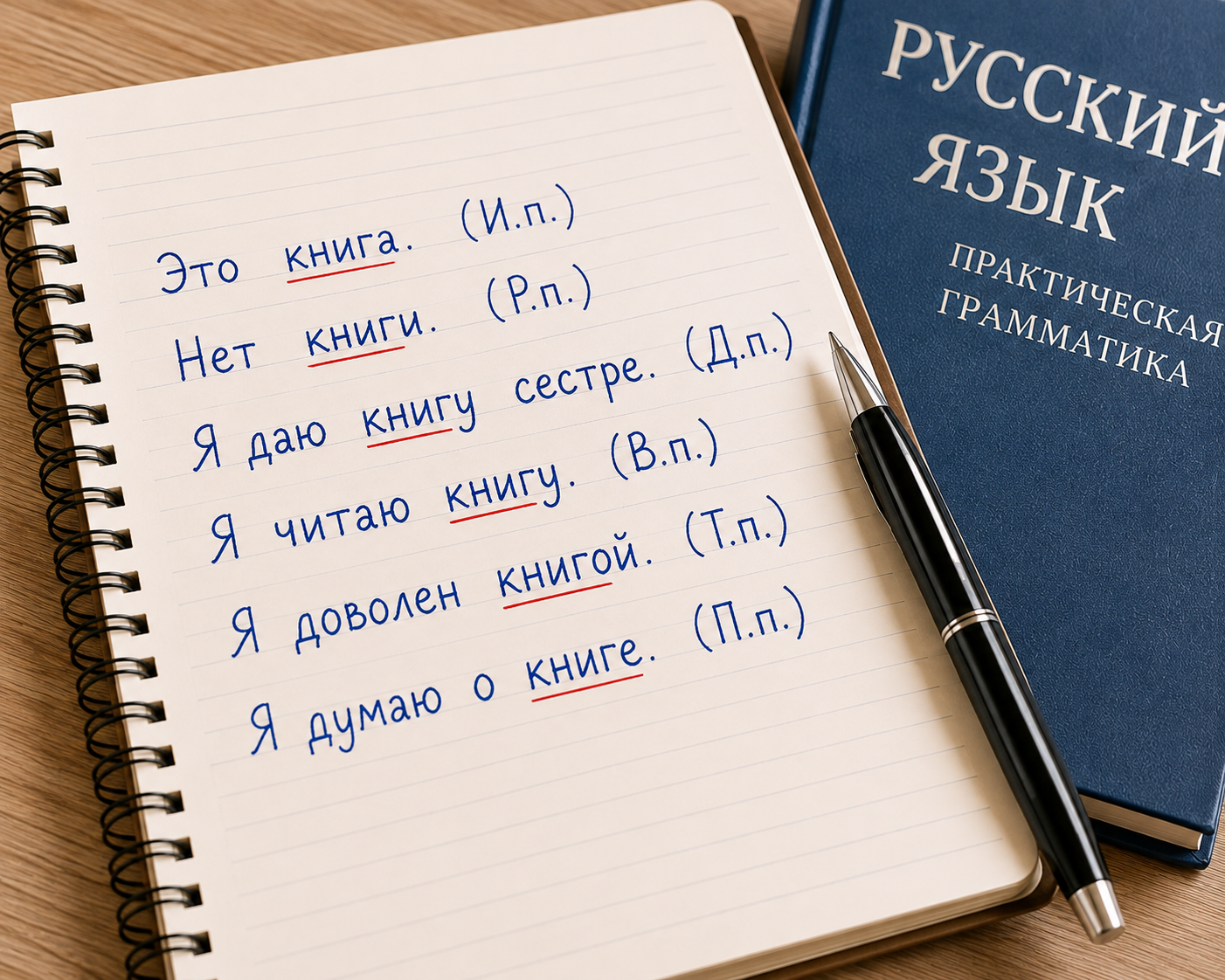
Russian has the following six cases:
Each case has a different function and indicates relationships such as “who,” “whose,” “to whom,” or “whom.”
For example, the nominative case is commonly used for the subject of a sentence, the genitive for possession or association, the dative for the recipient of an action, and the accusative for the direct object of an action. The instrumental can express tools, means, or a person with whom an action is performed, while the prepositional is used with certain prepositions to express location, topic, and other meanings.
The same noun changes its form depending on the case. For example, студе́нт, meaning “student,” changes as follows:
Although the basic meaning remains “student,” the ending changes according to the word’s role in the sentence.
When reading Russian, it is therefore important to learn how to identify the case of a word from its form and ending.
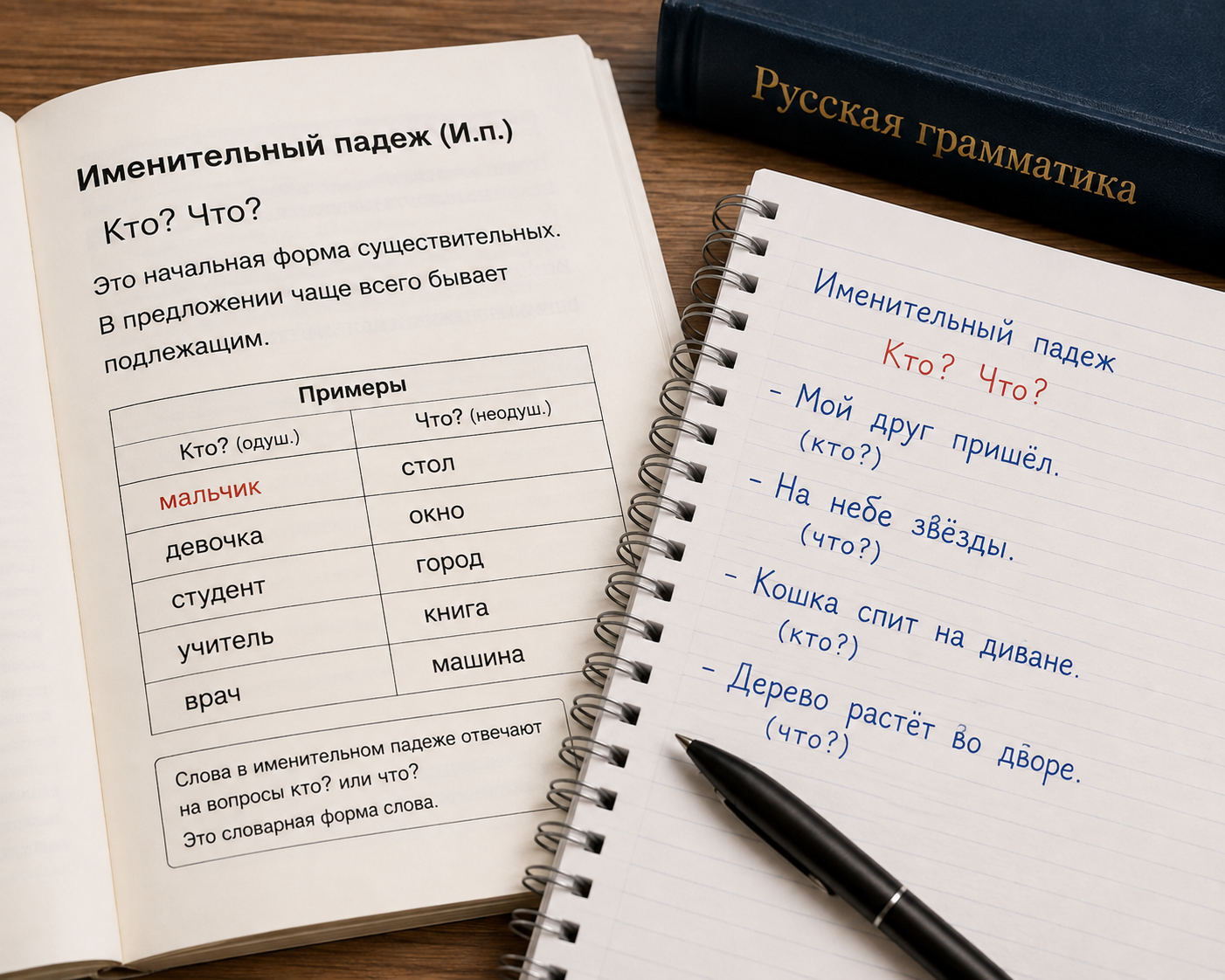
The nominative is the most basic of the six Russian cases. Nouns in dictionaries are generally listed in their nominative singular form.
For this reason, when you learn a new noun, you usually begin with the nominative form and then learn how it changes in the other cases.
One of the main functions of the nominative case is to indicate the subject of a sentence. In other words, it commonly corresponds to “who” or “what” performs the action.
In the following sentence, студе́нт, meaning “student,” is in the nominative case.
Кни́га, meaning “book,” changes to the accusative form кни́гу because it is the object of the action “to read.”
By distinguishing the nominative from the other cases, you can more easily understand who is doing what in a Russian sentence.
The genitive case is commonly used to express possession or association, often corresponding to “of” or the English possessive form.
For example, in the following phrase, студе́нт changes to the genitive form студе́нта.
The genitive is also used in many other contexts, including quantity, negation, and expressions of origin or starting point.
For example, nouns may appear in the genitive after numerals or words expressing quantity.
However, Russian numerals require different forms depending on the number or quantity expression involved. After два, the genitive singular is used, while after мно́го, the genitive plural is required.
The dative case mainly indicates the person or thing toward which an action is directed. Its function is similar in some respects to an indirect object in English.
In the following example, друг, meaning “friend,” changes to дру́гу.
Here, the action of giving the book is directed toward the friend, so друг appears in the dative case.
The dative is also used with expressions involving actions such as speaking to someone, calling someone, or helping someone.
Russian also uses the dative when expressing age or certain physical and emotional states.
Мне is the dative form of я, meaning “I,” and functions as the person experiencing the state.
In other words, Russian sometimes expresses ideas such as “I am 20 years old” or “I am cold” by placing the person in the dative case.
If you think of the structure more literally, “Мне два́дцать лет” can be understood approximately as “To me, there are 20 years,” while “Мне хо́лодно” is closer to “It is cold to me.”
The accusative case is mainly used for the direct object of a verb. Its function is similar to that of a direct object in English.
In the following sentence, кни́га, meaning “book,” changes to кни́гу.
Because the book is the direct object of the action “to read,” the accusative case is used.
Another important point when learning the accusative is the distinction between animate and inanimate nouns.
In Russian, nouns referring to people and animals are generally treated as animate, while nouns referring to objects and concepts are generally treated as inanimate.
For masculine singular nouns, the accusative of an animate noun has the same form as the genitive, while the accusative of an inanimate noun has the same form as the nominative. In the plural, the same distinction also applies: animate nouns use the genitive form, while inanimate nouns use the nominative form.
For this reason, the accusative cannot be formed simply by adding the same ending to every noun. Its form depends not only on gender and number, but also on whether the noun is animate or inanimate.
The instrumental case is used to express tools, means, professions, roles, and several other relationships.
One of its most common uses is to indicate the instrument or means by which an action is performed.
In the following sentence, ру́чка, meaning “pen,” changes to the instrumental form ру́чкой.
Here, the pen is the tool used for writing, so the instrumental case alone expresses the meaning “with a pen,” without the need for a preposition.
The instrumental is also commonly used to express professions, roles, and positions.
With verbs such as рабо́тать, meaning “to work as,” and стать, meaning “to become,” the instrumental can indicate what someone works as or what someone has become.
As its name suggests, the prepositional case is generally used together with prepositions.
One of its most common uses is with в and на to indicate where someone or something is located or where an action takes place.
In this way, combinations such as “в + prepositional” and “на + prepositional” can express location.
The prepositional case is also used to express topics of discussion, certain time expressions, and other meanings.
Unlike cases such as the nominative, genitive, and dative, however, the prepositional is not normally used on its own. It generally appears together with specific prepositions. This is one of the main features that distinguishes it from the other cases.
Russian nouns are divided into masculine, feminine, and neuter genders, and they also distinguish between singular and plural. For this reason, trying to memorize all six case forms separately for every noun can be difficult.
However, Russian case declension follows regular patterns.
For example, feminine nouns such as кни́га (book), шко́ла (school), and рабо́та (work), which end in -а, generally change -а to -у in the accusative singular.
Once you learn this pattern, you can apply it to many nouns of the same type.
When learning declension, it is also important to pay attention not only to the gender of the noun but also to the ending of its basic form. Even among feminine nouns, words ending in -а and those ending in -я may follow different patterns. Masculine and neuter nouns likewise have several declension patterns depending on their endings.
For this reason, it is generally more efficient to learn patterns such as “nouns with this ending change in this way” rather than memorizing six separate forms for every individual word.
As you encounter the same patterns repeatedly, you will gradually become able to predict which form is likely to appear in a particular context. Case declension may initially seem to involve a large amount of memorization, but recognizing its regularity can make the process considerably easier.
Russian case declension is a grammatical system in which nouns and other words change their form to show their role in a sentence and their relationship with other words.
The main points can be summarized as follows:
Case declension is one of the major challenges you will encounter when you begin learning Russian, but it is also essential for understanding Russian sentences accurately.
Rather than trying to memorize every form from the beginning, I recommend first understanding the basic role of each case and then gradually becoming familiar with the forms through actual sentences.