#57 The Hard Sign and Soft Sign in Russian
Yuri Miyajima Russian Forest

One of the most important areas of Russian grammar is the grammatical gender of nouns.
In English, nouns such as “book,” “house,” and “school” are not classified as masculine or feminine. In Russian, however, not only nouns referring to people but also nouns referring to objects, places, and abstract concepts have grammatical gender. They are generally classified as masculine, feminine, or neuter.
At first, this may seem like a great deal to remember. However, in Russian, you can often determine the gender of a noun from its ending, so learning the basic rules makes nouns much easier to identify.
In this article, I will explain what grammatical gender means in Russian, how you can distinguish masculine, feminine, and neuter nouns, and which important exceptions you should be aware of.
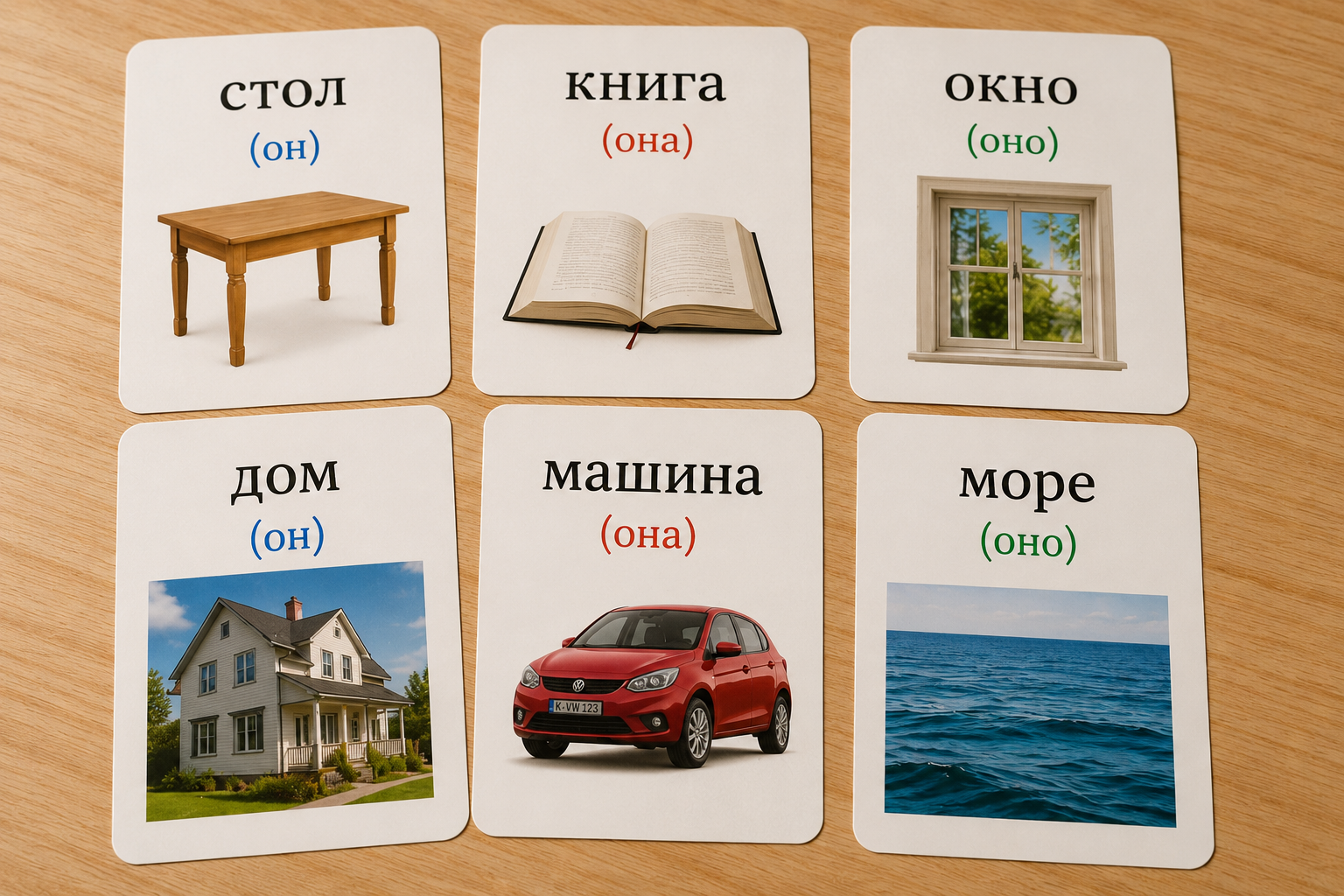
Russian nouns are divided into three grammatical genders:
When a noun refers to a person, its grammatical gender may correspond to that person’s biological sex. For example, оте́ц (father) is masculine, while мать (mother) is feminine.
However, nouns referring to objects, places, and abstract concepts also have grammatical gender. In Russian, стол (desk) is masculine, кни́га (book) is feminine, and окно́ (window) is neuter.
Of course, these objects do not actually have a biological sex. Unlike biological sex, grammatical gender is a system that classifies nouns according to grammatical characteristics.
For this reason, you should not try to determine gender based on ideas such as “a desk seems masculine.” Instead, you need to learn which grammatical gender each noun belongs to.
Gender also affects the forms of other words used with a noun. For example, the adjective но́вый, meaning “new,” changes its form depending on the gender of the noun it modifies.
This type of agreement appears not only with adjectives but also with pronouns and singular past-tense verbs. For this reason, correctly identifying noun gender is an essential part of forming sentences in Russian.
In Russian, nouns ending in a consonant are generally masculine.
As you can see, many nouns that end in a consonant rather than a vowel are masculine. Therefore, when you encounter an unfamiliar noun, checking its final letter is often a useful first step in determining its gender.
Nouns ending in -й are also generally masculine.
There are also masculine nouns ending in -ь (the soft sign).
However, nouns ending in -ь can also be feminine, as in ночь (night) and дверь (door). Therefore, you cannot assume that every noun ending in -ь is masculine.
In addition, some nouns referring to male people are grammatically masculine even though they end in -а or -я. Examples include па́па (father) and де́душка (grandfather).
Although noun gender can often be identified from the ending, it is important to remember that there are exceptions, especially among nouns referring to people.
Russian feminine nouns generally end in -а or -я.
If a noun ends in -а or -я, you can usually identify it as feminine.
There are, however, exceptions. Some nouns referring to male people, such as па́па (father), де́душка (grandfather), and дя́дя (uncle), are masculine even though they end in -а or -я.
Some feminine nouns also end in -ь (the soft sign).
An important point to remember is that some nouns ending in -ь are masculine. Therefore, when you encounter a noun ending in -ь, you generally need to learn its gender individually.
One useful clue is that nouns ending in -ость are generally feminine. The following words are all feminine:
In summary, nouns ending in -а or -я are usually feminine, while nouns ending in -ь require more attention. Although there are some patterns, it is generally best to learn the gender of -ь nouns individually.
Russian neuter nouns generally end in -о or -е.
As with masculine and feminine nouns, you can often identify neuter nouns from their endings.
In addition, nouns ending in -мя are also neuter.
There are only ten neuter nouns ending in -мя in Russian, and their case declension differs from that of regular neuter nouns.
For this reason, I recommend that you first learn the declension of the two most commonly used words, и́мя (name) and вре́мя (time).
Noun gender is important in Russian because it affects not only the noun itself but also the forms of other words connected to it.
In Russian, adjectives change their endings according to the gender of the nouns they modify. For example, the adjective краси́вый, meaning “beautiful,” changes as follows:
Although all three forms mean “beautiful,” краси́вый is used with masculine nouns, краси́вая with feminine nouns, and краси́вое with neuter nouns.
Possessive pronouns such as “my” and “your” also change in the same way. For example, the Russian possessive pronoun meaning “my” changes depending on the gender of the noun that follows:
Gender also appears in Russian past-tense verbs. In the singular past tense, masculine forms generally end in -л, feminine forms in -ла, and neuter forms in -ло.
As you can see, words in a Russian sentence do not function entirely independently. The forms of surrounding words often change according to the gender of the noun or subject they are connected to.
In the singular, distinctions between masculine, feminine, and neuter are clearly reflected in adjectives, possessive pronouns, and past-tense verbs.
In the plural, however, these gender distinctions disappear when adjectives, possessive pronouns, and past-tense verbs agree with plural nouns or subjects.
For example, the adjective но́вый, meaning “new,” changes according to noun gender in the singular:
When the nouns become plural, however, the adjective takes the form но́вые regardless of gender.
The same applies to possessive pronouns. In the singular, мой, моя́, and моё are used according to noun gender, but in the plural they all become мои́.
Past-tense verbs also differ according to gender in the singular.
In the plural, however, the same form is used regardless of gender:
Russian nouns have three grammatical genders: masculine, feminine, and neuter.
The main points can be summarized as follows:
Because English does not have this type of grammatical gender system for nouns, you may find it difficult when you first begin learning Russian.
However, many Russian nouns allow you to identify their gender from their endings. Once you learn the basic patterns, you will gradually become able to determine noun gender more easily.