#16 Countries of the Russian-Speaking World
Yuri Miyajima Russian Forest

Russian is spoken not only within Russia but also in many regions that were once part of the Soviet Union. One of the areas where Russian coexists with a particularly large number of other languages is the Caucasus.
The Caucasus is home to a wide variety of languages, including Georgian, Armenian, Azerbaijani, Chechen, and Avar. The region is highly diverse both ethnically and linguistically, and the role of Russian differs depending on the area.
In this article, I will explain how Russian is used in the Caucasus, the differences between the North Caucasus and the South Caucasus, and the relationship between Russian and the region’s other languages.
The Caucasus is a region located between the Black Sea and the Caspian Sea.
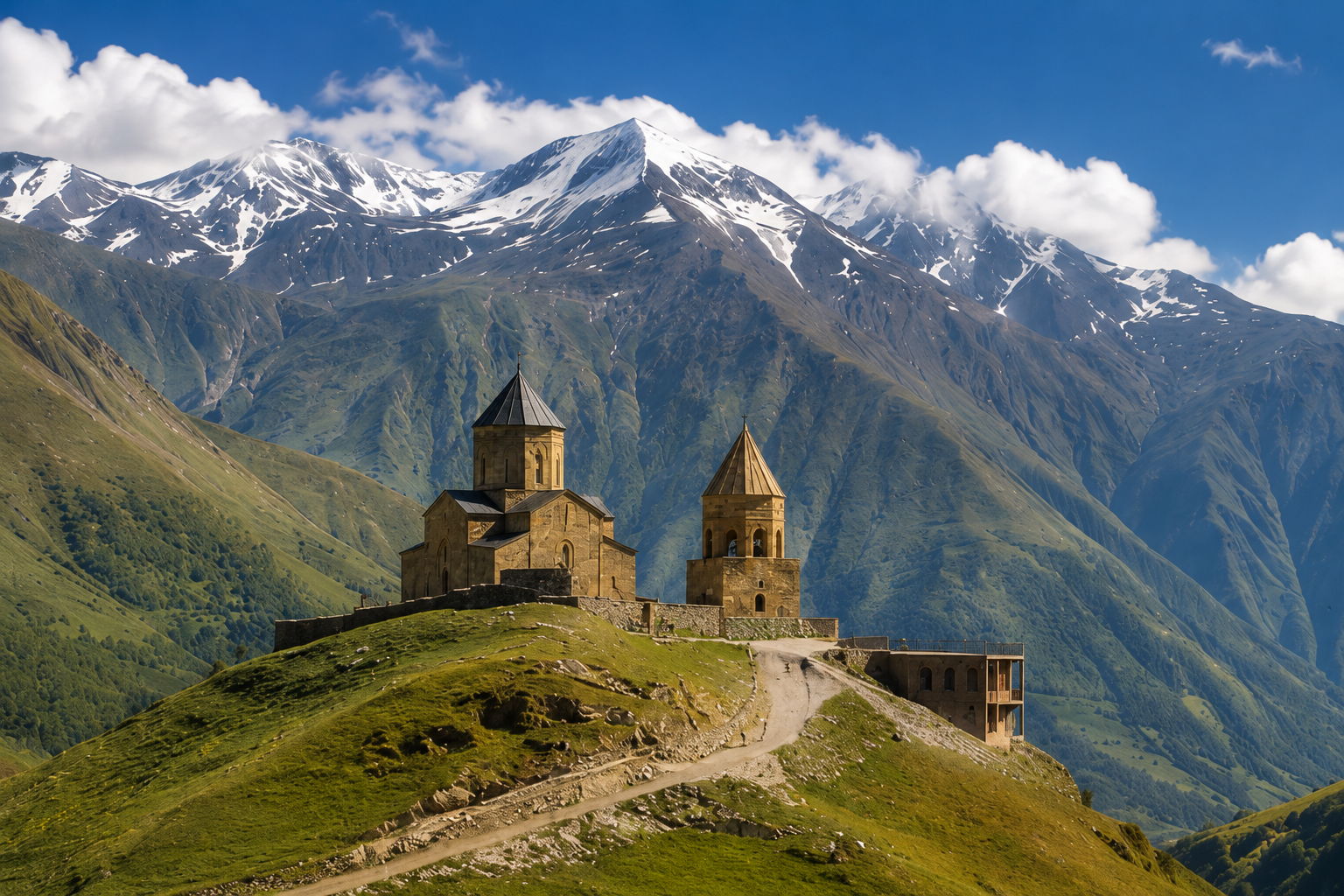
It lies near the boundary between Europe and Asia, and the Greater Caucasus mountain range extends from east to west through its central area, with peaks rising above 5,000 metres. Mount Elbrus, the highest mountain in Russia, is also located in the Caucasus Mountains.
The region is generally divided into the North Caucasus and the South Caucasus, with the Greater Caucasus range serving as the main geographical boundary.
The North Caucasus is part of the Russian Federation and includes several republics and territories, such as the Chechen Republic, the Republic of Dagestan, the Republic of Ingushetia, the Republic of North Ossetia–Alania, and the Kabardino-Balkarian Republic.
The South Caucasus, located south of the Greater Caucasus range, consists of three countries: Georgia, Armenia, and Azerbaijan. All three were formerly part of the Soviet Union and became independent during the dissolution of the USSR in 1991.
One of the defining characteristics of the Caucasus is its remarkable ethnic and linguistic diversity. A large number of ethnic groups live in the region, and the languages spoken there belong to several different language families.
For example, Russian, Armenian, and Ossetian belong to the Indo-European language family. Azerbaijani belongs to the Turkic language family, while Georgian belongs to the Kartvelian language family. The region is also home to Northeast Caucasian languages such as Chechen and Avar, as well as Northwest Caucasian languages such as Abkhaz and Kabardian.
The Caucasus has also historically occupied a strategic position linking Russia, the Middle East, the Black Sea region, and Central Asia. As a result, many different peoples and states have passed through or competed for influence in the region. The historical involvement of powers such as the Russian Empire, the Ottoman Empire, and Persia is closely connected to the ethnic and linguistic diversity that exists there today.
In the Caucasus, particularly in the North Caucasus, Russian has historically served as a common language connecting speakers of different ethnic and linguistic backgrounds.
The widespread use of Russian in the region is closely connected to the expansion of Russian imperial rule and the linguistic environment that later developed during the Soviet period.
From the 18th to the 19th century, the Russian Empire expanded southward and intensified its involvement in the Caucasus. In the South Caucasus, eastern Georgia was annexed by the Russian Empire in the early 19th century, and Russian control subsequently expanded into areas corresponding to present-day Armenia and Azerbaijan through wars with the Ottoman Empire and Persia.
In the North Caucasus, by contrast, Russian expansion met with strong resistance, and the Caucasian War continued for an extended period during the 19th century. By the 1860s, most of the North Caucasus had been incorporated into the Russian Empire, and Russian gradually entered regional society through administration, the military, and other institutions.
However, this did not mean that the entire population of the Caucasus began using Russian in everyday life. Within families and local communities, different ethnic groups continued to use their own languages, including Georgian, Armenian, Azerbaijani, and Chechen.
Russian became significantly more widespread among the general population during the Soviet period in the 20th century.
The Soviet Union was a multinational state containing a very large number of ethnic groups and languages. The Caucasus alone was home to many different languages, so a common language was needed for communication between people of different backgrounds. Russian increasingly came to fulfil this role.
During the Soviet period, education and publishing were also conducted in the languages of individual ethnic groups, but Russian gained importance in administration, higher education, science, the military, the media, and communication with other parts of the Soviet Union. In particular, acquiring Russian as a second language could provide social and professional advantages, especially in urban areas and among people pursuing higher education.
Internal migration and employment across different Soviet republics also increased contact between people with different native languages. Russian was frequently used as a common means of communication in such situations.
As a result, a multilingual environment developed across the Caucasus in which people maintained their own ethnic languages while also using Russian.
After the dissolution of the Soviet Union in 1991, Georgia, Armenia, and Azerbaijan became independent states, and their respective national languages became more central to public and social life. The North Caucasus, meanwhile, remained part of the Russian Federation, where Russian continues to be widely used.
The North Caucasus is part of the Russian Federation, and Russian continues to be used in a wide range of social settings.
The region includes the Chechen Republic, the Republic of Ingushetia, the Republic of Dagestan, the Republic of North Ossetia–Alania, the Kabardino-Balkarian Republic, the Karachay-Cherkess Republic, and the Republic of Adygea, among others. Many different ethnic groups live throughout these areas.
Each group has its own language, and a wide variety of languages are spoken in the North Caucasus, including:
These languages do not all belong to the same linguistic family. Northeast Caucasian and Northwest Caucasian languages coexist with Ossetian, which belongs to the Indo-European family, and Karachay-Balkar, which belongs to the Turkic language family.
In this kind of multilingual society, Russian functions as a common language.
Russian is the official language of the Russian Federation and is widely used in the North Caucasus in administration, education, the media, business, and many other areas of public life.
Dagestan is a particularly notable example because of its exceptional ethnic and linguistic diversity. Languages such as Avar, Dargwa, Kumyk, and Lezgian are spoken there, and people with different native languages frequently interact in everyday life. Russian therefore serves as a bridge when communication takes place across ethnic boundaries.
In this way, Russian functions as a lingua franca connecting speakers of different languages in the highly multilingual North Caucasus.
The South Caucasus consists of three countries: Georgia, Armenia, and Azerbaijan.
These are now independent states. Georgian is the official language of Georgia, Armenian is the official language of Armenia, and Azerbaijani is the official language of Azerbaijan.
Unlike the North Caucasus, which is part of the Russian Federation, Russian is therefore not the common national language of the South Caucasus as a whole.
However, all three countries experienced rule by the Russian Empire and later became constituent republics of the Soviet Union. During the Soviet period in particular, Russian was widely used in administration, higher education, science, the media, and other fields, as well as serving as a common language between people of different ethnic backgrounds.
After the Soviet Union dissolved in 1991, each country increasingly developed its public institutions around its own national language, and the status of Russian changed accordingly. Even so, many people, particularly those educated during the Soviet period, still understand Russian, and it continues to be used in everyday communication, business, tourism, and the media.
The South Caucasus is also home to numerous minority languages in addition to Armenian, Georgian, and Azerbaijani. As a result, Russian may still be chosen as a common language when people with different native languages communicate with one another.
However, the extent to which Russian is spoken and its social position differ among the three countries. Russian remains relatively widely understood in Armenia, while in Georgia, English has become increasingly important, particularly among younger generations. Russian also retains a noticeable presence in Azerbaijan, especially in urban areas such as Baku, where many people continue to speak it.
Russian in the South Caucasus can therefore be understood as one of several languages used within the region’s multilingual societies.
The Caucasus is an ethnically and linguistically diverse region located between the Black Sea and the Caspian Sea.
Its main characteristics can be summarized as follows:
Many different ethnic groups and languages have coexisted in the Caucasus over a long period of history. Within this environment, Russian has become one of the important languages that make up the region’s linguistic landscape.
In the North Caucasus, Russian supports administration, education, and communication between ethnic groups. In the South Caucasus, by contrast, its role differs according to the historical and social circumstances of each country.
Understanding the linguistic situation in the Caucasus can also help you see how Russian spread beyond Russia itself and how it became established in different societies across the surrounding region.